Filed Under: Legal Today, Criminal Tomorrow
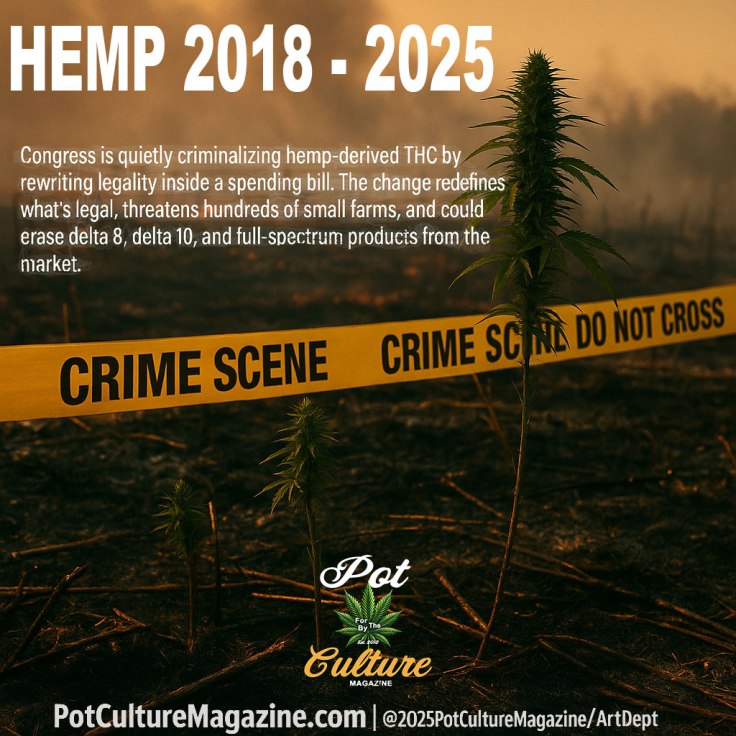
They legalized it, then they buried it.
Not with a press conference, not with a vote, not even with a public sentence. Hemp was undermined inside the 2025 federal spending bill, hidden within a clause that quietly redefines hemp and excludes intoxicating derivatives of the plant. That single sentence may erase an entire tier of the cannabis economy, criminalize products sold legally for years, and threaten hundreds of thousands of jobs without so much as a headline.
This is not policy. It is a purge.
The 2018 Farm Bill cracked the door open by defining hemp as cannabis containing less than 0.3 percent delta-9 THC by dry weight. It was a narrow definition, so narrow that few noticed the freight train rolling through it. By 2019, labs and processors were converting CBD into delta-8 THC, a psychoactive cousin that delivered a high without violating the delta-9 rule. Then came delta-10, HHC, and THCA, all created through chemical manipulation of cannabinoids that were technically legal.
By 2021, the hemp-derived THC sector had become a multibillion-dollar industry, thriving outside state-licensed dispensaries. The Farm Bill had accidentally unleashed a gray rush. Farmers pivoted to high-resin flower, extractors scaled up, and legacy brands entered the space. Veterans opened hemp companies. Lawmakers called it a loophole, but they left it open.
Until the money shifted.
Big cannabis wanted the competition gone. Pharmaceutical interests wanted a clear runway for synthetic cannabinoids and FDA-approved extracts. Alcohol lobbyists saw delta-8 as a threat to their market share. By 2024, fifteen states had already restricted hemp-derived THC, yet at the federal level, hemp was still hemp until Congress rewrote the law.
Buried in the 2025 omnibus appropriations bill is a redefinition that excludes “synthetically derived tetrahydrocannabinols,” a phrase vague enough to criminalize nearly every major alt-cannabinoid product. There were no hearings, no public comment, no press coverage. Just a sentence that could erase an industry valued at nearly $28 billion and end more than 300,000 jobs, according to the U.S. Hemp Roundtable.
advertisement
F O R T H E C U L T U R E B Y T H E C U L T U R E
Reefer Report Card Vol. 28: The Rescheduling That Wasn’t
This week’s Reefer Report Card cuts through the hype around cannabis “rescheduling,” exposing how a label change left federal prohibition fully intact. Arrest authority, workplace punishment, and immigration penalties remain untouched. Headlines claimed progress. Reality delivered none. A week defined by performance over policy, and reform that never arrived.


THE SCHEDULE III SCAM
Federal officials claim cannabis is moving forward, but Schedule III changes nothing that matters. This investigation breaks down what rescheduling actually does, what it deliberately avoids, and why prohibition logic remains intact. Arrests continue. Markets remain conflicted. Reform language replaces reform action. The system shifts labels while preserving control.
LEGAL WEED, OLD RULES
Legalization promised freedom but preserved prohibition logic. This investigation examines how cannabis reform left arrests, racial disparities, job punishment, medical blame, and equity barriers intact. By tracing enforcement, employment law, healthcare practice, and licensing rules, it shows how legalization changed the label without dismantling the system.
advertisement
Retailers are already bracing. Distributors are cutting product lines. Farmers are abandoning crops mid-cycle. The chilling effect is immediate. This was supposed to be cannabis reform slow, imperfect, but forward. Instead, Congress is dismantling the only market that made cannabis accessible to millions of Americans living in prohibition states.
The U.S. Hemp Roundtable warns that up to ninety-five percent of the hemp market could disappear, along with more than $1.5 billion in state tax revenue. Processing labs, packaging suppliers, and freight companies that depend on hemp contracts are freezing hiring. The shock will land hardest in rural counties that politicians love to praise during election season.
Brandon Harshbarger, president of Cheech & Chong’s Global Holding Company, told Pot Culture Magazine that the damage reaches far beyond his brand.
“A sudden nationwide ban would upend an entire sector overnight, including the hemp products that millions of Americans rely on for relief and wellness. For Cheech & Chong’s Global Holding Company, it would not just impact individual SKUs, it would affect our retail partners, our supply chain, and the hundreds of thousands whose livelihoods are tied to this industry. What concerns us most is the consumer. These products exist because there is real demand from millions of consumers, and prohibition would not make that demand disappear. It would simply push people toward unregulated, unsafe alternatives, which helps no one.”
He said the company supports smart regulation, not quiet prohibition.
“We absolutely believe regulation is needed, thoughtful, consistent regulation that protects consumers. But what is being proposed now is not regulation. It is prohibition bundled inside a government funding bill with no public debate, no hearings, and no consideration for the economic impact. That kind of move disproportionately harms small businesses, family-owned operators, and legacy brands who have been part of this space for years. There are more than three-hundred-thousand Americans whose livelihood depends on this industry. There is a responsible path forward, but this is not it.”
Harshbarger called for unity across the entire cannabis economy.
“This is a moment for unity. Whether you are a farmer, a small operator, a manufacturer, or a legacy brand, we are all tied to the same supply chain and the same communities. A ban does not just hit companies like ours, it hits the growers, the processors, the retailers, and the millions of consumers who rely on these products every day. The message is simple: stay engaged and speak up. Decisions of this magnitude should never be made behind closed doors, and the only way to protect this industry’s future is by standing together. Our founders, Cheech Marin and Tommy Chong, have been advocating for access for more than fifty years, and we are not stopping now.”
The coming crackdown will decide who survives and who vanishes. The winners are the corporations large enough to lobby. The losers are the small farms, cooperatives, and independent extractors who built this market from scratch when no one else cared.
As the industry scrambles, NORML, the National Organization for the Reform of Marijuana Laws, has issued a public call to action. The group is urging citizens to contact their lawmakers and demand transparency before Congress locks the new definition into law.
“This fight is not just for farmers or brands,” reads NORML’s statement. “The public has a seat at the table. Tell your lawmakers: do not bury this market in silence.”
NORML’s Take Action portal makes it easy for voters to send letters directly to their representatives and support legislation that would finally remove cannabis from the Controlled Substances Act.
Consumers seeking hemp-derived relief products can explore Cheech & Chong CBD and hemp selections for safe, lab-tested alternatives that align with the movement to keep access legal and transparent.
Public pressure matters. Every message, every email, every voice in the record counts. Reform does not move without noise.
For hemp workers watching their future vanish, silence is the enemy. For consumers who depend on these products for relief, the stakes are deeply personal.
Hemp was once a symbol of possibility, proof that the plant could coexist with law. Now it stands again on the edge of extinction, not because of evidence, but because of greed and fear.
If Congress believes in transparency, it should hold hearings, publish data, and confront the human cost of erasing a legal industry in the dark. Until that happens, this remains prohibition by paperwork.
Verdict: Hemp was not regulated; it was erased.
©2025 Pot Culture Magazine. All rights reserved. This content is the exclusive property of Pot Culture Magazine and may not be reproduced, distributed, or transmitted in any form or by any means without prior written permission from the publisher, except for brief quotations in critical reviews.
Affiliate Disclosure: Pot Culture Magazine may receive commissions from purchases made through affiliate links such as Cheech & Chong. This helps support our independent journalism without affecting our editorial standards.
F O R T H E C U L T U R E B Y T H E C U L T U R E

THE PRODUCT THEY NEVER TEST
Hospitals increasingly diagnose Cannabinoid Hyperemesis Syndrome without testing the cannabis products involved. This investigation examines how cartridges, edibles, and other cannabis materials are excluded from medical evaluation, despite known contamination risks, leaving patients with diagnoses based on symptoms and self reported use rather than verified evidence.
THE CON OF CANNABIS REFORM
Cannabis rescheduling keeps resurfacing in headlines, then vanishing without action. This feature breaks down how federal officials repeatedly float reform language, let deadlines pass, and leave the law untouched. By tracing the mechanics behind the stall, the piece exposes why delay is intentional, who benefits from it, and why cannabis reform remains trapped in federal…

Ohio Tightens Screws On Legal Weed
Ohio voters approved legalization, but lawmakers followed with Senate Bill 56, a measure that tightens control through enforcement expansion, licensing caps, and market restrictions. This piece breaks down what the law actually changes, who benefits from the new structure, and how state authority grows while legal access narrows after the vote.
Discover more from POT CULTURE MAGAZINE
Subscribe to get the latest posts sent to your email.

Leave a comment