Filed Under: Legalized Lost
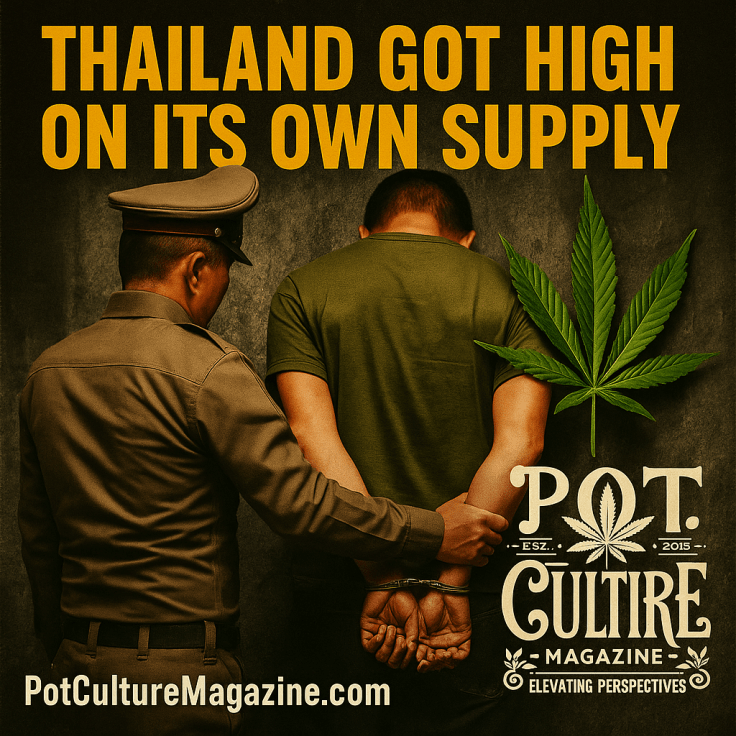
It started with a headline and a giveaway. In June 2022, Thailand became the first country in Asia to decriminalize cannabis. More than 4,000 prisoners walked free. The government handed out a million free cannabis seedlings. And Anutin Charnvirakul, the health minister who engineered the policy, stood grinning in front of cameras as if he’d just reinvented rice. The message was clear: cannabis was no longer a crime, it was a cure, a business, and a nationalist flex. What wasn’t clear was everything else.
There was no regulatory framework. No new law. No clarity on who could grow, sell, buy, or smoke. Cannabis was simply removed from the narcotics list, and that vacuum sucked in every hustler, healer, and hedge fund within range. Dispensaries popped up overnight, starting in Bangkok and spreading like wildfire to tourist islands, rural roadsides, and border towns. You could walk out of Suvarnabhumi Airport and into a vape bar offering infused slushies, potent flower, and THC edibles with cartoon wrappers, sometimes next to a 7-Eleven.
Technically, recreational use was still banned. Public consumption could be fined as a nuisance. Extracts over 0.2 percent THC were illegal. Sales to anyone under 20 were prohibited. But none of it mattered. Police weren’t enforcing anything. Ministers couldn’t agree on what was legal. One dispensary owner in Chiang Mai was quoted as saying he got his license by downloading a form from Facebook and mailing it to a P.O. box in Bangkok. Nobody called him back. He opened anyway. So did thousands of others.
By early 2023, Thailand had more than 6,000 cannabis shops. Some were slick boutiques backed by foreign capital. Some were wood shacks with mason jars and handwritten menus. It became a green gold rush. Cannabis cafes offered rooftop joints with craft cocktails. Ganja cooking schools popped up next to massage parlors. Street vendors sold pre-rolls next to pad Thai carts. The Chamber of Commerce projected a 1.2 billion cannabis economy by 2025. Travel blogs called it the new weed capital of the world. One British tourist described it as the new Amsterdam, but warmer, cheaper, and less judgmental. Anutin said this was what the future looked like.
Then it turned.
As cannabis shops multiplied, so did headlines. Teenagers hospitalized for edibles. Parents are protesting near schools. Activist groups are warning of addiction and a generation lost to THC. Conservative lawmakers fumed. Health officials started leaking data. A quarter of Thai adults had used cannabis since legalization, up from just two percent. Youth use was spiking. Emergency rooms were reporting a rise in cannabis-linked hospital visits. News anchors asked if Thailand had legalized chaos.
By 2023, the backlash was in full swing. Pheu Thai, the party that took power in August, campaigned on rolling back cannabis. Prime Minister Srettha Thavisin declared that cannabis would be medical only. Recreational use, he said, had never been part of the deal. He called the weed boom a mistake. A reclassification as a narcotic was on the table. The government’s new messaging was unmistakable. The party was over, and nobody had cleaned up.
But unwinding the high wasn’t so easy. Bhumjaithai, the same party that pushed decriminalization, was now part of the ruling coalition and wasn’t about to let its only political victory get erased. They argued that a full rollback would destroy the rural economy, betray millions of voters, and collapse an industry that had already gone legit. So the government tried to split the difference. Instead of a full ban, they introduced a medical-only rulebook. All cannabis purchases would now require a doctor’s prescription. Dispensaries could only sell to other licensed vendors or patients. Public use would be more tightly policed. No prescription, no weed.
Chokwan “Kitty” Chopaka, one of Thailand’s most prominent cannabis activists, called it what it was, a purge. She predicted 90 percent of dispensaries would shut down. Only the biggest shops, the ones in tourist corridors or backed by corporate money, would survive. The ones that are going to be left are the bigger shops, which actually have that war chest, she said. And the locals will probably grow their own, because getting a doctor’s note is going to be too much of an issue. She estimated maybe one thousand shops would make it. The rest would fold or go underground.
Rattapon Sanrak, founder of the Highland Network, warned that sudden enforcement could cause chaos. He called the rule change unrealistic and short-sighted. Businesses, the public, and officials will not have time to learn the new rules or adjust their work. Changing everything overnight is not realistic. Gloria Lai of the International Drug Policy Consortium called the new bill a knee-jerk reaction. It is questionable whether the proposal to restrict the buying and selling of cannabis to medical prescription only will solve anything, she said. What it would do, everyone agreed, was shatter whatever fragile trust had formed between the government and the cannabis industry.
Meanwhile, the black market was booming. Legal weed was being exported illegally. Fast. In March 2025, Thai authorities intercepted 22 suitcases carrying 375 kilos of cannabis headed for the UK. Thirteen people were arrested. Thai cannabis was being shipped to London, Manchester, and Paris. Officials in Europe flagged a spike in high-potency products that traced back to Thailand. British customs reported that more than 50 citizens had been arrested in Thailand for attempting to smuggle weed. The headlines wrote themselves.
Then it got worse.
Jarred Shaw, a 34-year-old American basketball player, was arrested in Jakarta after receiving a package of THC gummies sourced from Thailand. Indonesian police found 132 cannabis candies in his apartment. In Indonesia, that’s trafficking. Shaw now faces life in prison or the death penalty. He was paraded on television in a prison jumpsuit, flanked by armed officers. The Indonesian Basketball League banned him. His team dropped him. His case was held up as an example of how Thailand’s weed-free-for-all was causing international damage.
Other countries began issuing warnings. Japan said that citizens returning from Thailand could be prosecuted if THC was found in their systems. Singapore reminded everyone that cannabis remained illegal under any circumstances. The Thai government started plastering airports with signs warning tourists not to leave with cannabis products, legal or not. But it was too late. Thailand had already become the plug.
At home, the economic fallout had started. Farmers who took out loans to build greenhouses were abandoning them. Small growers, once promised a place in the legal economy, were priced out by imported weed flooding in from the US, Canada, and Europe. Dispensaries that paid for licenses and tried to follow the rules were suddenly told the rules had changed. The market was oversaturated, underregulated, and now collapsing under the weight of its own contradiction. The government had created a weed economy, then turned around and treated it like a national threat.
What makes Thailand’s case so maddening isn’t just the backpedal. It’s the chaos they left behind. One part of the government is pushing for stricter enforcement. Another says the new medical law is only temporary until a comprehensive cannabis act can be passed, maybe in two years, maybe never. No one knows which rules apply. Patients don’t know if their prescriptions will be honored. Dispensary owners don’t know whether to renew their leases or burn their signage. Foreign investors are bailing. Activists are fuming. The public is confused, again.
And through it all, the same people who legalized cannabis with a grin now speak about it like it’s a disease they accidentally unleashed. There’s no accountability, just warnings. The same minister who handed out a million cannabis seedlings in 2022 now says it’s time to put the genie back in the bottle. That’s not policy. That’s cowardice.
Thailand wanted the world to see it as a bold reformer, a cannabis pioneer in a prohibitionist region. And for a minute, it worked. The country went from prison sentences to pre-roll menus in under a year. It showed what was possible when the law caught up with reality. But legalization without a spine, without structure, without respect for the people who believed in it, is just another way to light money on fire.
Now the dispensaries are closing. The patients are stranded. The tourists are leaving. And the people who tried to play by the rules are learning the same lesson outlaw growers knew decades ago. The game is rigged.
Thailand got high on its own supply. Then it sobered up, cracked the whip, and left its own cannabis movement coughing in the dust.
© 2025 Pot Culture Magazine. All rights reserved. This content is the exclusive property of Pot Culture Magazine and may not be reproduced, distributed, or transmitted in any form or by any means without prior written permission from the publisher, except for brief quotations in critical reviews.
Discover more from POT CULTURE MAGAZINE
Subscribe to get the latest posts sent to your email.

Leave a comment