Filed Under: The Dutch Fix
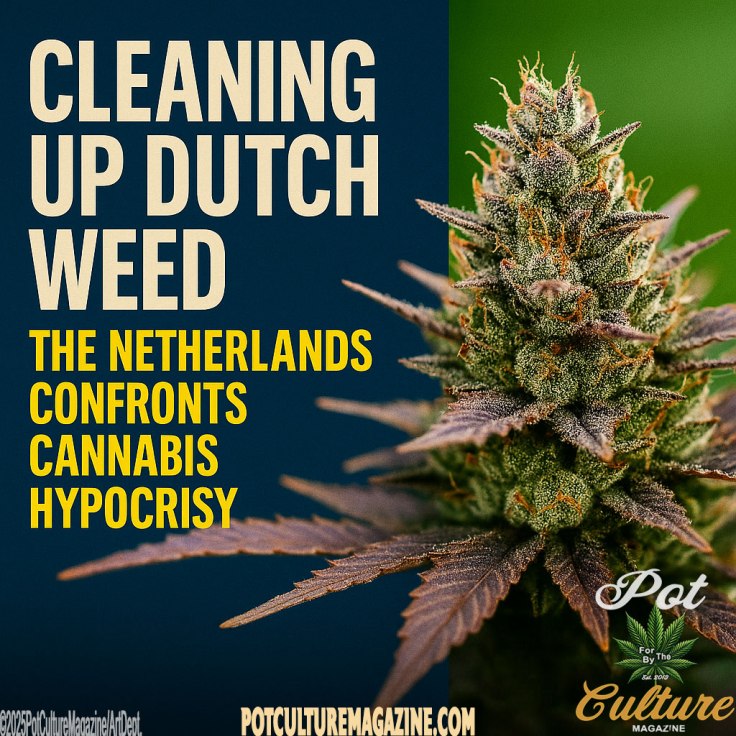
For decades, the Netherlands has lived with a paradox baked right into its soul. The country that built the modern cannabis image, the cozy coffee shop, the easy smile, the tolerant shrug, never legalized the plant that made it famous. You could buy weed on a sunny afternoon in Amsterdam and roll it in plain sight, but the people who grew it were criminals. Every gram that crossed a counter was technically contraband. It was a system that looked progressive from the outside and rotten from within.
Now the Dutch government is trying to clean it up. The new state-run cannabis experiment has expanded beyond its first test cities, adding more licensed growers and more coffee shops under official supply rules. For the first time in history, ten legal producers are being allowed to grow, test, and distribute cannabis under full state supervision. It is the biggest shift in Dutch drug policy since the 1970s, when the country first drew a legal line between hard and soft drugs. What they are building now is something Europe has never seen, a genuine seed-to-sale legal chain.
That may sound bureaucratic, but in the Netherlands, it is revolutionary. For half a century, the entire coffee shop system was a wink and a nod, legal on the surface, illegal underneath. Shop owners bought their product from whoever could get it to them. Many relied on hidden networks of small growers, some with mob ties, others working in attics and barns under threat of arrest. The government taxed the sales while pretending not to see the crime that supplied them. It was the clean-front, dirty-back hypocrisy of prohibition dressed up as policy.
Earlier this year, Pot Culture Magazine exposed how deep that hypocrisy ran in Dirty Weed in the Netherlands: Contaminants Found in Coffee Shop Cannabis. Independent testing revealed that much of the cannabis sold in Dutch coffee shops was contaminated with pesticides, mold, and heavy metals. In a country that prides itself on precision and purity, people were inhaling toxic weed because the state refused to legalize the farms that produced it. That contamination was not an accident; it was the natural outcome of a system that forced growers underground. Without oversight, quality control was a myth. Without legalization, consumers became the test subjects.
The new state experiment is designed to end that rot. Each of the ten licensed cultivators must grow under lab-grade conditions, submit to mandatory testing, and follow strict environmental rules. THC content will be standardized, pesticides banned, and distribution logged and traceable. Coffee shops in pilot cities like Tilburg, Breda, Groningen, and Maastricht will buy directly from those growers and sell only verified products. The goal is simple: kill the black market by beating it at its own game, better weed, cleaner weed, legal weed.
It is an ambitious fix for a country that has long hidden behind tolerance as an excuse for inaction. Dutch policymakers love to cite their gedoogbeleid, or tolerance policy, which for decades allowed cannabis sales to exist without a legal foundation. It kept police from raiding coffee shops and gave tourists their safe stoner haven, but it never touched the root problem. It protected the front end and criminalized the back. That contradiction became cultural wallpaper, accepted, ignored, and quietly profitable for everyone who benefited from the shadows.
advertisement
F O R T H E C U L T U R E B Y T H E C U L T U R E

Zurich’s Black Market Problem
Zurich’s Züri Can pilot is giving cannabis reformers something stronger than slogans. New interim findings show regulated, nonprofit access reduced several reported health problems while pulling demand away from the illegal market, giving Switzerland fresh evidence for national cannabis reform and putting prohibition panic on weaker ground.


Vegas Knew, Vegas Looked Away
Las Vegas sold tourists the illusion of legal cannabis while fake dispensary style hemp shops operated near the Strip. Vegas Knew, Vegas Looked Away exposes how Nevada’s casino separation rules, weak hemp oversight, delayed Clark County action, and tourist confusion created a loophole economy hiding in plain sight.

CANNABIS LIES Vol. 10: The Medical Lie
For decades, federal policy claimed cannabis had no accepted medical use while opioid prescriptions moved through the health care system by the tens of millions. Cannabis Lies Vol. 10 exposes the contradiction behind Schedule I, blocked research, medical cannabis patients, and the institutions that spent years pretending politics was medicine.
advertisement
By the time the state decided to intervene, the damage was already clear. The contamination study published by Pot Culture Magazine showed samples laced with substances like myclobutanil and imidacloprid, chemicals that have no place in something people inhale. Some samples tested positive for bacteria and mold spores that can trigger respiratory illness. It was a mirror held up to Dutch hypocrisy. The same government that taxed coffee shops for selling cannabis let the suppliers operate like clandestine chemical labs. Consumers trusted the system, and the system lied to them.
This new legal chain is the government’s attempt to wash the blood off its hands. Officials say it is about safety, but it is also about control. Every seed, every harvest, every gram will be tracked from cultivation to sale. Growers will face audits, inspections, and strict quotas. Coffee shops will be limited in what they can buy and how much they can stock. The message is clear, freedom had its run, now the state takes over. In the same breath, they are saving and suffocating the culture that built this entire global image of cannabis freedom.
Still, it is a step forward. For decades, reformers begged for a legal supply chain, arguing that legalization without production reform is a farce. They were right. You cannot build trust on hypocrisy. The Dutch experiment may be heavily regulated, but it marks a rare moment when the government admitted its own failure. Officials have even conceded publicly that the illegal supply chain they criminalized was a product of their own laws. That acknowledgment, in itself, is progress.
The experiment began modestly, with just two test cities in late 2023, but as of this year, it has grown to include over a dozen municipalities. The expansion follows strong early data showing that consumers overwhelmingly prefer regulated cannabis when the price and potency match the underground market. Coffee shop owners in pilot zones have reported smoother logistics and cleaner inventory. The growers, freed from the shadows, are producing higher-quality flower without fear of raids or asset seizures. Early feedback from inspectors shows significant reductions in contamination levels.
That does not mean it is perfect. Critics point out that government-issued weed still comes with limited strain diversity and sterile branding, which strips away the culture and creativity that defined Dutch cannabis for generations. The experiment is clinical by design, and that sterility risks turning the country’s most famous counterculture export into a government-sanctioned commodity. Some coffee shop owners privately joke that the weed experiment feels more like a pharmaceutical trial than a cultural reform.
But the alternative, leaving the old system intact, was poisoning people and protecting criminals. As Pot Culture Magazine reported, black-market cultivation in the Netherlands became a multibillion-euro enterprise operating in the shadows of legality. Growers built complex irrigation systems in rented houses, dodged inspectors, and paid off middlemen. Entire neighborhoods were wired with illegal power lines to feed grow lamps, causing electrical fires and property damage. When the police did intervene, the penalties often fell hardest on small growers, not the organized crime networks that financed them.
By legalizing and licensing a limited number of producers, the state is finally acknowledging the obvious, that prohibition fuels the very criminality it claims to fight. When you force a product underground, you do not eliminate demand; you just surrender control. The new system reclaims that control and, for the first time, gives Dutch cannabis a chance to exist without hypocrisy.
There is also an economic layer to this shift. The Netherlands, long the poster child of tolerance, began falling behind as other countries moved toward full legalization. Canada, Germany, and parts of the United States built regulated markets, while the Dutch stayed stuck in the gray zone they invented. That stagnation cost them credibility. The weed capital of Europe was running on an illusion. The state’s new plan is as much about restoring reputation as it is about fixing policy.
Yet for all its bureaucratic polish, the experiment still carries the scent of irony. The same state that refused to protect its growers for decades now wants to play regulator, distributor, and tax collector. Every gram that once flowed through back doors will now be logged in government databases. It is not a revolution born of empathy; it is a reform born of embarrassment. The Dutch are cleaning up their image because they can no longer pretend the old system works.
But even controlled progress is still progress. For the first time since the 1970s, there is a real chance that the Netherlands could move from tolerance to legalization. If this system works, if consumers trust it, if the black market withers, it could set a blueprint for the rest of Europe. Other nations with half-hearted decriminalization laws are watching closely. Germany’s upcoming cannabis rollout borrows heavily from the Dutch pilot framework, though with stricter distribution rules. Switzerland’s ongoing experiments mirror the same seed-to-sale concept. The domino effect has already begun.
The lesson here is not just about weed, it is about honesty. For fifty years, the Netherlands sold the world an illusion of freedom. Behind the red lights and the coffee cups was a quiet moral compromise, a government willing to profit from illegality as long as it stayed polite. Now, under pressure from both public health and international competition, that illusion is collapsing. The country that taught the world tolerance is finally being forced to practice it for real.
It is easy to romanticize the old Dutch system, the cozy coffee shops, the international mystique, the soft laughter spilling into the canals. But the truth is that the system ran on willful blindness. Consumers trusted what they bought, thinking Dutch quality meant purity, while in reality, they were smoking products loaded with invisible toxins. The government’s tolerance was a performance, not a policy. And the price of that performance was public health, integrity, and the credibility of an entire national identity.
This cleanup is long overdue. It is not a corporate land grab like in the United States. It is not an ideological crusade like in Germany. It is something simpler and more human, a country finally confronting its own double standard. The Dutch built the modern cannabis myth, then spent fifty years betraying it. Now they have a chance to redeem it.
If this experiment works, it will not just clean up Dutch weed, it will clean up Dutch conscience. The Netherlands can once again become what it pretended to be, a country unafraid to tell the truth about a plant, its people, and the lies that held them back.
©2025 Pot Culture Magazine. All rights reserved. This content is the exclusive property of Pot Culture Magazine and may not be reproduced, distributed, or transmitted in any form or by any means without prior written permission from the publisher, except for brief quotations in critical reviews.

Jersey’s New Cash Crop
Jersey reinvented itself. A forty-five square mile island once known for offshore finance is now exporting pharmaceutical-grade cannabis into Germany’s booming medical market. With strict regulation, heavy investment, and a government eager for diversification, Jersey has become an unlikely European powerhouse. The contradiction between local policing and global commerce tells the real story.
A State of the Union on the State of Cannabis Media
Cannabis media is undergoing a predictable institutional decay. The movement’s original architects have transformed from revolutionary contributors into defensive gatekeepers, protecting their legacy rather than fostering future growth. This manifesto examines the four archetypes of decay: the Gatekeeper, the Mercenary, the Scavenger, and the Shill, that currently stifle the industry’s independent voice and threaten the…
Cannabis Lies Vol. 9: The Reform Lie
The federal move to Schedule III is a masterclass in bureaucratic maintenance. While corporations celebrate tax relief, the core structure of the drug war remains untouched. This analysis deconstructs the Reform Lie, exposing how the state uses symbolic gestures to professionalize a privilege for the few while keeping the machinery of punishment active for everyone…
Discover more from POT CULTURE MAGAZINE
Subscribe to get the latest posts sent to your email.

Leave a comment