Filed Under: Workplace Wars
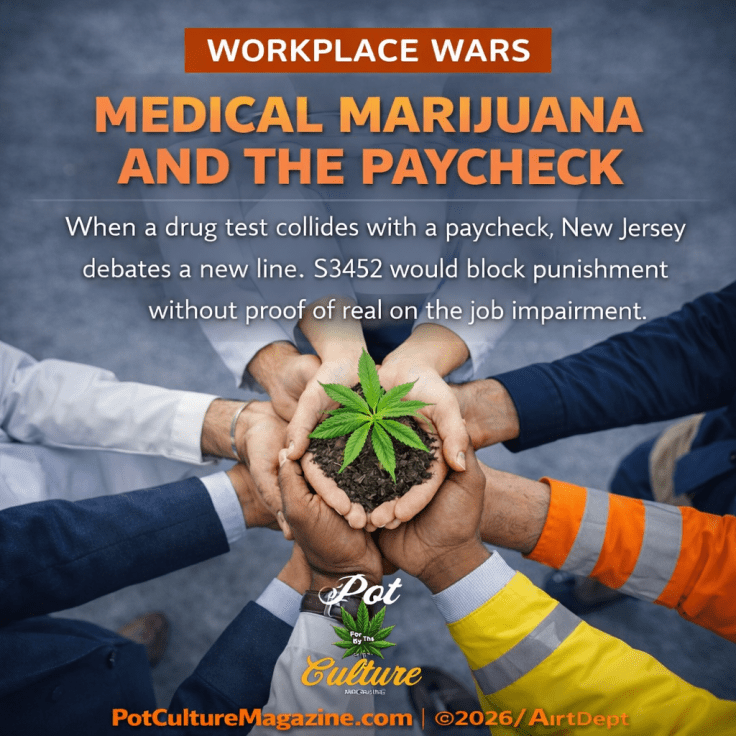
New Jersey just dragged one of the ugliest cannabis questions back into daylight: whether a registered medical patient can keep a job when a drug test lights up for THC.
On February 9, 2026, State Senator James Beach introduced Senate Bill S3452. The introduced text would prohibit an employer from taking adverse employment action against an employee who is a qualified registered patient using medical cannabis consistent with state law based on either the employee’s status as a registry identification cardholder or the employee’s positive drug test for cannabis components or metabolites, unless the employer establishes by a preponderance of the evidence that lawful use impaired the employee’s ability to perform job responsibilities.
The bill also builds an observation-based impairment frame into the statutory explanation. It says an employer may consider job responsibilities impaired when the employee manifests “specific articulable symptoms” while working that decrease or lessen the performance of the duties or tasks of the job position.
That structure is the point. S3452 is designed to stop metabolite-only punishment and force the employer to show impairment connected to job performance.
The bill also retains the written notice and response lane for positive tests. Under the introduced text, when an employer has a drug testing policy and an employee or job applicant tests positive for cannabis, the person must be offered an opportunity to present a legitimate medical explanation and provided written notice of the right to explain. Within three working days after receiving notice, the employee or applicant may submit information to explain the result or request a confirmatory retest of the original sample at their own expense. The person may present a health care practitioner recommendation, a registry identification card, or both, as part of the explanation.
New Jersey has been stuck in the larger problem S3452 tries to address. The state’s workplace cannabis rules have leaned on interim guidance while the Workplace Impairment Recognition Expert (WIRE) concept remains unfinished as a uniform standard under CREAMMA.
The New Jersey Cannabis Regulatory Commission’s workplace impairment guidance is explicit on two key points. First, it states an employee shall not be subject to adverse action solely due to the presence of cannabinoid metabolites in bodily fluid from permitted conduct. Second, it states that a scientifically reliable objective testing method showing metabolites alone is insufficient to support an adverse employment action, while a test combined with evidence-based documentation of physical signs or other evidence of impairment during prescribed work hours may be sufficient.
The CRC also describes that document as guidance “until the NJ CRC formulates and approves standards for the Workplace Impairment Recognition Expert certification.” That “until” is the problem.
Employer groups have been saying out loud that this uncertainty is not workable. In a May 13, 2022, New Jersey Business and Industry Association post about testimony to a Senate committee, NJBIA Chief Government Affairs Officer Chrissy Buteas is quoted as saying, “We need some clarity for our employer community,” followed by a description of the gap between a statute calling for WIRE criteria and the absence of regulations explaining certification.
Enforcement pathways matter as much as policy language. Erick Zanetich found that out after a Walmart job offer in New Jersey was rescinded following a positive cannabis test. In December 2024, the Third Circuit held that New Jersey’s adult-use cannabis employment provision does not create a private right of action for damages, emphasizing the statute did not provide a remedy and reading that as a legislative choice, as summarized in Reuters coverage of the decision.
That ruling does not mean workplace cannabis protections are meaningless. It does mean a statute can sound protective while leaving workers with limited private tools to enforce it. S3452 sits in that same real-world environment, lawmakers trying to reduce ambiguity and shift disputes away from metabolite presence toward provable impairment.
HELP POT CULTURE MAGAZINE STAY ALIVE, AND INDEPENDENT
Nationally, medical cannabis employment protections remain uneven. The National Conference of State Legislatures’ cannabis and employment tracker states medical cannabis is legal in 38 states, and that about half of those states have policies that in some way address anti-discrimination for medical cannabis patients, while far fewer require accommodations, and most leave policy to employers.
The patchwork shows up in the case law and statute language people keep citing.
Colorado remains the cautionary tale because courts treated state-licensed use as not protected when federal illegality controlled the interpretation. Coats v. Dish Network is the classic example, and the lesson is brutal: state legality does not automatically translate into workplace protection.
Massachusetts is the accommodation route. Barbuto v. Advantage Sales & Marketing is widely cited for holding that off-site medical marijuana use may be a reasonable accommodation under state disability law and that federal illegality alone does not end the inquiry.
Arizona is the statutory model. A.R.S. § 36 2813 prohibits employment discrimination based on cardholder status or a qualifying patient’s positive drug test for marijuana components or metabolites, unless the patient used, possessed, or was impaired at the workplace or during work hours, with a federal benefit carveout.
California is the metabolite pivot at scale. AB 2188 took effect January 1, 2024, and restricts many employers from taking action based on off-duty cannabis use or drug test results that detect non-psychoactive cannabis metabolites, while also including multiple exemptions, including for parts of the building and construction trades and for certain federally regulated positions.
New Jersey’s introduced bill is trying to force that same distinction into its medical framework. Metabolites alone would not be enough. The employer would have to prove impairment connected to job responsibilities under a preponderance standard, using an observation-based concept that the bill spells out.
Employer pushback will land in predictable places: liability, safety, inconsistent supervision, and federal compliance. Patient advocates will land in predictable places, too: science, fairness, treatment parity, and the right to manage a medical condition without a lab report turning into a career death sentence.
The hard truth is that legalization matures in stages. Arrest relief comes first. Retail comes next. Daily life consequences follow: housing, custody, licensing, and employment. The paycheck is where legalization either becomes real or stays conditional.
S3452 is current because it exists right now, it was introduced on February 9, 2026, and it tries to make New Jersey’s medical program behave like medicine instead of a permission slip that expires the moment HR calls.
©2026 Pot Culture Magazine. All rights reserved. This content is the exclusive property of Pot Culture Magazine and may not be reproduced, distributed, or transmitted in any form or by any means without prior written permission from the publisher, except for brief quotations in critical reviews.
F O R T H E C U L T U R E B Y T H E C U L T U R E
CANNABIS LIES Vol. 8: The Addiction Lie
Cannabis is often labeled addictive, but the science tells a more precise story. This piece breaks down cannabis use disorder, how it is defined, and why mild, moderate, and severe cases get flattened into one fear-driven narrative. The result is a distorted public understanding of risk that fuels policy, perception, and misinformation.

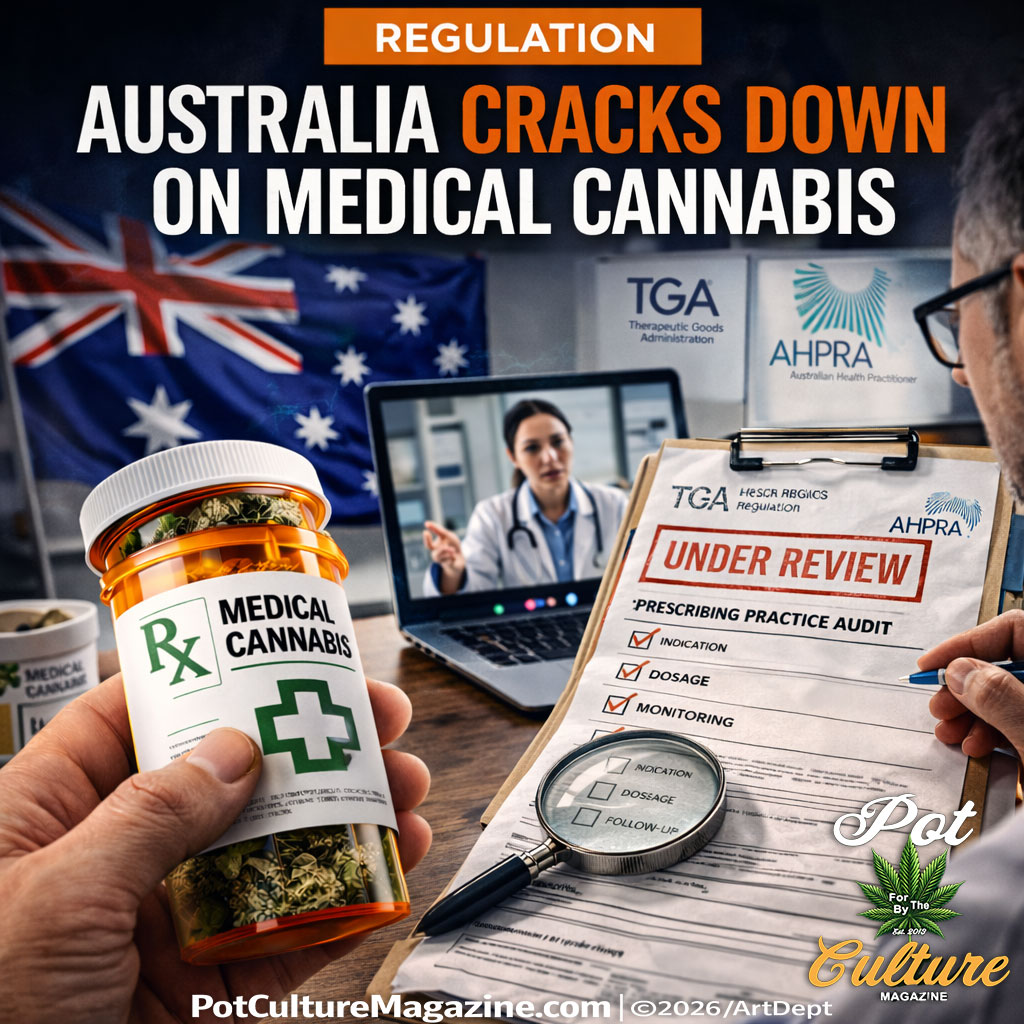
Australia Cracks Down on Medical Cannabis
Australia’s medical cannabis system expanded rapidly through telehealth and high-volume prescribing. Now regulators are tightening oversight. The TGA and AHPRA are increasing scrutiny on prescribing practices, signaling a shift from rapid patient access toward stricter clinical control that could reshape how doctors prescribe and how patients obtain treatment.

Missouri Tightens Grip On Hemp Sales
Missouri legalized cannabis, then moved to squeeze intoxicating hemp into the dispensary system. HB 2641 is being sold as consumer protection, but critics say it protects licensed marijuana operators while threatening hemp retailers, growers, and small businesses across the state.
Discover more from POT CULTURE MAGAZINE
Subscribe to get the latest posts sent to your email.

Leave a comment