Filed Under: The Rubes of Reefer

Every time the federal government needs a softer headline, cannabis suddenly reenters the conversation through the same tired script. A source says reclassification is being considered. Another source suggests executive action could arrive as soon as Monday. Then an official clarifies that no final decisions have been made. The words spread fast. Hope spikes. Nothing follows.
The community has seen this movie before.
The language is always careful. Considering. Looking at. Under review. Each phrase is selected because it generates optimism without obligation. Each one buys time. Each one allows the government to change the subject without changing the law.
When Monday passes, the outcome is predictable. No executive order appears. No scheduling rule is finalized. No notice is published in the Federal Register. Cannabis remains exactly where it was before the quotes hit the wire.
That is not a failure of follow-through. It is the design.
Cannabis reform has become a reliable pressure valve at the federal level. It can be deployed during moments of political heat to generate goodwill, then quietly withdrawn once attention shifts. This tactic did not originate with any single administration. It is structural.
The most recent cycle followed the same choreography. As coverage intensified around issues unrelated to cannabis, reclassification talk resurfaced. Reporters were fed language about internal deliberation. Markets reacted. Advocates leaned forward. The moment stretched just long enough to redirect the narrative.
Then the trail went cold.
For more than a decade, federal cannabis reform has been introduced through suggestion rather than execution. Reviews are announced. Recommendations are hinted at. Comment periods are opened. Silence finishes the job.
In October 2022, the executive branch formally directed the Department of Health and Human Services to conduct a scientific review of cannabis scheduling. The directive generated praise and headlines. It did not compel an outcome.
In August 2023, HHS completed its review and transmitted a recommendation to move cannabis to Schedule III under the Controlled Substances Act. That recommendation carried no binding authority.
The public did not learn about it until May 2024, months after it was finalized. By then, the narrative had already shifted from evidence to anticipation. The question became when it would happen, not whether anything required it to happen at all.
That framing was false.
HELP POT CULTURE MAGAZINE STAY ALIVE, AND INDEPENDENT
Under federal law, the agency that evaluates medical science does not control scheduling outcomes. HHS can advise, but it cannot decide. Final authority rests with enforcement agencies insulated from urgency and protected by procedure.
Those agencies are not required to act on recommendations. They are required only to consider them. Consideration has no deadline. Silence satisfies the obligation.
Once the recommendation was entered into that system, it moved into a rulemaking process designed to absorb pressure without producing commitment. A public comment period opened in May 2024 and closed in July 2024. Tens of thousands of submissions were logged. None compelled action.
By early 2025, there was still no final rule, no published schedule change, and no explanation for the delay. The system returned to quiet because quiet is where it operates best.
Recent remarks reported by major outlets fit perfectly into that structure. Officials said reclassification was being reviewed and described the idea as under strong consideration. Those words dominated coverage within minutes. They did not activate any legal mechanism.
As of publication, no executive order has been signed, no scheduling rule has been finalized, and no federal action has altered cannabis’s legal status.
That distinction matters because executive rhetoric is not executive power. Even a signed order would not, by itself, reschedule cannabis. Scheduling requires administrative rulemaking under the Controlled Substances Act. That process has not been completed. It has not been forced forward.
Advertisement
F O R T H E C U L T U R E B Y T H E C U L T U R E

Zurich’s Black Market Problem
Zurich’s Züri Can pilot is giving cannabis reformers something stronger than slogans. New interim findings show regulated, nonprofit access reduced several reported health problems while pulling demand away from the illegal market, giving Switzerland fresh evidence for national cannabis reform and putting prohibition panic on weaker ground.


Vegas Knew, Vegas Looked Away
Las Vegas sold tourists the illusion of legal cannabis while fake dispensary style hemp shops operated near the Strip. Vegas Knew, Vegas Looked Away exposes how Nevada’s casino separation rules, weak hemp oversight, delayed Clark County action, and tourist confusion created a loophole economy hiding in plain sight.
Advertisement
The talk exists to manage perception, not policy.
Cannabis remains illegal under federal law.
Interstate commerce involving cannabis remains a federal crime.
Federal employment drug testing policies remain enforceable.
Immigration penalties tied to cannabis remain in place.
Federal housing and student aid consequences still apply.
Veterans continue to face barriers inside federal healthcare systems.
Medical research remains constrained by federal sourcing rules.
Federal enforcement authority remains unchanged.
Arrests continue.
The United States still records more than 200,000 cannabis-related arrests each year, with enforcement disproportionately impacting Black and Latino communities.
None of that shifts when a quote hits the wire.
Rescheduling to Schedule III would change one narrow slice of federal policy. It would modify tax treatment under Internal Revenue Code Section 280E for certain businesses. It would not legalize cannabis. It would not deschedule it. It would not stop arrests. It would not protect workers. It would not expunge records. It would not prevent federal prosecution.
Schedule III is a modification within prohibition, not an exit from it.
Power stays concentrated by never resolving the question. Messaging replaces movement, so accountability never arrives. Process becomes a shield that absorbs pressure without yielding results. Market instability weakens challengers while entrenched interests remain insulated. Delay itself becomes the operating condition.
Nothing about reclassification requires theater. If the will existed, the steps are known. Agencies understand the process. The law provides pathways. Silence remains a choice.
Cannabis keeps getting promised because promising is easy.
It keeps getting dropped because delivering would force accountability that the system does not want.
That is the con.
©2025 Pot Culture Magazine. All rights reserved. This content is the exclusive property of Pot Culture Magazine and may not be reproduced, distributed, or transmitted without prior written permission from the publisher, except for brief quotations in critical reviews.
F O R T H E C U L T U R E B Y T H E C U L T U R E
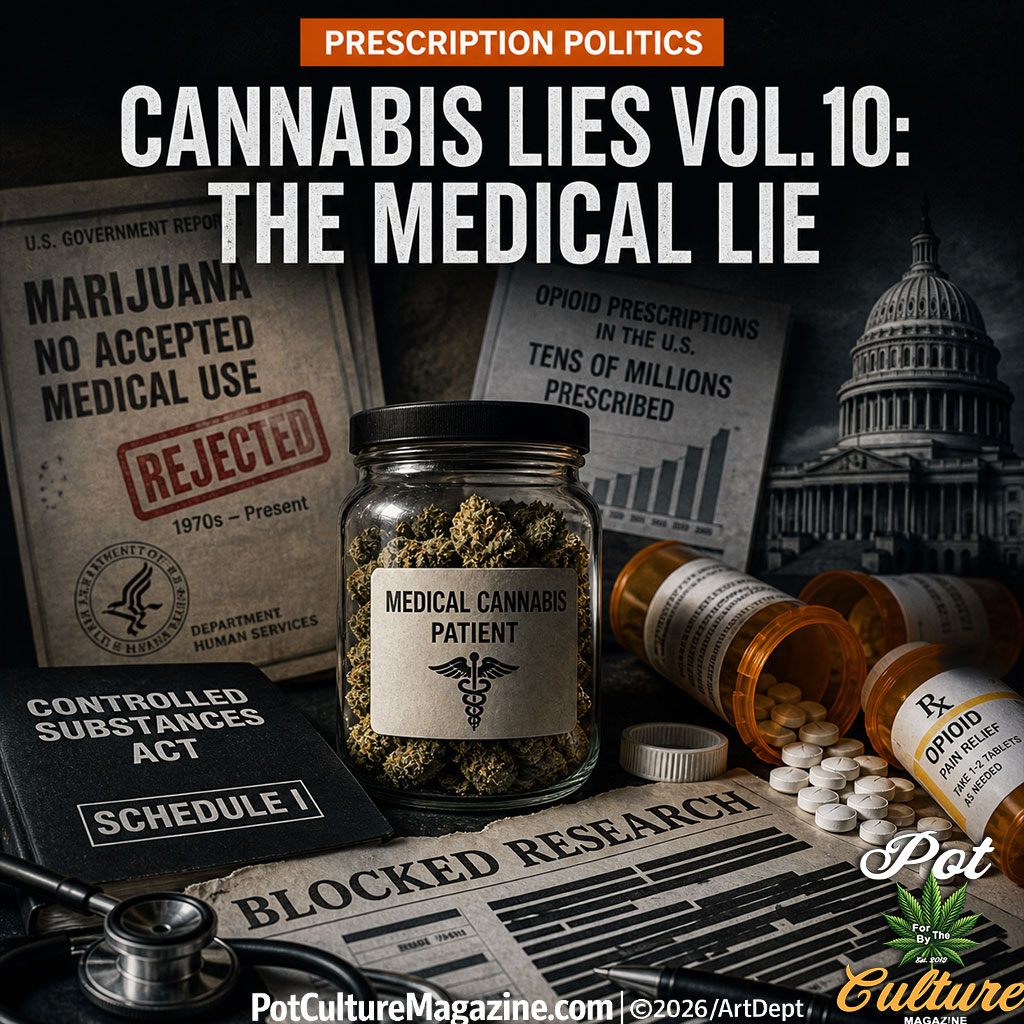
CANNABIS LIES Vol. 10: The Medical Lie
For decades, federal policy claimed cannabis had no accepted medical use while opioid prescriptions moved through the health care system by the tens of millions. Cannabis Lies Vol. 10 exposes the contradiction behind Schedule I, blocked research, medical cannabis patients, and the institutions that spent years pretending politics was medicine.

Jersey’s New Cash Crop
Jersey reinvented itself. A forty-five square mile island once known for offshore finance is now exporting pharmaceutical-grade cannabis into Germany’s booming medical market. With strict regulation, heavy investment, and a government eager for diversification, Jersey has become an unlikely European powerhouse. The contradiction between local policing and global commerce tells the real story.

A State of the Union on the State of Cannabis Media
Cannabis media is undergoing a predictable institutional decay. The movement’s original architects have transformed from revolutionary contributors into defensive gatekeepers, protecting their legacy rather than fostering future growth. This manifesto examines the four archetypes of decay: the Gatekeeper, the Mercenary, the Scavenger, and the Shill, that currently stifle the industry’s independent voice and threaten the…
Discover more from POT CULTURE MAGAZINE
Subscribe to get the latest posts sent to your email.

Leave a comment