Filed Under: Hey Man, Am I driving okay?
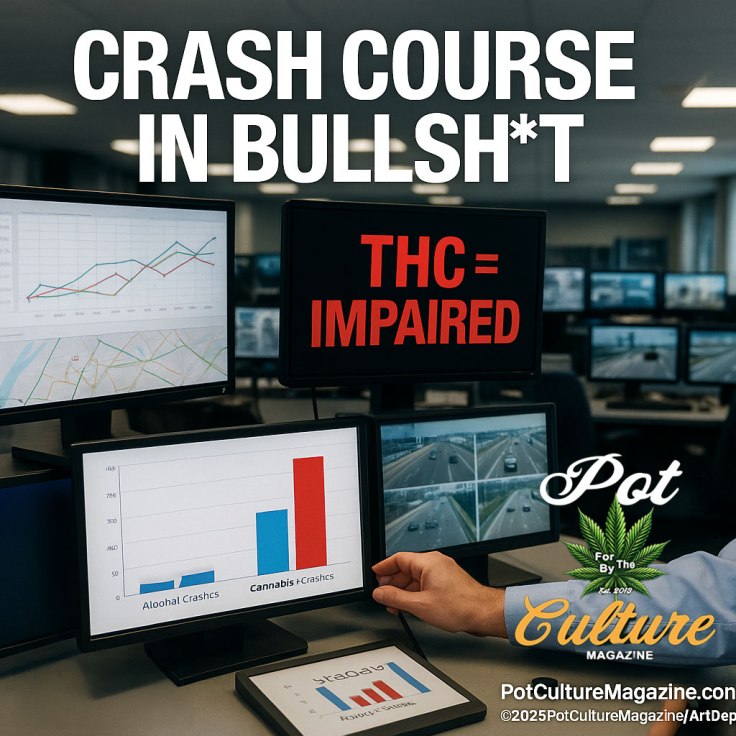
They want the public to believe weed is the next drunk driving epidemic. They want headlines to scare voters into thinking legalization was a mistake. They want tragic accidents to become anti-cannabis propaganda. And they are doing it with a toxic mix of bad science, worse journalism, and weaponized half-truths.
Every time a crash makes the news and the driver tests positive for cannabis, another think piece gets filed. Editors call it public safety. In reality, it is fear marketing. It is a prohibition recycled for the age of clickbait.
Let’s make something brutally clear from the start.
THC in your system does not mean you were high.
It does not prove impairment.
It does not cause a crash.
That statement is not stoner spin. It is the conclusion of the most comprehensive traffic safety study the federal government has ever funded. The National Highway Traffic Safety Administration’s Drug and Alcohol Crash Risk Study tracked over 9,000 drivers, pairing crash-involved subjects with non-crash controls in the exact same locations. They found that after adjusting for age, sex, race, and alcohol, drivers who tested positive for THC showed no statistically significant increase in crash risk.
Let’s say that again for every headline writer out there cashing in on panic.
THC detection alone does not make you more likely to crash.
That is a fact. From the U.S. government.
WHO’S REALLY DRIVING THE DANGER
If the goal is traffic safety, we need to talk about alcohol. Not because it’s trendy to bash booze, but because it remains the number one substance involved in fatal crashes. According to the CDC, 32 percent of all traffic deaths in the United States involve alcohol-impaired driving. That is not theoretical. That is blood, glass, and highway body counts.
By contrast, cannabis, despite being the second most detected substance in driver toxicology reports, is not strongly linked to impairment-based crash causation. Presence does not equal blame.
Here’s what the real data shows.
DETECTION VS. IMPAIRMENT
Between 2019 and 2021, trauma centers and medical examiner data collected through national reporting systems revealed the following:
- Cannabis (active THC) was detected in about 25 to 26 percent of drivers involved in serious or fatal crashes
- Alcohol was detected in about 21 to 22 percent
- Roughly 18 percent of those cases involved multiple substances, most commonly alcohol and THC (Source: NHTSA, CDC)
In some state-level data, cannabis detection rates have now surpassed alcohol. That sounds damning until you understand what detection actually means.
THC is stored in fat cells and metabolized slowly. Unlike alcohol, it does not clear out of the bloodstream in a predictable linear path. You could smoke a joint on Saturday and test positive on Monday. You could vape on Tuesday and get into a car accident on Thursday, completely sober and still test positive.
That is not speculation. That is pharmacokinetics. That is why THC detection is a garbage metric for determining driver impairment.
And yet, media reports keep using phrases like “tested positive for cannabis” as if that proves intoxication. It doesn’t. It proves the person has used cannabis at some point in the recent past. That’s it.
By contrast, alcohol tells the truth. A blood alcohol concentration above 0.08 percent correlates directly with psychomotor impairment. There is a dose-response relationship. More alcohol equals worse driving. Every level of intoxication is measurable, predictable, and prosecutable.
The same cannot be said for cannabis. Not even close.
CRASH RISK BY THE NUMBERS
Meta-analyses of cannabis driving studies have found modest associations at best. A 2021 review published in Accident Analysis & Prevention found that recent cannabis use within three hours may increase crash risk by about 32 percent, or an odds ratio of 1.3.
Now compare that to alcohol.
Drivers with a blood alcohol concentration of 0.08 percent or higher have between a 6 and 12 times greater risk of being involved in a fatal crash. That is a risk increase of 600 to 1,200 percent.
| Measure | Alcohol | Cannabis (THC) |
|---|---|---|
| Involved in fatal or serious crashes | ~21 to 22 percent | ~25 to 26 percent |
| Multi-drug involvement | Common (may mask other substances) | Common (often co-detected with alcohol) |
| Relative crash risk | 6 to 12 times higher at BAC ≥ 0.08% | ~1.3 times higher if used within 3 hrs |
| Consistent dose-risk relationship | Yes | No |
Let’s stop pretending these substances are remotely comparable in risk.
THE POLY-DRUG PROBLEM
One of the most overlooked facts in cannabis driving fear stories is the presence. According to trauma center data, up to 20 percent of crash-involved drivers had both alcohol and THC in their system. Some had more. When alcohol is detected, testing often stops. That means many of the so-called cannabis-only crashes are actually mixed-substance events.
In real terms, alcohol plus cannabis multiplies impairment. The effect is not additive. It is exponential. A driver with a couple of beers and a hit of weed is more impaired than either substance alone.
But instead of focusing on co-use patterns, media reports isolate cannabis to create moral panic.
They do not disclose that alcohol may have been present. They do not mention that testing ended after alcohol was confirmed. They do not cite field sobriety results or actual behavior behind the wheel. They just say “the driver tested positive for cannabis” and move on.
That is not journalism. That is misdirection.
SCIENCE VS. STIGMA
While alcohol has clear enforcement tools like breath tests and established thresholds, THC laws are a patchwork of pseudoscience.
As of 2025:
- 12 states have zero-tolerance policies for THC
- 5 states have per se limits ranging from 2 to 5 nanograms per milliliter, despite no consensus on what those levels actually mean
- 33 states use effects-based laws, which rely on observed impairment, not chemistry (Source: NHTSA, MPP, AAA Foundation)
Zero-tolerance and per se limits criminalize cannabis users even when they are not impaired. A medical patient could dose legally, sleep eight hours, drive to work, get rear-ended, and face a DUI simply because THC was still detectable.
Conviction rates for THC DUIs under these laws are lower than alcohol, about 70 percent for cannabis versus 93 percent for booze.
Even Colorado, one of the earliest legal states, acknowledges the problem. The state’s 5 ng/mL threshold is not an automatic conviction. It allows rebuttal with behavioral evidence.
STATE SPOTLIGHT: MICHIGAN, WASHINGTON, COLORADO
- Michigan has a zero-tolerance law. Any THC in your blood and you’re guilty, regardless of impairment
- Washington uses a 5 ng/mL per se limit, but courts allow impairment defenses
- Colorado uses a permissible inference model, meaning 5 ng/mL presumes impairment, but the driver can challenge it
None of these reliably measures real impairment. That is the problem.
THE REAL DANGER
Cannabis legalization is not causing an epidemic of deadly drivers. What we are seeing is an increase in detection, not danger. That detection is being misinterpreted by journalists, manipulated by prohibitionists, and shoved at the public without scientific scrutiny.
If cannabis detection were a public health crisis, we would see it in the fatality data. But we don’t. What we see is alcohol. Again and again.
The fact that alcohol still causes a third of all traffic deaths while cannabis gets the blame is a cultural farce. It is a double standard so baked into the system that no one questions it. Liquor companies buy Super Bowl ads. Cannabis patients lose jobs. Drinkers are seen as social. Smokers are treated as dangerous.
This is not about safety. This is about narrative. And the narrative is built on misinformation.
- THC detection does not mean the driver was high
- Cannabis crash risk is small, inconsistent, and often disappears after adjusting for alcohol and age
- Alcohol is still the number one cause of impaired driving deaths
- Most cannabis-positive crash drivers are also using alcohol
- Current laws criminalize presence, not behavior, and that’s a disaster for civil liberties
If the media wants to have a conversation about drug-impaired driving, then let’s do it. Let’s base it on science, not stigma. Let’s separate presence from impairment. Let’s hold alcohol to the same standard we hold cannabis. Let’s talk about what actually causes crashes, not what sells headlines.
Until then, every weed crash headline is just another version of the same old lie.
©2025 Pot Culture Magazine. All rights reserved. This content is the exclusive property of Pot Culture Magazine and may not be reproduced, distributed, or transmitted in any form or by any means without prior written permission from the publisher, except for brief quotations in critical reviews
F O R T H E C U L T U R E B Y T H E C U L T U R E
IDAHO TRIES TO STOP A VOTE BEFORE IT STARTS
Idaho lawmakers passed a resolution urging voters to reject a medical cannabis initiative before it reaches the ballot. The move highlights how officials are shaping public opinion ahead of a…

MS LIMITS MEDICAL CANNABIS WHERE IT MATTERS MOST
Mississippi maintains strict limits on medical cannabis after Governor Tate Reeves vetoed expansion bills on March 26, 2026. Patients remain unable to use cannabis in hospitals while eligibility and access…
CANNABIS LIES Vol. 6: The Driving Apocalypse Lie
Legal cannabis is often blamed for rising traffic deaths, but federal data tells a more complicated story. NHTSA findings, toxicology limitations, and conflicting crash studies reveal that THC presence is…
Discover more from POT CULTURE MAGAZINE
Subscribe to get the latest posts sent to your email.

Leave a comment