Filed Under: Regulatory Theater
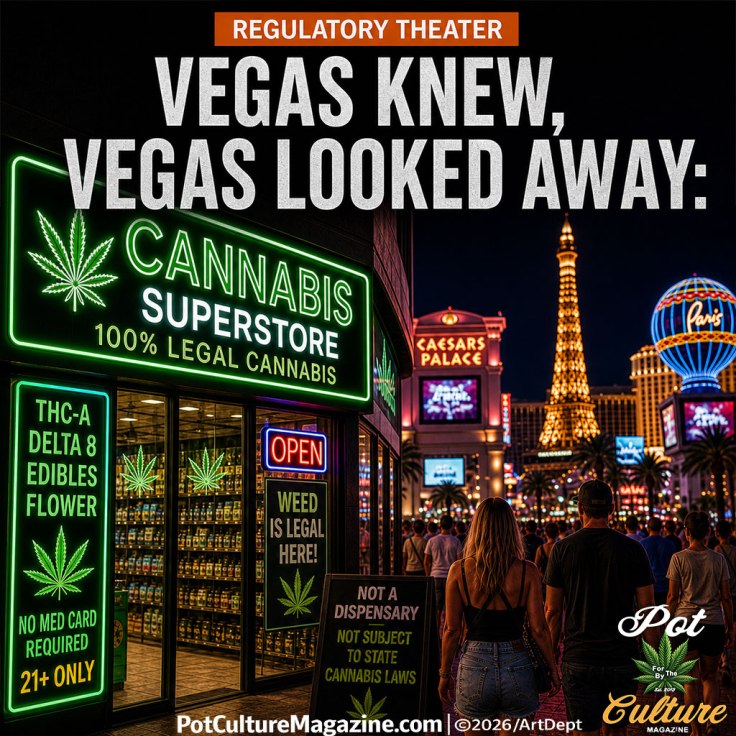
Las Vegas does not run on confusion. It sells confusion to tourists, then regulates the hell out of everything behind it.
The Strip tracks chips, watches doors, measures pours, monitors tables, and protects gaming licenses like state secrets. Nothing important is left unattended for long. Fake weed storefronts survived there anyway, glowing in plain sight.
For years, visitors walked into shops near Las Vegas Boulevard thinking they were buying legal Nevada cannabis. The signs looked right. The language sounded right. The jars, gummies, counters, and green glow did the rest.
Then came the catch.
They were buying hemp.
Hemp is dressed in the visual language of regulated cannabis. Hemp sold to people who thought Nevada legalization meant the green cross on the Strip led to the same tested, tracked marijuana sold inside the state’s licensed system. The confusion grew in the space Nevada created when it legalized cannabis but kept licensed dispensaries away from casino properties.
This was not a mystery hiding in the desert. Nevada regulators had warnings. Clark County had records. The storefronts were operating in plain sight.
For years, the hustle stayed alive because the same rules that make Las Vegas look tightly controlled also built the perfect hiding place for it.
Nevada’s own Cannabis Compliance Board tells consumers that the only legal way to purchase cannabis products in Nevada is through a state-licensed cannabis retail store. The CCB also warns visitors that licensed cannabis operators are generally not located within 1,500 feet of resort casinos on the Strip, and that delivery to a resort casino is a warning sign that the cannabis may be illegal and unsafe.
One warning explains the whole con.
Las Vegas Boulevard is built around gaming. Casino operators live in a federally sensitive world of banking, licensing, money movement, and enforcement exposure. The Justice Department has clarified that FDA approved cannabis derived medications can be treated differently under federal scheduling rules, while marijuana itself remains federally illegal, and broader rescheduling hearings remain unresolved. Nevada’s separation between cannabis and gaming still reflects the industry’s fear of federal exposure, not the way visitors actually move through the city.
A 2026 report from UNLV’s Cannabis Policy Institute put the practical impact in plain terms. Because of the density of gaming licensees in tourist areas, the 1,500-foot separation rule and resort hotel delivery restriction create what the report called:
“total prohibition”
The UNLV report estimated that roughly 30 million Las Vegas tourists each year are affected by the cannabis and gaming separation, with consumer spending pushed away from the licensed recreational market and toward illegal or unlicensed channels.
Not a loophole. Infrastructure.
Nevada built a legal cannabis market, then left the most visible tourist corridor in the state outside its practical reach. Licensed dispensaries had to stay away. Unlicensed lookalikes moved closer. Visitors saw cannabis cues, sales counters, flower jars, edibles, and staff using familiar weed language. The obvious assumption was also the dangerous one. Las Vegas would not let a fake dispensary operate in the open.
The hustle worked because that assumption made sense.
Pot Culture Magazine documented the mechanics in our earlier report, “The Vegas Hemp Hustle: Tourists Duped by Strip’s Slick Cannabis Cons.” The setup was never complicated. These shops borrowed the visual language of licensed cannabis without carrying the same regulatory weight. Green crosses. Weed leaves. Strain talk. THC language. Medical-looking scrubs. Glass jars behind counters. Menus built to suggest legitimacy. Storefronts close enough to the Strip to catch customers before they ever learned the real dispensaries were somewhere else.
Every hemp retailer was not running the same con. The legal problem is cleaner than that. Enough shops built their sales pitch around confusion that the distinction became the business model.
The CCB has tried to teach the public how to spot the difference. Ahead of 4/20 in 2025, the agency issued a “Buy Legal at Nevada Dispensaries and Lounges” release with the blunt message:
“only licensed, only legal.”
The agency warned that businesses missing from its licensed operator list may be selling intoxicating hemp, CBD, or low-potency products, but they are not licensed to sell cannabis in Nevada. The same release told consumers that products inside licensed cannabis establishments cannot be seen from the street, and that anything visible without a barrier is not cannabis from a licensed operator.
Useful warning. Damning admission.
When regulators have to tell visitors that the weed store on the Strip is not necessarily a weed store, the problem has already outgrown consumer education.
The CCB followed with a billboard campaign in May 2025, using the message:
“Don’t gamble on safety. Buy legal cannabis.”
According to the agency, the billboards appeared along the Strip, Downtown, near Stateline, along routes around Harry Reid International Airport, and at other resort corridor locations. The campaign was scheduled to run through June 30, 2026.
The CCB also drew the line between the regulated market and everything else. Products sold in licensed cannabis dispensaries and consumption lounges are tracked and tested from seed to sale. Cannabis grown, manufactured, or sold illegally is not regulated for harmful pesticides, unsafe chemicals, or unsanitary practices.
Visitors see the location. Regulators see oversight.
Licensed Nevada cannabis exists inside a regulated chain. The state requires cultivation, production, packaging, testing, security, identification checks, certificates of analysis, surveillance, audits, and inspections. The system is expensive and imperfect, but it creates a path to accountability. A licensed dispensary has a license to lose. A tested product has a paper trail. A batch can be recalled. A regulator can inspect records.
A Strip hemp shop selling lookalike products never had to carry the same weight.
The word “hemp” does a lot of work here. It sounds harmless. Agricultural. Familiar. Rope, shirts, lotions, wellness counters, and CBD shelves. In the real marketplace, hemp became something far more slippery after the 2018 Farm Bill defined legal hemp by its delta-9 THC concentration, not by whether the finished product could intoxicate a person.
Manufacturers and retailers found the gap. Delta 8 THC can be made from hemp-derived CBD through chemical conversion. THCa flower can test below the federal delta 9 limit on paper, then convert into intoxicating THC when heated. Other cannabinoids and semi-synthetic products filled the shelves with unpredictable results. A customer might get a weak product, a powerful one, a contaminated one, or a package whose label does not match the contents inside.
The FDA has warned that delta 8 THC has psychoactive and intoxicating effects, that the natural amount of delta 8 in hemp is very low, and that additional chemicals are often used to convert CBD into delta 8. The agency has also warned that final delta 8 products may contain harmful byproducts or contaminants from the conversion process, especially when manufacturing occurs in uncontrolled or unsanitary settings.
America’s Poison Centers reports that delta 8 products are often chemically made from CBD and may contain cannabinoids, terpenes, or chemical contaminants not listed on the product label. From 2021 through 2025, poison centers managed 10,434 delta-8 THC exposure cases, with severe toxicity associated with heart rate changes, low blood pressure, difficulty breathing, and coma.
None of this means every hemp product is poisonous. Lazy writing would stop there and call it a day.
The sharper point is oversight. The regulated cannabis market has testing requirements because inhaled and ingested cannabinoid products can carry real risk when nobody verifies potency, contaminants, conversion residue, solvents, pesticides, heavy metals, microbial growth, or labeling accuracy. A person who buys a product labeled as hemp may still experience intoxication. Cannabis imagery can make a buyer believe the state has inspected a product that never moved through Nevada’s regulated marijuana system. A vacation purchase can go sideways fast when the high feels wrong, the edible hits too hard, the receipt is useless, or hotel security explains that the delivery should never have reached the property in the first place.
The purchase creates another trap. Even after the sale, Las Vegas gives the buyer almost nowhere to consume it.
Nevada law allows adult cannabis possession, but the CCB says cannabis cannot be used in any public place, cannot be used in a moving vehicle, even by a passenger, and can only be consumed on private property if the property owner has not prohibited it. Cannabis may also be consumed at a licensed cannabis consumption lounge. That last detail matters because hotel rooms are not magic legal bubbles. Hotels and casino resorts are private property. If the property bans cannabis use, the guest does not get to override the rule because Nevada legalized possession.
Smoking in a hotel room is the rookie mistake. Most Las Vegas casino hotels do not allow cannabis smoking in rooms or on casino property. Get caught, and the consequences can move fast. A guest can be hit with a cleaning fee, charged for violating the room policy, forced to deal with hotel security, or removed from the property. If the situation escalates, the vacation can turn into a hallway argument with security and a front desk bill that costs more than the fake weed did.
So the buyer gets squeezed twice. First, by the imitation dispensary economy, then by the consumption rules. The shop sells the illusion of access. The hotel removes the place to use it. Las Vegas offers the product theater without the legal runway.
Nevada had warnings in its own backyard.
Clark County’s Department of Business License sent a notice to licensees in June 2021 after Senate Bill 49 passed, warning that the production, distribution, and sale of synthetic cannabinoids, including products containing delta 8 THC, was illegal in Nevada. The letter said the law became effective when Governor Steve Sisolak signed it on June 4, 2021.
The idea that nobody understood the risk does not hold up.
The county knew synthetic cannabinoids were a problem in 2021. State cannabis officials later warned consumers about unlicensed sellers. Clark County drafted new rules after hemp retail expanded rapidly. Congress included major hemp-related changes in the November 12, 2025, appropriations package because the 2018 hemp language had opened the door to intoxicating products.
Nobody was confused. The delay was the choice.
Clark County finally moved in 2026. In February, local reporting described a county effort to target deceptive cannabis style signage and labeling in stores selling so-called counterfeit cannabis. Commissioner Tick Segerblom described the effort as a response to businesses that mimic dispensaries in tourist areas where licensed dispensaries are not allowed because of state law.
By March, Clark County had passed sweeping rules for hemp retailers. FOX5 reported that the ordinance required hemp sellers to obtain a license, test products, disclose ingredients, post signs telling customers the store is not a licensed dispensary, and stop selling CBD in edible products.
The county’s own draft ordinance laid out the reason. The Board of County Commissioners found that hemp retail sales in unincorporated Clark County had expanded rapidly after changes to federal law, and that hemp products can pose health risks if contaminated, inaccurately dosed, misrepresented, or sold without safeguards. The draft also stated that many hemp products were being sold without rigorous third-party testing or uniform compliance standards, creating risks tied to inaccurate labeling, potency, contamination, youth access, inconsistent business practices, and public welfare.
County paperwork finally said the quiet part out loud.
Products were mislabeled, testing was inconsistent, health risks were real, and the market had expanded faster than regulation could keep up.
Necessary when?
For the person who already paid $80 for a jar of hemp flower, thinking it was Nevada cannabis, the answer came too late.
The hustle survived because it sat between systems. Cannabis regulators could warn consumers about legal dispensaries, but hemp retailers were not licensed cannabis establishments. County business licensing could regulate retail activity, but cannabis specific enforcement sat elsewhere. Police had bigger problems than a mislabeled gummy from a storefront with a leaf in the window. Federal law created the hemp definition that let the market explode. State cannabis law created the distance rule that kept licensed dispensaries away from the Strip. Gaming law made everyone nervous about putting cannabis anywhere near casinos.
Everybody has jurisdiction over a piece of the mess. Nobody owns the whole thing.
The bill lands on the visitor.
Meanwhile, licensed dispensaries got the worst of both worlds. They paid the taxes. They followed the rules. They stayed outside the forbidden radius. They complied with testing, packaging, inventory tracking, security, and audits. They operated under a federal tax burden that punishes cannabis businesses, specifically IRS Code 280E. Then they watched lookalike retailers sit closer to the customer, use looser branding, swipe ordinary credit cards, pay no cannabis excise tax, and sell products that borrowed the appearance of weed without carrying the same regulatory cost.
Not a free market.
Regulatory theater.
Nevada built a legal cannabis system with strict rules, then gave the most valuable tourist corridor to the imitation market.
Federal law is now on track to change. Congress included major hemp-related changes in the November 12, 2025, appropriations package, creating one of the biggest federal hemp shifts since the 2018 Farm Bill. Legal analysts say the new framework moves away from the delta-9 only loophole and toward a broader total THC standard. The change will likely make many intoxicating hemp-derived cannabinoid products federally unlawful when it takes effect on November 12, 2026, unless Congress changes course before then.
A large part of the Strip hemp hustle may collapse under that change.
It does nothing for the visitor who has already been burned.
Until the rule takes effect and until enforcement actually reaches the sidewalk, the basic consumer problem remains. A visitor arrives in Las Vegas. Nevada’s reputation says cannabis is legal. The Strip says everything visible has been vetted by somebody. A storefront offers the familiar menu, CBD, THC, flower, pre-rolls, edibles, relief, sleep, euphoria, and all the language needed to get a credit card out. Most visitors do not know the CCB license list. They do not know the 1,500-foot guidance. They do not know that a real licensed dispensary cannot display products from the street. They do not know that delivery to a resort casino is a red flag.
The storefront decides what the visitor learns.
Education alone was never enough.
A billboard is better than silence. A website is better than nothing. A consumer warning has value. Las Vegas, though, did not become Las Vegas by expecting tourists to read regulatory guidance before spending money. The city became this machine by knowing exactly how visitors behave, then designing every inch of the environment around that behavior.
The imitation dispensary economy understood that lesson better than the regulators did.
It did not need to beat Nevada’s legal cannabis system on quality. Proximity did the work. Visibility closed the sale. Confusion handled the rest. The lookalike shops were closer to the customer, easier to find, legal enough at a glance, and located where visitors were already walking.
The imbalance made Las Vegas Boulevard a perfect laboratory for post-legalization fraud. This was not black market weed in an alley, a guy whispering near a nightclub, or a pre-legalization throwback. It was brighter, cleaner, more corporate, and more Vegas than that. The hustle wore retail lighting. It spoke wellness. It printed receipts. It hid the trick behind the word hemp.
The blame does not fall on hemp itself. Hemp has legitimate uses. CBD has legitimate consumers. Non-intoxicating products can belong in a lawful marketplace when they are honestly labeled, tested, and sold without pretending to be regulated marijuana. The scam begins when hemp is used as camouflage for intoxication, when cannabis imagery is used to imply licensure, when visitors are steered into confusion, and when regulators respond with public education long after the business model has matured.
Clark County’s 2026 ordinance is a start. Required signage, product testing, age restrictions, licensing, and clear warnings all matter. Those rules should have existed before the Strip became a carnival midway of almost weed.
Now the enforcement question begins.
A rule on paper does not protect anybody if it is not visible at the counter. A warning sign does not mean much if it is buried behind merchandise or written like legal wallpaper. Testing requirements do not matter if products keep moving faster than inspectors. Licensing does not mean accountability if bad actors can dissolve one entity and reappear under another name.
Vegas knows how to move fast when gaming integrity is at stake.
A casino cannot shrug at a crooked table game and say customers should have checked a website. A sportsbook cannot let fake betting windows operate near the lobby because the signage was technically somebody else’s problem. A resort corridor built on surveillance and license protection does not become helpless when the product is cannabis adjacent.
That is the insult, not in the existence of hemp, but in the selective urgency.
The corridor is not underregulated because Las Vegas lacks the tools. It is underregulated because cannabis sits in the political dead zone between acceptance and stigma. Legal enough to sell Nevada as an adult and free. Too entangled with federal law to sit comfortably beside gaming. Too profitable to ignore. Too stigmatized to defend with the same urgency as a casino chip.
So the state settled into a contradiction.
Licensed cannabis was treated as risky near casinos, while unlicensed cannabis lookalikes operated close to customers. Regulated dispensaries were pushed away to protect gaming, while unregulated hemp retailers filled the vacuum that gaming separation helped create. The industry that followed the rules lost proximity. The businesses exploiting confusion gained the sidewalk.
Consumer protection was never the real goal.
Optics were.
Nevada can still fix it, but the fix requires honesty. Stop pretending the Strip problem is just a tourist education issue. Stop acting as though a green cross next to a casino corridor is harmless decoration when the entire business model depends on borrowed legitimacy. Stop letting licensed operators carry the burden of regulation while imitation retailers benefit from the public trust created by that regulated market.
The state wanted legal cannabis without disturbing the casino kingdom. The result was predictable. Visitors got sent into a maze where the real product was harder to reach than the fake one.
Las Vegas did not accidentally look away.
It looked at the gaming risk. It looked at the cannabis stigma. It looked at the tourist money. It looked at the enforcement mess. Then, for too long, it let the hustle breathe.
Now the county is writing rules. The CCB is buying billboards. Congress is trying to close the federal hemp loophole. Regulators are finally telling people what the storefronts are not.
Good. It should have happened years ago.
The Strip still has a credibility problem. Nevada sold itself as a legal cannabis state while leaving its most famous street open to cannabis imitation. That gap hurt consumers, undercut licensed operators, and turned legalization into a guessing game for visitors who had every reason to believe Vegas would not let fake weed stores operate under the lights.
Inside the casinos, every variable gets watched.
Outside, a visitor can still walk past the cameras, follow the green glow, and learn the oldest Vegas lesson the hard way.
The house always knows.
©2026, Pot Culture Magazine. All rights reserved. This is the property of Pot Culture Magazine and is protected by U.S. and international copyright laws. Unauthorized reproduction, distribution, or transmission of this work, in part or in whole, without the express written permission of Pot Culture Magazine is strictly prohibited.
F O R T H E C U L T U R E B Y T H E C U L T U R E
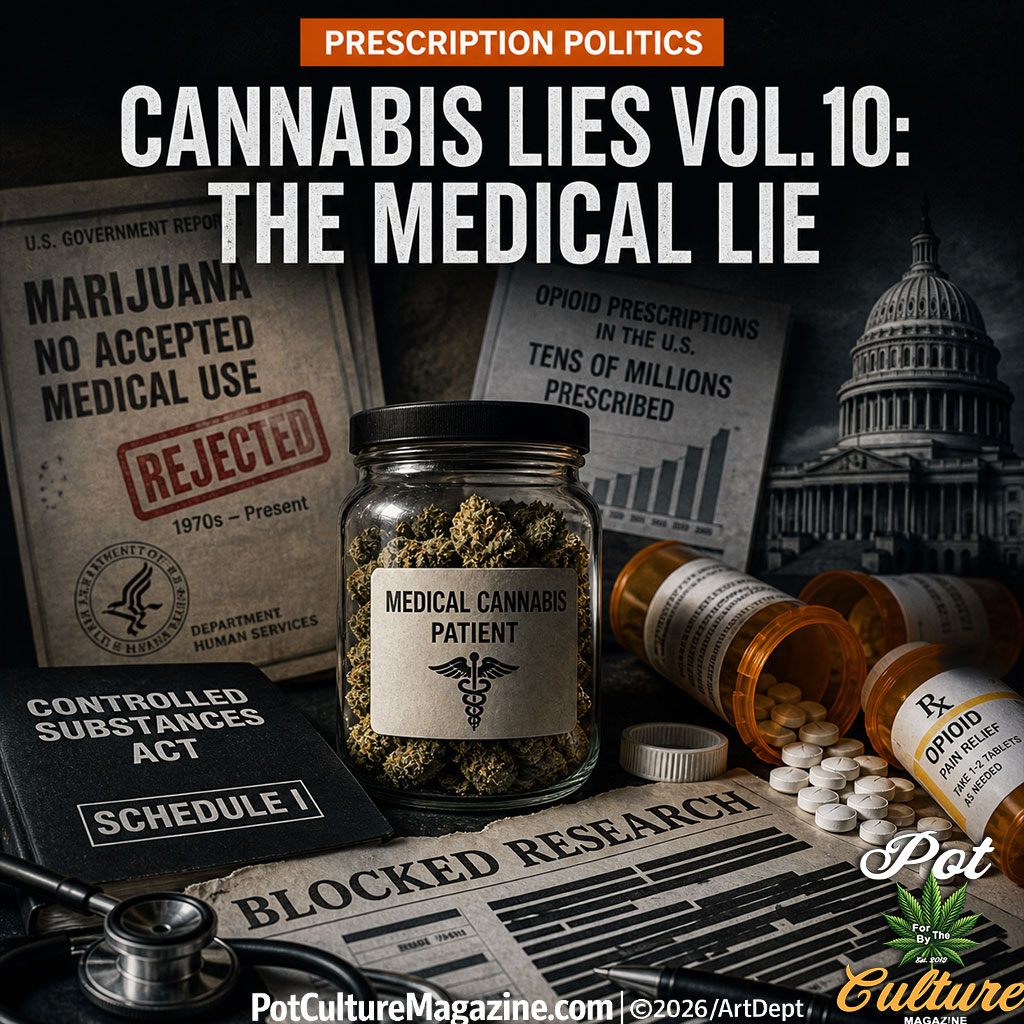
CANNABIS LIES Vol. 10: The Medical Lie
For decades, federal policy claimed cannabis had no accepted medical use while opioid prescriptions moved through the health care system by the tens of millions. Cannabis Lies Vol. 10 exposes the contradiction behind Schedule I, blocked research, medical cannabis patients, and the institutions that spent years pretending politics was medicine.

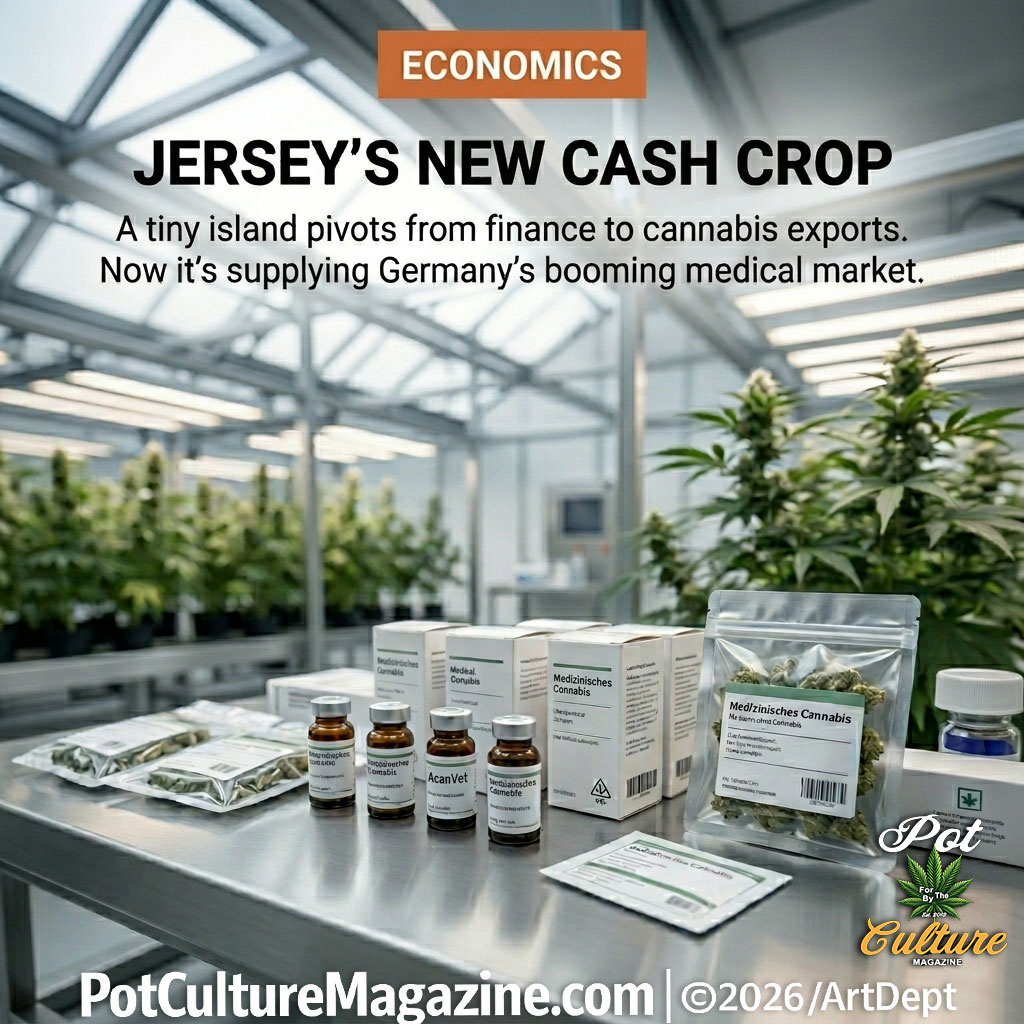
Jersey’s New Cash Crop
Jersey reinvented itself. A forty-five square mile island once known for offshore finance is now exporting pharmaceutical-grade cannabis into Germany’s booming medical market. With strict regulation, heavy investment, and a government eager for diversification, Jersey has become an unlikely European powerhouse. The contradiction between local policing and global commerce tells the real story.
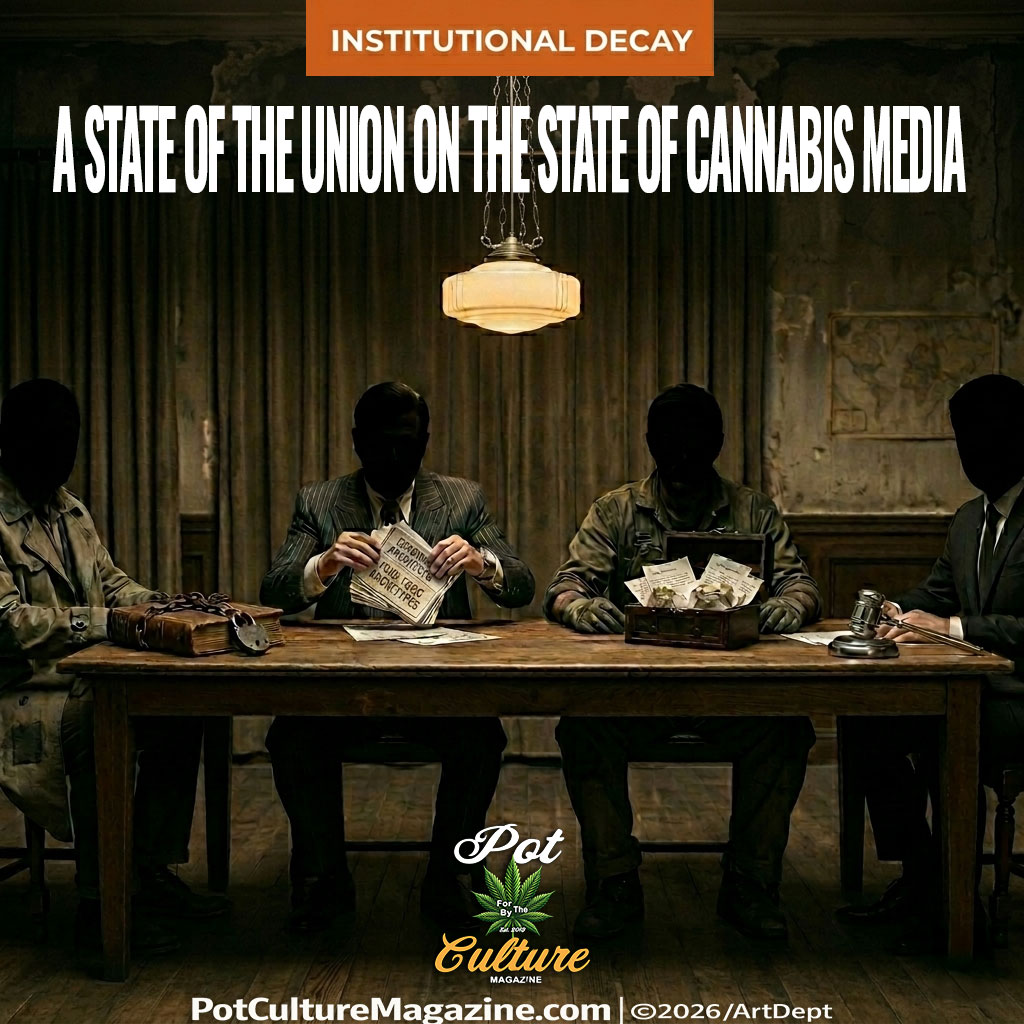
A State of the Union on the State of Cannabis Media
Cannabis media is undergoing a predictable institutional decay. The movement’s original architects have transformed from revolutionary contributors into defensive gatekeepers, protecting their legacy rather than fostering future growth. This manifesto examines the four archetypes of decay: the Gatekeeper, the Mercenary, the Scavenger, and the Shill, that currently stifle the industry’s independent voice and threaten the…
Discover more from POT CULTURE MAGAZINE
Subscribe to get the latest posts sent to your email.

Fascinating! Great reporting on this convoluted con.
LikeLike