Filed Under: System Malfunction
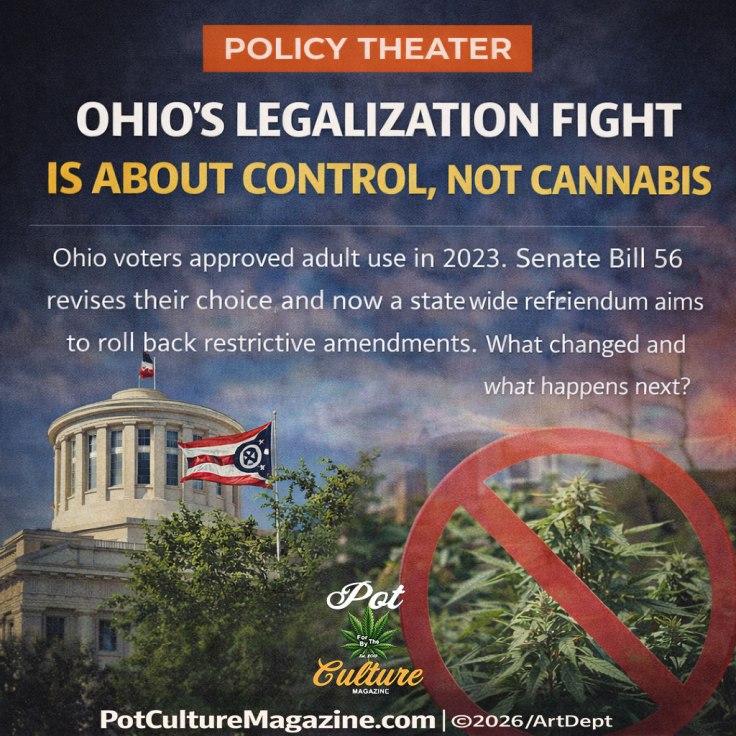
Ohio voters legalized adult-use cannabis in November 2023 with 57 percent support after approving Issue 2. The language was clear. Adults 21 and over could possess cannabis, grow it at home within limits, and purchase from licensed retailers. Tax revenue would flow to local governments, social equity programs, and substance abuse treatment.
That was the deal.
More than two years after voters approved Issue 2 in November 2023, the deal was rewritten.
In late 2025, the Republican controlled Ohio General Assembly passed Senate Bill 56. Governor Mike DeWine signed it into law on December 19, 2025. The measure did not repeal legalization. It narrowed it, restructured parts of it, and reshaped the relationship between marijuana and hemp-derived intoxicating products.
Now, a citizen referendum campaign is underway to challenge key sections of SB 56. Ohio Attorney General Dave Yost rejected the initial petition on January 13, 2026. A revised submission was received on January 20, 2026. The Attorney General certified the revised petition title and summary on February 3, 2026, clearing organizers to begin collecting signatures.
To place the referendum on the November 2026 ballot, organizers must submit roughly 248,000 valid signatures, including required county distribution from at least 44 of Ohio’s 88 counties, by the statutory deadline under Ohio’s county distribution and signature requirements. If they meet that threshold, the challenged provisions of SB 56 will be paused while voters decide.
This is not a symbolic skirmish. It is a structural fight over who controls legalization after voters approve it.
The bill makes several consequential changes. It restricts the retail sale of intoxicating hemp-derived THC products outside licensed marijuana dispensaries. It lowers THC caps on certain product categories. It tightens regulatory oversight. It limits license expansion. It consolidates intoxicating THC sales under the state’s marijuana control program.
Supporters describe the changes as responsible governance. Opponents describe them as a legislative clawback.
After the 2018 federal Farm Bill legalized hemp, defined as cannabis containing no more than 0.3 percent THC by dry weight, a secondary market expanded rapidly. Chemically converted cannabinoids, such as delta 8 THC, were sold widely through vape shops, smoke stores, and gas stations. Many of these products produced psychoactive effects but were not regulated under state marijuana laws.
Republican lawmakers argue that Ohio voters legalized regulated adult use of marijuana in 2023, not an unregulated intoxicating hemp market operating outside of dispensaries. They frame SB 56 as closing a loophole and bringing intoxicating THC products under one regulatory structure.
Supporters also argue that intoxicating hemp products were too accessible to minors and inconsistently tested. They present consolidation into licensed dispensaries as a public health safeguard.
The bill revises allowable THC limits on certain forms of cannabis. Lawmakers claim that high-potency products raise health concerns and that the legislature has the authority to impose guardrails.
Issue 2 was a statutory initiative, not a constitutional amendment. That means lawmakers legally retain the power to amend it. Governor Mike DeWine and legislative leadership argue they are refining, not reversing, legalization.
HELP POT CULTURE MAGAZINE STAY ALIVE, AND INDEPENDENT
The youth access argument is politically potent. It is also measurable.
National research tracking adolescent cannabis use after adult use legalization does not show consistent increases. In some states studied, past 30-day use among younger teens declined after legalization took effect. One peer-reviewed study found that 8th-grade past-month use dropped by roughly 22 percent and 10th-grade use by about 13 percent following recreational legalization in certain jurisdictions.
Broader federal data tells a similar story. Youth Risk Behavior Surveillance System data show that current marijuana use among high school students fell from 23.1 percent in 2011 to 15.8 percent in 2021, a period during which adult use legalization expanded across multiple states. More recent federal survey data shows past year marijuana use among people aged 12 to 20 reached a four-year low in 2024, according to the National Survey on Drug Use and Health, even as more states legalized adult use.
Legalization has not produced a national spike in teen cannabis use.
That does not eliminate regulatory responsibility. It does undermine the claim that legalization automatically drives adolescent consumption upward.
SB 56 channels intoxicating hemp products into the licensed marijuana system. Licensed marijuana operators invested heavily to enter Ohio’s adult-use market. They navigated application processes, capital requirements, and compliance standards. Hemp retailers operated under a different regulatory framework derived from federal hemp definitions.
By restricting intoxicating hemp sales to dispensaries, SB 56 reduces competition from independent hemp stores and concentrates revenue within the existing licensed system.
Licensed dispensaries benefit from reduced competition. Hemp retailers face existential disruption. Consumers encounter fewer points of sale for certain products.
THC caps shape product design, pricing, and consumer behavior. Lower potency limits may reduce the availability of certain formulations. They may also push demand toward alternative products. Whether potency caps meaningfully reduce harm is debated within public health literature. What is not debated is that they influence market structure.
SB 56 moved through a Republican majority General Assembly and was signed by Governor Mike DeWine. Many Republican lawmakers opposed adult-use legalization before voters passed Issue 2. After voters approved it, the legislature exercised its authority to amend it.
Legislators acted within their authority. Statutory initiatives can be amended by majority vote. That is a feature of Ohio law. The referendum process is the counterbalance. If enough valid signatures are gathered, voters can override legislative changes.
Adult use of marijuana remains legal in Ohio. Home cultivation remains legal within statutory limits. Dispensaries operate. Tax revenue flows.
The referendum does not determine whether cannabis is legal. It determines who defines the contours of that legality.
If SB 56 stands, intoxicating hemp products will be confined largely to licensed marijuana dispensaries. THC limits will reflect legislative revisions. Market structure will tilt toward consolidation under existing operators.
If voters overturn the revisions, the original statutory framework remains intact.
The central question is not whether cannabis should be legal. Ohio voters answered that.
The question is whether the legislature’s revisions align with the intent of that 57 percent majority.
That decision will not be made in press conferences. It will be made on a ballot.
And this time, voters will be voting on the details.
©2026 Pot Culture Magazine. All rights reserved. This content is the exclusive property of Pot Culture Magazine and may not be reproduced, distributed, or transmitted in any form or by any means without prior written permission from the publisher, except for brief quotations in critical reviews.
F O R T H E C U L T U R E B Y T H E C U L T U R E
IDAHO TRIES TO STOP A VOTE BEFORE IT STARTS
Idaho lawmakers passed a resolution urging voters to reject a medical cannabis initiative before it reaches the ballot. The move highlights how officials are shaping public opinion ahead of a vote, while maintaining strict prohibition and blocking even limited access for patients.

MS LIMITS MEDICAL CANNABIS WHERE IT MATTERS MOST
Mississippi maintains strict limits on medical cannabis after Governor Tate Reeves vetoed expansion bills on March 26, 2026. Patients remain unable to use cannabis in hospitals while eligibility and access rules stay tightly controlled. This feature examines what the veto blocks, how it affects patients, and what it means for the state’s growing cannabis market.
CANNABIS LIES Vol. 6: The Driving Apocalypse Lie
Legal cannabis is often blamed for rising traffic deaths, but federal data tells a more complicated story. NHTSA findings, toxicology limitations, and conflicting crash studies reveal that THC presence is not a reliable measure of impairment. This investigation breaks down how flawed testing and policy shortcuts have shaped the narrative around so-called stoned driving.
Discover more from POT CULTURE MAGAZINE
Subscribe to get the latest posts sent to your email.

Leave a comment