Filed Under: Sovereignty Meets the State
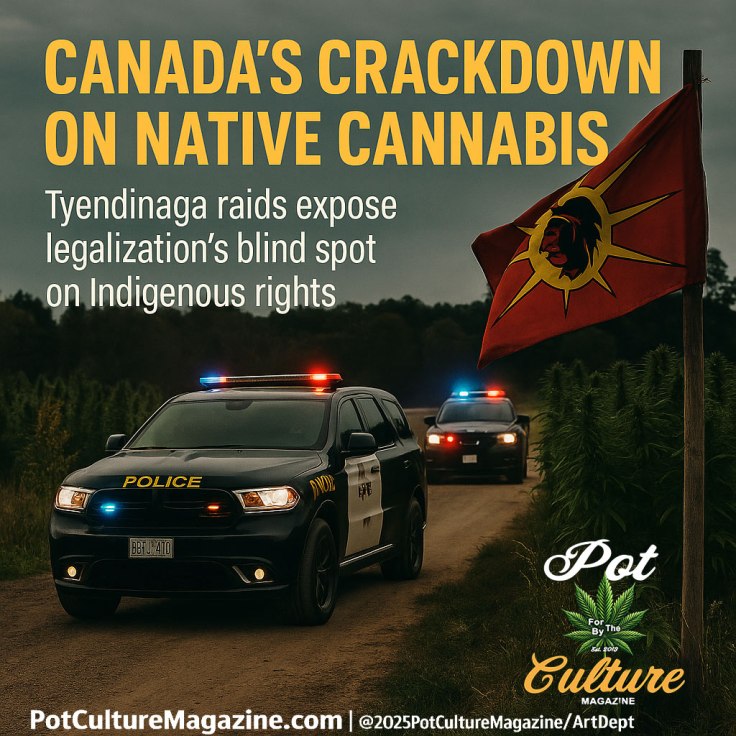
The Ontario Provincial Police rolled onto Tyendinaga Mohawk Territory in late summer, accompanied by armored trucks, helicopters, and a price tag already included in the press release. Officers said they seized more than $200 million worth of cannabis and shut down ten large grow sites. They charged twenty-four people connected to those operations and called it a victory.
What they never explained was the part that matters. Why were the police on sovereign Indigenous land in the first place, and what did sovereignty even mean in the moment that the plants came out of the ground? Canada legalized cannabis in 2018 under a federal system that promised consistency and uniformity. What Canada delivered was a country where corporate producers control the industry, the provinces control the stores, and Indigenous nations were told to get in line or be left behind. Tyendinaga has lived in that contradiction ever since.
To understand the raid, you have to understand the history. Tyendinaga Mohawk Territory sits along the Bay of Quinte in Ontario, one of the most politically active Mohawk communities in the country. It is home to more than two thousand residents on reserve and thousands more Mohawks of the Bay of Quinte living off the territory. It has a long record of asserting jurisdiction over its own land, its own laws, and its own economy. When Canada legalized cannabis, the federal government invited provinces to build regulatory frameworks, but did not offer Indigenous nations meaningful authority over production or retail unless they signed agreements with the province. Many refused because those agreements treated Indigenous governments as subordinates instead of sovereign nations.
The result was predictable. A thriving cannabis economy grew on the territory. Dozens of shops opened. Some operated with licenses and regulations created by the Mohawk people themselves through local governance structures, elders councils, and community consensus. Others operated independently and saw cannabis as a route out of poverty and into self-sufficiency. Canada never clarified which of these businesses had legal standing and which did not. It simply declared that anything not licensed by Health Canada was illegal. That declaration ignored Indigenous law.
Cannabis on reserves has always existed in a fog of jurisdiction. Under the Indian Act, reserves are under federal authority, but provinces still enforce criminal law on them. Indigenous band councils can pass bylaws, but federal law overrides them. Self-government agreements give limited autonomy but rarely include control over controlled substances. Canada legalized cannabis without giving Indigenous communities a clear and equal place within the framework. Health Canada’s own 2022 “What we heard from Indigenous partners” review admits that many First Nations view cannabis regulation as part of their right to self-determination and economic development, and that the current law does not reflect that view.
F O R T H E C U L T U R E B Y T H E C U L T U R E
CANNABIS LIES Vol. 5: The Gateway Lie
For decades, politicians have claimed marijuana is a gateway to heroin and harder drugs. Federal youth surveys, NSDUH data, and NIDA’s own language tell a different story. Cannabis use is widespread, hard drug use remains rare, and most users do not progress. The data dismantles one of prohibition’s most durable fear narratives.

The Study That Pretends Cannabis Does Nothing
A new cannabis study claims marijuana does nothing for anxiety, depression, or PTSD. The reality is far more complicated. Decades of federal restrictions, limited research access, and synthetic substitutes have shaped the science. This breakdown exposes how incomplete data and selective interpretation continue to drive misleading headlines about cannabis and mental health.
Florida Blocked the 2026 Weed Vote
Florida’s ballot system claims to give voters power, yet the 2026 election cycle shows how procedural barriers can quietly shut the door on citizen initiatives. Signature thresholds, geographic distribution rules, and court challenges blocked every measure from reaching voters, revealing how cannabis legalization fights are often decided by bureaucratic design long before election day.
So when the police arrived in September and October to shut down ten large grow sites on Tyendinaga, the force treated the territory like any other patch of Ontario farmland. Officers said the farms did not have federal licenses under the Cannabis Act. They said the plants were destined for the unregulated market. They said the operation had nothing to do with sovereignty. They treated the enforcement as routine. They did not mention the years of political conflict over jurisdiction that made the raid anything but routine.
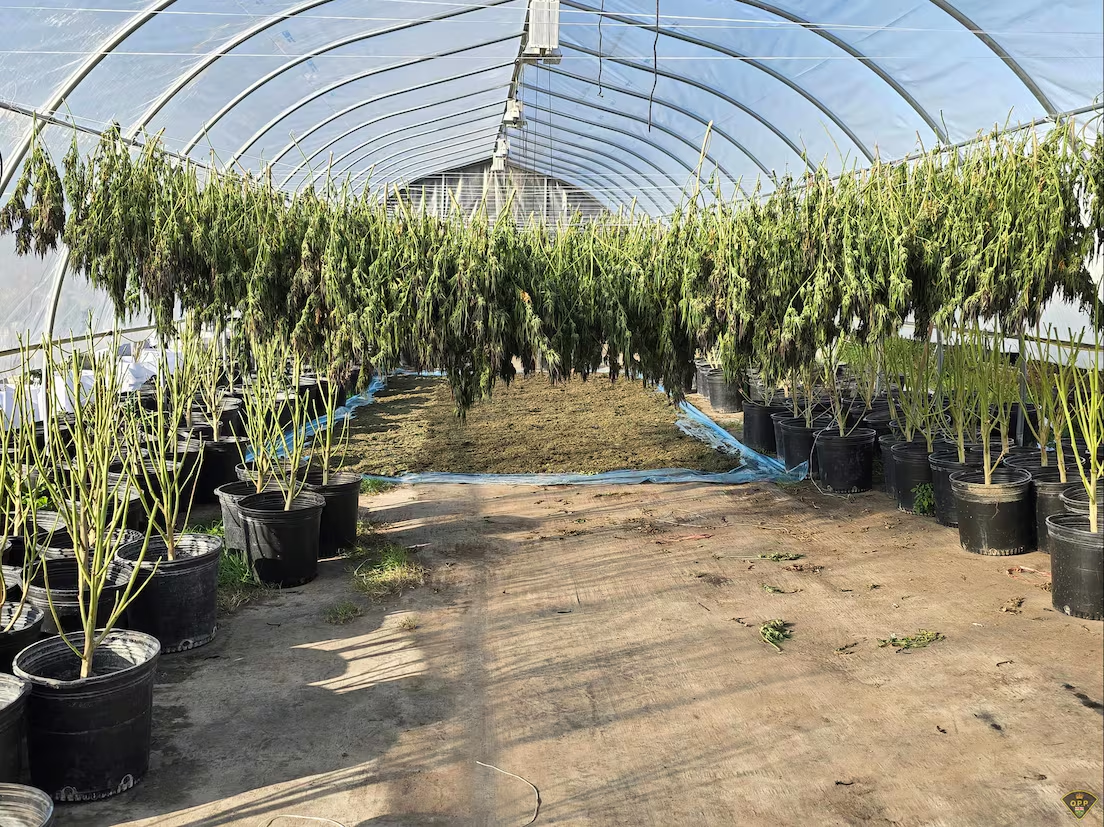
Were these Indigenous growers? In many cases, the answer is yes. Tyendinaga has made public statements for years affirming the right of Mohawk people to control cannabis commerce on their land. The community has hosted meetings, created internal regulatory structures, and attempted to build economic pathways separate from external corporate control. Mohawk dispensaries have operated openly for years. Some have attempted to negotiate with the province. Others refuse provincial oversight entirely because they believe the land is theirs, the authority is theirs, and the economic benefit should also be theirs.
The farms that were raided appear to have included both Mohawk and non-Mohawk participants. Police reports suggest several workers came from outside Ontario. What the police do not clarify is who owned the land and who authorized cultivation. On reserve land, ownership is not individual. In most cases, the land is held collectively or through certificates of possession under Indigenous law. A farm that appears illegal under federal law may have legitimate standing under Mohawk practice. Police statements focused on Cannabis Act offences and alleged links to the unregulated market. They did not publicly explain what, if any, consultation took place with the Mohawk Council of Tyendinaga before the raids.
Sovereignty in Canada exists in a strange limbo. Indigenous nations assert inherent rights to land, governance, and economic development. Canada recognizes those rights in theory, but controls them through federal acts, court rulings, and funding agreements. The Cannabis Act recognizes no Indigenous jurisdiction. Health Canada issues licenses to grow, process, and sell cannabis. Provinces decide where stores open. Indigenous communities are invited to participate only through provincial frameworks unless they negotiate separate agreements. Those agreements are rare and often controversial because they can undermine sovereignty by placing provincial or federal regulators above Indigenous governments.
The raids on Tyendinaga show what happens when a community moves forward without waiting for the federal government to catch up. The community created its own cannabis industry because the federal and provincial systems excluded them. They saw cannabis as a path to economic independence. They saw the federal system as another extension of colonial control. They decided to operate on their own terms. The police enforced the law on federal terms. The conflict was inevitable.
To understand how differently Canada treats Indigenous cannabis businesses, look at the licensing numbers. More than nine hundred federally licensed cannabis operators now run under the Cannabis Act, yet only a small fraction are Indigenous owned or affiliated, and even fewer are based on reserve land. According to federal data, just over fifty licences are connected to Indigenous licence holders out of more than nine hundred across the country. Many Indigenous nations report that Health Canada licensing requirements are expensive, slow, and designed for corporate operations rather than small-scale producers. The cost of compliance is high. The cost of waiting is a lost economic opportunity. Communities that choose to proceed without federal licences are criminalized for asserting what they view as their rights.

Canada’s legalization system did not solve this conflict. It created it. When the government legalized cannabis in 2018, it handed provincial governments enormous control while offering Indigenous nations token consultation. Some nations negotiated their own laws, but most were denied recognition. Manitoba and Saskatchewan have openly stated that Indigenous communities must follow provincial licensing. Ontario has allowed isolated exceptions, but no broad recognition of sovereignty. The message is clear. Indigenous nations may run smoke shops. They may run gas stations. They may run casinos if the province allows it. But cannabis. That belongs to the state.
The irony is that the federal government has already given Indigenous nations the ability to pass bylaws that restrict intoxicants. Communities can prohibit alcohol or cannabis on their land through their own governance processes. What they cannot do, under the federal system as it stands, is have those same bylaws recognized as a complete substitute for federal or provincial cannabis licences. In practice, that means they have the power to say no, but not a clearly recognized power to say yes on their own terms. Sovereignty is conditional and incomplete.
Tyendinaga has challenged that structure for years. Its cannabis shops operate with community recognition even if they lack provincial licenses. The community developed its own regulatory council. It collected fees from businesses to support health and social services. It created its own cannabis economy because the federal one was designed without them. The raids dismantled farms that were part of that local economy. Whether every farm was authorized by the community is a matter of internal politics, but the broader point stands. Canada sent armed officers into a sovereign Indigenous nation to enforce a law written without Indigenous consent.
Supporters of the raids argue that sovereignty cannot shield criminal enterprise. They point to organized crime risks, concerns about unsafe products, and large-scale unregulated production. Those concerns deserve attention. But they are also used to justify denying Indigenous nations the right to control their own industries. It is impossible to separate enforcement from the political struggle over who gets to profit from cannabis. Canada’s legal industry is dominated by corporations with government relationships and stock market valuations. Indigenous growers who attempt to enter the market on their own terms are labeled illegal even when they operate transparently within their own communities.
The question of legality becomes more complex when considering treaties. The Mohawks of the Bay of Quinte are part of the Haudenosaunee Confederacy, whose relationships with colonial governments predate Canada itself. Treaties recognize Indigenous rights to land and economic practices. Court decisions have acknowledged that Indigenous peoples retain rights unless those rights are explicitly extinguished. Canada has not extinguished the right to grow or trade cannabis. Instead, it has created a regulatory system that excludes Indigenous law and uses criminal enforcement to maintain control.
The raids on Tyendinaga will not be the last. Other Indigenous communities across Canada have faced similar conflicts. Millbrook First Nation in Nova Scotia saw police shut down dispensaries. Kahnawake in Quebec has fought provincial attempts to regulate its stores. Several nations in British Columbia operate outside the provincial licensing system but maintain their own strict community rules. The issue is not cannabis. It is sovereignty in the era of legalization.
The path forward is not complicated. Indigenous nations want control over their own cannabis industries. They want revenue to support their communities. They want recognition of their laws and their right to self-determination. They want the federal government to negotiate nation-to-nation instead of requiring them to become franchisees of provincial systems. Health Canada has acknowledged this need but has not acted on it. Provinces have shown even less interest because Indigenous control threatens provincial revenue and regulatory power.
The Tyendinaga raids reveal how fragile Canada’s legalization system really is. It works for corporations. It works for provinces. It does not work for Indigenous nations. When communities create their own systems, the state sends police. When communities ask for recognition, the state delays. When communities assert sovereignty, the state calls it illegal.
The $200 million worth of seized cannabis is not the story. The story is who gets to decide what grows on Indigenous land. The story is what sovereignty means when federal law ignores it. The story is how legalization entrenched inequality by building an industry thaténées
©2025 Pot Culture Magazine. All rights reserved. This content is the exclusive property of Pot Culture Magazine and may not be reproduced, distributed, or transmitted in any form or by any means without prior written permission from the publisher, except for brief quotations in critical reviews.
F O R T H E C U L T U R E B Y T H E C U L T U R E
The Cannabis Lie: Vol. 4 — The Crime Wave Lie
Politicians and pundits warned that legal cannabis would unleash a crime wave. The data tell a different story. From Colorado’s violent crime trends to DOJ time-series research and statewide arrest declines, the evidence shows no consistent long-term surge tied to legalization. The numbers never matched the panic.
South Africa Legalized Weed, But Not the Market
South Africa recognized private adult cannabis use and home cultivation, but never built a legal domestic market around them. With buying and selling still largely outside the law, the illicit trade remains dominant while regulators scramble to set limits, draft rules, and prepare a broader Cannabis Bill that could finally address commerce.
NY’s Legal Weed Market Is Running Out of Weed
New York legalized cannabis and opened hundreds of stores, but regulators now warn the legal market may not produce enough weed to keep them stocked. With nearly 600 stores open and sales nearing $3 billion, the state is discovering that legalization alone does not guarantee a functioning market.
Discover more from POT CULTURE MAGAZINE
Subscribe to get the latest posts sent to your email.

Leave a comment