Filed Under: Lone Star Loopholes, Medical on Paper
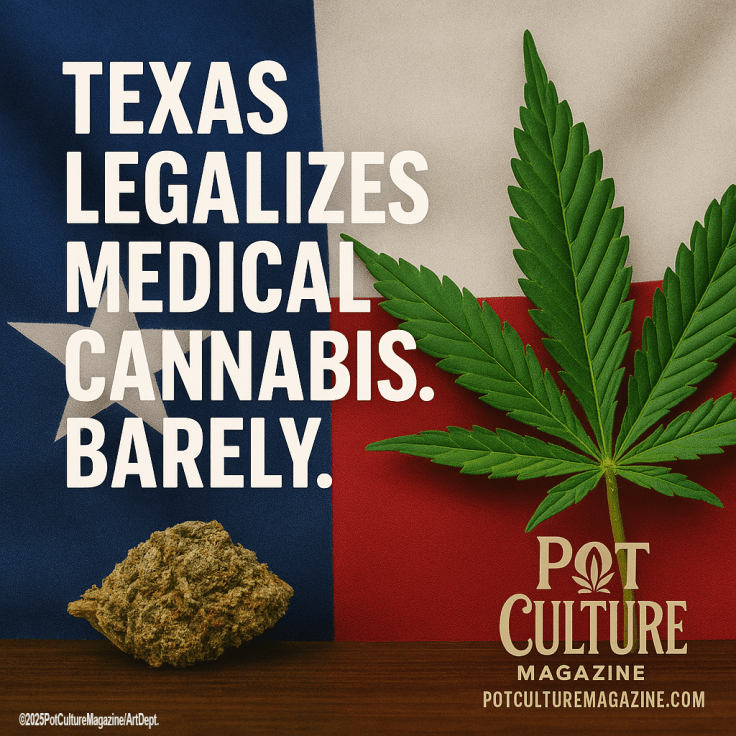
Texas finally joined the club. Kind of.
On Saturday, Governor Greg Abbott signed HB 46 into law, making Texas the 40th state to legalize medical cannabis. Applause echoed through reform circles. National advocates patted backs. Headlines declared victory. But back in Texas, people living with pain, trauma, and chronic illness scanned the fine print and quickly realized something: this law still sucks.
For decades, Texas has operated under the deeply restricted Texas Compassionate Use Program (TCUP). It was so limited that the Marijuana Policy Project (MPP) did not even consider it a legitimate medical cannabis program. Patients could only access cannabis with less than one percent THC, prescribed by a handful of registered doctors, and only for a short list of qualifying conditions. It was less of a program and more of a press release in legal form.
HB 46 was supposed to fix that. To some degree, it does.
The bill expands the list of qualifying conditions to include chronic pain, traumatic brain injury, and Crohn’s disease. It also allows new delivery methods: vaporizers, inhalers, lotions, patches, suppositories, and nebulizers. The previous THC cap of one percent is replaced with a more realistic ten milligrams per dose, and a limit of one gram of THC per package.
That sounds good, until you realize what the law does not do.
There is no allowance for whole flower. Patients cannot smoke or vaporize actual cannabis buds, even with a prescription. Instead, they are limited to processed products manufactured by a small group of highly regulated dispensaries. Only 15 total licenses will be issued across the entire state. For reference, Oklahoma has over 2,800 dispensaries for a population of just four million. Texas has more than 30 million residents and now just 15 licensed outlets.
That disparity is not accidental. It is engineered.

Lieutenant Governor Dan Patrick has long stood in the way of meaningful cannabis reform. He has blocked bills, delayed hearings, and used his platform to question whether cannabis has any medical value at all. While he has not publicly opposed HB 46, his influence is evident in its design. The bill is a compromise tilted toward control, not access.
Lawmakers avoided a voter referendum. They sidestepped full decriminalization. What Texans got instead was a slow, shallow rollout that serves more as a public relations fix than a public health solution.
The Marijuana Policy Project praised the law’s passage, but did not mince words about how long it took and how far it still needs to go. Kevin Caldwell, MPP’s Southeast Legislative Manager, said plainly,
“The existing Texas Compassionate Use Program has been severely limited, leaving countless Texans without the relief they desperately need.”
His sentiment reflects years of failed lobbying efforts, blocked expansion attempts, and a state government allergic to progressive drug policy.
Lauren Daly, Interim Executive Director at MPP, called it “a commonsense policy” that finally allows Texans to use medicine already improving lives in 39 other states. But she, too, acknowledged that HB 46 passed only because of overwhelming public support. Voters have demanded reform for years. Lawmakers finally responded, but just barely.
Polling has consistently shown that a large majority of Texans support medical cannabis access. A University of Texas/Texas Politics Project poll from 2023 found that more than 70 percent of Texas voters back expanding medical cannabis laws. That includes a majority of Republicans. Yet legislative action has lagged far behind public opinion.
Under HB 46, the Department of Public Safety will begin issuing the new licenses. Operators have 24 months to become fully functional. But with the state so vast and the license count so low, patients will likely face long drives, limited product variety, and high costs. Insurance will not cover these treatments. Cannabis is still classified as a Schedule I drug federally, and no protections exist for patients in housing or employment.
Doctors must also register with the state and prescribe under narrow guidelines. That gatekeeping alone will limit access, especially in rural areas. Many Texans will remain outside the program entirely. Others may return to unregulated markets or suffer in silence.
The bill does not legalize adult-use cannabis. Possession of even small amounts without a medical prescription remains a crime. Texas continues to arrest thousands of people each year for minor cannabis offenses. In many counties, diversion programs or citation reforms exist, but in others, especially in rural or conservative jurisdictions, people still go to jail for a joint.
Advocates have been quick to note that HB 46 is a step forward. It is. But steps are measured, and the direction of this one is cautious at best.
Several states have taken similar approaches and later expanded. Florida began with a limited CBD program and now has a multi-billion-dollar medical cannabis market. Arkansas, once among the most restrictive states, has slowly broadened its patient access and dispensary network. Texas could follow that path. But with Lt. Gov. Dan Patrick still holding the reins, that future is uncertain.
Texas’s medical cannabis law now technically qualifies under national standards. It clears the Marijuana Policy Project’s threshold. It puts the state on reform maps. But for patients, caregivers, and providers, it is still a far cry from meaningful access.
© 2025 Pot Culture Magazine. All rights reserved. This content is the exclusive property of Pot Culture Magazine and may not be reproduced, distributed, or transmitted in any form or by any means without prior written permission from the publisher, except for brief quotations in critical reviews.
Discover more from POT CULTURE MAGAZINE
Subscribe to get the latest posts sent to your email.
