Filed Under: You Smell That, Officer?
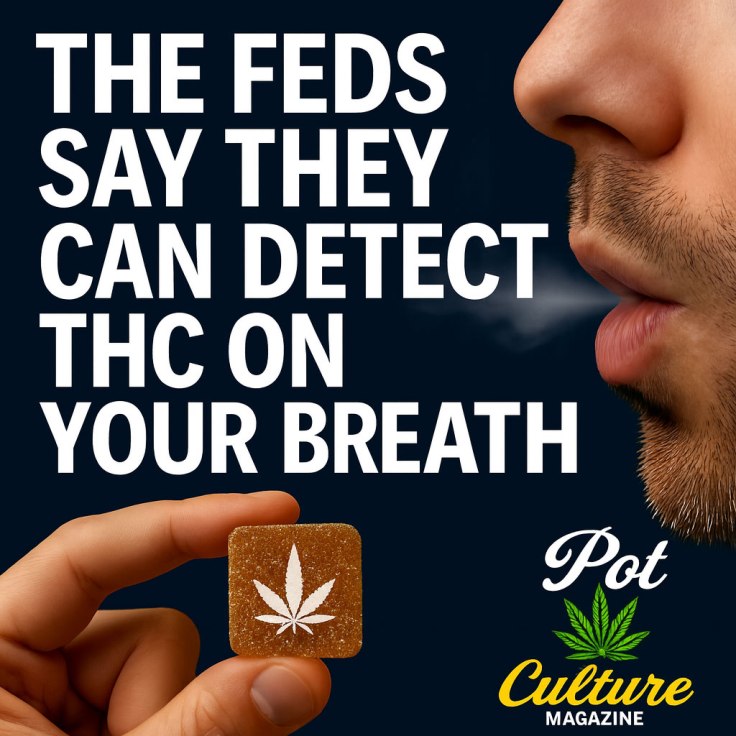
The feds say they can smell your weed now. Not in the back of your car, not in your hoodie, not in the stale resin stink you’ve grown nose-blind to, but in your breath. Even if you ate it. Even if you waited hours. Even if you weren’t high anymore.
Earlier this month, the National Institute of Standards and Technology, or NIST, published a study in the Journal of Analytical Toxicology claiming they’ve pulled off a first: detecting THC in human breath after someone consumed an edible.
“This is an important step forward,” said NIST chemist Jennifer Berry in the agency’s press release.
But what exactly are we stepping into? Science, or surveillance.
The test group? Twenty-nine volunteers, all hauling in their own gummies and brownies, which ranged from 5 milligrams to 100 milligrams of THC. No potency verification, no controlled dosing. Just DIY snacktime for science. Breath samples were taken before and at intervals of 47, 92, and 180 minutes after consumption. Participants were also instructed to stay off edibles for 12 hours, and off smoked weed for 8. Still, 27 of them lit up the results before even taking a bite.
The outcome was a mess of variance. Nineteen saw THC levels go up. Four stayed flat. Six went down. The drop-offs? They started with the highest pre-edible levels. Which only proves one thing. If you use cannabis often, you’re always carrying a chemical echo. That’s not intoxication. That’s memory baked into your breath.
“The research supports the idea that multiple breath samples over time could help determine recent cannabis use,” said Tara Lovestead, one of the chemical engineers leading the work.
Multiple tests, varying thresholds, no standardized calibration. And still, they’re planning to hand this off to prosecutors.
NIST is not building a breathalyzer, but they are creating the scientific stage for one. In September, they’re expected to host a summit with tech companies and legal officials to figure out how to spin this into policy gold. The original date was in April. The delay? Unexplained.
Here’s what’s never said plainly. There is no consistent correlation between THC presence and cannabis impairment. THC doesn’t behave like alcohol. It metabolizes differently, lingers longer, and varies wildly depending on the user. Someone could test clean and be zonked. Someone else could test hot and be clear as glass.
In 2023, a joint report from NIST and the University of Colorado Boulder stated that THC in breath, measured once, could not reliably confirm recent use.
“States may need to get away from the idea that blood or breath THC levels alone can prove impairment,” said Frances Scott from the Department of Justice.
Advertisment
F O R T H E C U L T U R E B Y T H E C U L T U R E
Zurich’s Black Market Problem
Zurich’s Züri Can pilot is giving cannabis reformers something stronger than slogans. New interim findings show regulated, nonprofit access reduced several reported health problems while pulling demand away from the…


Vegas Knew, Vegas Looked Away
Las Vegas sold tourists the illusion of legal cannabis while fake dispensary style hemp shops operated near the Strip. Vegas Knew, Vegas Looked Away exposes how Nevada’s casino separation rules,…
Advertisment
Research from The Lancet, NHTSA, and other agencies confirms what people in the real world already know. There’s no reliable link between THC numbers and actual driving ability. Despite that, most states enforce per se limits—hard thresholds like five nanograms per milliliter—that carry legal weight without scientific support.
And we know who that burden falls on.
Black Americans are arrested nearly four times as often for cannabis as white Americans, despite similar use. In places like Chicago, legalization hasn’t stopped disproportionate policing. And tribal cannabis operators continue to be raided despite staying within state guidelines.
A THC breath test won’t correct this imbalance. It’ll just arm it with new ammo.
Detection is easy. Interpreting it without bias is not.
You can test positive without being impaired. You can fail a test without being a danger. And that line between presence and performance is where enforcement goes off the rails. Because if cops and courts start using your breath to judge your state of mind, you better believe it won’t be used equally.
So no. We’re not applauding NIST for breaking new breath science. We’re asking who this test actually helps. Because it’s not medical patients. It’s not recreational users. It’s not anyone who’s ever had to fight a charge from the passenger seat of their own life.
“This isn’t safety,” one advocate told us off-record. “It’s a new version of stop and frisk. But now it smells like bubblegum gummies.”
This is not about impairment. It’s about control. And if you think cannabis breath testing is going to make the roads safer and the laws fairer, you haven’t been paying attention.
©2025 Pot Culture Magazine. All rights reserved. This content is the exclusive property of Pot Culture Magazine and may not be reproduced, distributed, or transmitted in any form or by any means without prior written permission from the publisher, except for brief quotations in critical reviews.
F O R T H E C U L T U R E B Y T H E C U L T U R E
CANNABIS LIES Vol. 10: The Medical Lie
For decades, federal policy claimed cannabis had no accepted medical use while opioid prescriptions moved through the health care system by the tens of millions. Cannabis Lies Vol. 10 exposes…

Jersey’s New Cash Crop
Jersey reinvented itself. A forty-five square mile island once known for offshore finance is now exporting pharmaceutical-grade cannabis into Germany’s booming medical market. With strict regulation, heavy investment, and a…

A State of the Union on the State of Cannabis Media
Cannabis media is undergoing a predictable institutional decay. The movement’s original architects have transformed from revolutionary contributors into defensive gatekeepers, protecting their legacy rather than fostering future growth. This manifesto…
Discover more from POT CULTURE MAGAZINE
Subscribe to get the latest posts sent to your email.

Leave a comment