Filed Under: Hemp Hysteria
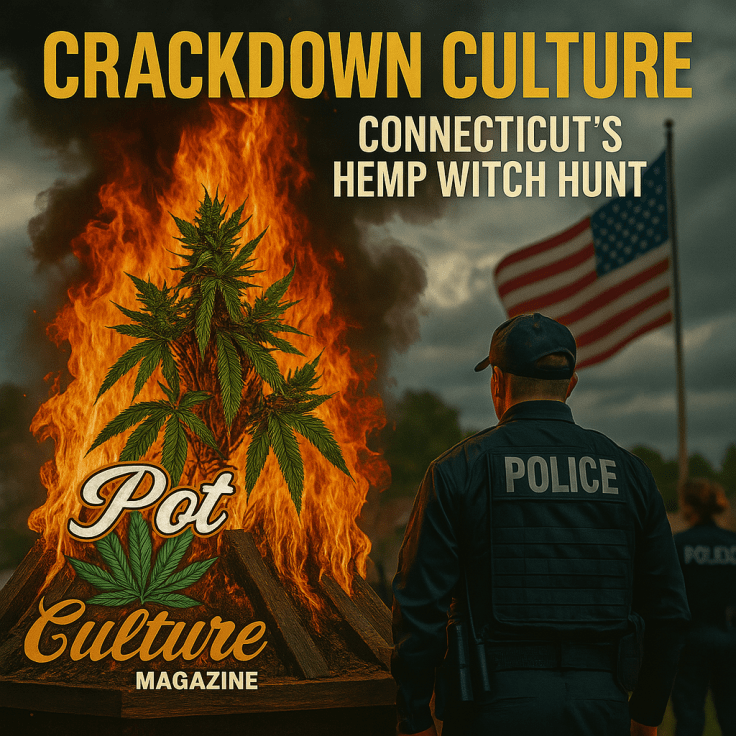
Connecticut wants you to believe this crackdown is about public safety. But what it really looks like is highway robbery with a badge. Armed state agents are storming local smoke shops, seizing gummies and carts, and slapping felony charges on people who played by federal hemp rules since 2018. Welcome to a new era of prohibition dressed in legalization colors.
Shop owners say they are being set up. Kristin Souza watched her livelihood vanish overnight. Selling federally legal hemp products with full disclosure was her business. Then Connecticut rewrote definitions, slashing THC thresholds so low that products once considered harmless now carry criminal labels. No warning, just raids.
“It essentially criminalized my entire product line … It essentially closed me and put me out of business.” — Kristin Souza
State officials argue this is consumer protection. They point to gummies that mimic child-friendly treats and carts with no proof of testing. That sounds reasonable until you dig deeper. This blanket enforcement wipes out small operators and leaves the field open for big corporate dispensaries with deep pockets and airtight legal teams.
It isn’t just Souza. In East Haven, Planet Zaza was raided and fined nearly five million dollars for selling products with THC levels Connecticut had just decided were too high. The shop’s owner said he never got so much as a warning letter. One week he was selling legal gummies under the Farm Bill. The next, his storefront was swarmed with armed officers who treated him like he was running a fentanyl ring.
“The State of Connecticut is not playing around. Legal cannabis is not a free‑for‑all. If you are unlicensed, if you sell untested, unregulated cannabis, we will find you and we will hold you accountable.” — AG William Tong
Connecticut’s legislature rammed through House Bill 7181 in June, creating a new hemp regulatory division and giving state agents expanded seizure powers. It limited THC content to one milligram per serving or ten milligrams per package, a standard so strict even CBD tinctures could violate it. That standard effectively criminalizes almost every full-spectrum hemp product on the market. If you can’t taste it, it’s probably illegal in Connecticut.
“This isn’t about safety. It’s about protecting the state’s cannabis cartel.” — Genevieve Park Taylor, civil rights attorney
FOR THE CULTURE BY THE CULTURE
CANNABIS LIES Vol. 5: The Gateway Lie
For decades, politicians have claimed marijuana is a gateway to heroin and harder drugs. Federal youth surveys, NSDUH data, and NIDA’s own language tell a different story. Cannabis use is…

The Study That Pretends Cannabis Does Nothing
A new cannabis study claims marijuana does nothing for anxiety, depression, or PTSD. The reality is far more complicated. Decades of federal restrictions, limited research access, and synthetic substitutes have…
By spring 2025, the crackdown was everywhere. Norwalk police raided a vape shop and arrested its owner after finding marijuana and THC products being sold illegally. In Bridgeport, officers found far more than mislabeled gummies. A raid on G’s Smoke Shop uncovered hallucinogenic mushrooms, a loaded gun, and one hundred sixty-five thousand dollars in cash hidden on the premises. Photographs from these raids show display cases of colorful cannabis-infused candies and vapes being hauled away in evidence bags.
People are not smoking cannabis, they are smoking chemicals, said one New York City sheriff after a NYC raid on a similar shop. The statement resonated because Connecticut’s regulators are borrowing playbooks from New York, where Mayor Eric Adams’s task force swept seventy-five shops in a single week. Surprise inspections and padlock orders became standard operating procedure, and now Connecticut’s own “hemp squad” is carrying out the same playbook with ruthless efficiency.
There is no warning to offenders. Enforcement teams strike fast and hard. The aim is not only to seize illegal products but to make it hurt financially. Unlicensed vendors in Connecticut face thirty-thousand-dollar civil fines per violation. Landlords can be fined ten thousand dollars if they knowingly lease to an illegal cannabis shop. Courts are authorized to seize cash registers, inventory, and ill-gotten profits on the spot.
Three years after Connecticut legalized adult-use cannabis, the legal market has struggled to compete with a proliferation of under-the-radar dealers. People in licensed dispensaries are at a real disadvantage when gas stations and smoke shops sell products with no oversight. Regulators say this isn’t a debate about cannabis or not. This is about public safety. Legal cannabis is not a free-for-all.
But for small operators, this feels like a betrayal. Connecticut lawmakers promised equity when legalization passed. Now they are raiding minority-owned shops and crushing immigrant entrepreneurs in the name of public health.
The tension isn’t limited to Connecticut. Across the country, a quiet war is being waged in strip malls and bodegas. New York City is deploying padlock teams and issuing million-dollar fines. Minnesota regulators are confiscating hemp flower sold as “legal weed” and destroying thousands of pounds of inventory. Texas lawmakers tried to ban all intoxicating hemp compounds until Governor Greg Abbott vetoed the bill, warning of constitutional challenges.
Federal courts are siding with the states. Judges have upheld delta-8 bans in Arkansas and Virginia, rejecting claims that the Farm Bill protects intoxicating hemp derivatives. The legal momentum favors state authority. Congress never promised a free market for hemp gummies and THC-O vape pens. The Farm Bill was about agricultural hemp and CBD, not a workaround for marijuana laws.
In Connecticut, smoke shop owners are still fighting back. A federal lawsuit filed by several operators alleges that Connecticut’s milligram caps violate the Farm Bill and amount to discrimination. Discovery is ongoing, and a court date is expected later this year.
By then, it may be too late for shops like Souza’s. She closed her CBD store for the last time, her inventory seized, and her business destroyed.
“They essentially criminalized my entire product line … and put me out of business.” — Kristin Souza
The crackdown isn’t about safety. It’s about power. Regulators and politicians talk about protecting kids, but in practice, they are protecting corporate cannabis and killing off anyone who refuses to play by their rules. Legalization was supposed to end the war on drugs. Instead, it created a new one.
©2025 Pot Culture Magazine. All rights reserved. This content is the exclusive property of Pot Culture Magazine and may not be reproduced, distributed, or transmitted in any form or by any means without prior written permission from the publisher, except for brief quotations in critical reviews
Discover more from POT CULTURE MAGAZINE
Subscribe to get the latest posts sent to your email.

Leave a comment