Filed Under: Legal for Some, Locked Out for Others
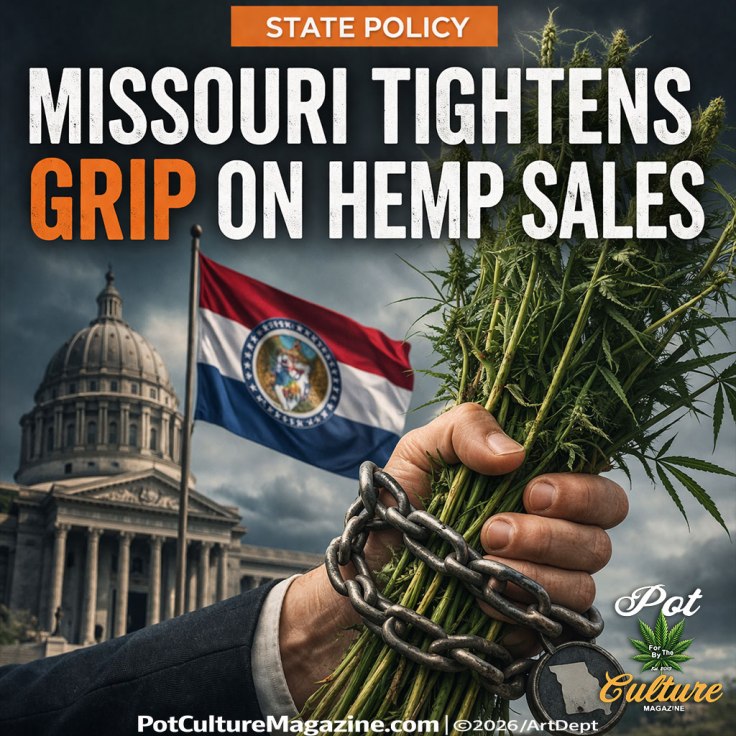
Missouri voters approved the adult use marijuana in November 2022. Adult sales began on February 3, 2023. The state did not tiptoe into legalization. It built a regulated market, issued comprehensive licenses, and let adults buy cannabis from dispensaries in plain sight. Missouri’s own health department** marks November 8, 2022, as the Amendment 3 vote and February 3, 2023, as the start of adult use sales.** When that launch arrived, NORML argued that a robust legal market could pull consumers away from unregulated sales and toward lab-tested products sold at competitive prices.
That history clears away one lazy frame before the piece gets very far. Nobody in Jefferson City can honestly claim this is still a fight over whether adults should have access to intoxicating cannabis. Adults already have that access. They can walk into a licensed dispensary and buy it. The battle around HB 2641 lands somewhere else, in the colder zone where legalization turns into a contest over control, channel, and whose license counts.
The enrolled bill is blunt. HB 2641 says the cultivation, production, manufacturing, testing, transportation, and retail sale of intoxicating hemp-derived cannabinoid products in Missouri shall be conducted solely by entities licensed under Article XIV of the Missouri Constitution. The same section folds those products into the marijuana framework. A few lines later, the bill makes the enforcement threat plain. Unauthorized commercial activity in violation of the section can bring a five-thousand-dollar fine per transaction and a class D felony. Casual possession is not what the bill is targeting there. Commerce is.
No one should confuse that with a housekeeping bill. The state is not just adding labels, adding age gates, or telling stores to move a few gummies behind the counter. It is trying to reroute a whole category of intoxicating hemp commerce into the existing marijuana system and punish businesses that keep selling outside it. Once the structure is laid out that clearly, the angle stops being abstract. Missouri legalized cannabis, then moved to build a wall around who gets to profit from it.
Supporters have an argument, and it needs to be stated accurately before it gets cut apart. Backers say intoxicating hemp products have been sold too loosely, too widely, and too often in places that are not built like dispensaries. They argue that children can access them too easily, labels are inconsistent, and the safest course is to force intoxicating products into the same tightly regulated system already used for marijuana. Missouri’s House summary** says proponents framed the bill as a compromise to keep intoxicating cannabinoids out of the hands of children while matching an anticipated federal shift.** The same summary says supporters argued that treating those products as marijuana would subject them to the testing and regulatory standards already used in the state’s licensed cannabis market.
“What my bill does is it aligns with the new federal definition of hemp, and it puts it in there exactly as the federal definition is.”
That remains a supporter’s claim, not a settled description of the legal landscape. Federal policy around intoxicating hemp products is still in motion. Missouri, by contrast, wrote its own threshold and framework into HB 2641. When the bill cleared the legislature on April 3, St. Louis Public Radio reported that Governor Mike Kehoe had already treated the legislation as a priority during his January State of the State address. The same report said the bill would prohibit sales of intoxicating hemp products, including THC seltzers and hemp-derived THC edibles, everywhere except licensed marijuana dispensaries.
A serious cannabis publication does not need to lie about the weak spots in the hemp market. There are weak spots. Age restrictions make sense. Testing makes sense. Clear labels make sense. Candy-styled products sold with sloppy oversight deserve scrutiny. NORML has spent years arguing that consumers should have access to regulated, lab-tested products and that legal markets should not be confused with the worst examples of the gray market. Even so, a call for regulation is not the same thing as a call to hand the whole category to existing dispensary operators.
HB 2641 goes much further than cleanup.
Missouri sets its own threshold in the bill text. Under the enrolled language, a final intoxicating hemp-derived cannabinoid product falls inside the act if it contains more than four-tenths of one milligram combined total per container of tetrahydrocannabinols, including THCA, and any other cannabinoids with similar effects or marketed as having similar effects as tetrahydrocannabinol, as determined or designated by the U.S. Secretary of Health and Human Services. That number is Missouri’s statutory line in HB 2641. It should not be confused with a fully settled federal rule that is already in force. Missouri lawmakers and supporters have talked about federal alignment, but the state chose to write this threshold into its own law.
The same bill also targets products that contain cannabinoids not naturally produced by the plant, cannabinoids synthesized outside the plant, and smokable or vapeable products made from raw flower or bud material that contain any amount of tetrahydrocannabinolic acid. Non-intoxicating hemp products such as fiber, grain, and compliant CBD are not all swept into Article XIV by default. The sharpest force lands on intoxicating hemp-derived cannabinoid products and related commercial activity. That distinction matters for precision, especially in a story where supporters are already trying to frame the bill as a simple cleanup measure.
Taken together, the definitions are broad enough to flatten most of the intoxicating hemp market as consumers currently know it. When that point appears in this article, it needs grounding. Craig Katz of the Missouri Hemp Trade Association supplied it. KBIA** quoted him saying that “95% of the hemp industry in Missouri will be hurt by the legislation.”** He also put the economic logic in plain English:
“By putting these products into marijuana dispensaries, you’re eliminating competition for those dispensaries, which results in prices going up.”
That is the source for the wipeout claim. It is not decorative rhetoric from the magazine. It is the market’s own warning, stated on the record.
The damage would not stop at the counter. Farmers have planting decisions to make months before any final sale. Processors have inventory to move. Small CBD shops, wellness retailers, and hemp beverage sellers need to know whether the category they built their business around will still exist in recognizable form by the next season.
“As of right now, we do not have a plan to grow for this coming year because everything is up in the air.”
Katz warned that farmers face a brutal choice. Plant and risk harvesting something that becomes commercially useless under the new system, or hold back and choke the supply chain before the law even takes effect.
Lawmakers recorded the split in plain language during testimony. Supporters leaned on child safety, claimed federal alignment, and argued that intoxicating cannabinoids belong in the dispensary system. Opponents answered from a different place. The House summary says critics argued the bill would drive responsible retailers out of business, destroy jobs, chill entrepreneurship, and eliminate an industry that has already been asking for sensible regulation for years. The same summary records a sharper complaint that the marijuana industry was using the moment to protect its own interests instead of backing a fair regulatory framework. Testimony came from the Hemp Beverage Alliance, the Missouri Hemp Trade Association, and other businesses asking the state to regulate rather than erase.
That is where the cleanest angle lives. Missouri did not decide that cannabis was too dangerous. Missouri decided who gets to sell a legal intoxicating cannabis adjacent product and who does not.
The hypocrisy gets easier to spot once the state’s own marijuana system enters the frame. Adults over twenty-one can already buy potent marijuana flower, concentrates, vapes, and edibles from licensed dispensaries. The Missouri Department of Health and Senior Services says adult sales began in February 2023 and that hundreds of medical facilities converted to comprehensive licenses. A state that already tolerates and taxes an adult-use marijuana market is now treating competing hemp-derived intoxicating products as unacceptable unless they move through the exact same gated system. It is not a moral stand. It is channel protection.
Even NORML’s Missouri launch statement helps sharpen the contradiction. When adult sales began, Paul Armentano said a robust, above-ground retail marijuana market was necessary to disrupt the unregulated marketplace and ensure access to lab-tested, high-quality products at competitive prices. Competitive prices. Those words do heavy work here. Competition disciplines markets. Competition broadens access. Competition limits the ability of a smaller pool of favored operators to set the terms. Katz’s warning about prices rising once intoxicating hemp products are forced into dispensaries is not some abstract talking point. It collides directly with the logic NORML used when Missouri launched legal sales in the first place.
The strongest pro-hemp quotes in the public record also come from Missouri itself.
“Missouri’s hemp industry is facing one of the most serious threats we have seen.”
The group’s statement cut even deeper from there:
“HB 2641 is being presented as regulation, but buried language could wipe out nearly every hemp product category except drinks by November 12, 2026. This would happen even if federal law allows those products. That is not alignment. That’s elimination.”
Rep. LaKeySha Bosley, a St. Louis Democrat who voted against the measure, framed it from the local business side.
“You’re now putting mom and pop shops out of business in rural communities where they already do not have access to healthcare. It is a problem. Let’s regulate it properly.”
Those quotes give the article the spine it needs. None of them denies that regulation is necessary. They accuse lawmakers of choosing the most destructive form of it.
The U.S. Hemp Roundtable has gone even harder, though its language belongs in the piece only as advocacy, not as neutral fact. On its Missouri action page, the Roundtable calls HB 2641 a legislative “poison pill” designed to dismantle the open market and forcibly reclassify legal hemp-derived products as marijuana. It also calls the bill a “structural power grab” that would hand “a total monopoly to a few politically connected corporations.” That is campaign language, not courtroom language, but it reflects how national hemp advocates are reading Missouri’s move. They are not treating this as a minor compliance update. They are treating it as a template for how a legal cannabis state can absorb and neutralize a rival cannabinoid market.
One detail deserves sunlight because it gets smoothed over too easily. The bill’s November 12, 2026, effective date is not random. St. Louis Public Radio reported that Sen. Karla May pushed the effective date from August to November 12, tracking an anticipated federal regulatory shift.
“The feds made it November 12. They’re giving people time.”
The date reflects expected federal movement, not guaranteed final federal enforcement reality. Missouri still chose to write its own system around that expectation. If Congress later changes course and allows some intoxicating hemp products under federal law, the bill still routes those sales into licensed dispensaries. The destination does not change. Only the schedule does.
That detail weakens the softest version of the state’s defense. Lawmakers are not merely trying to avoid conflict with federal law. They are building a Missouri-specific structure that keeps the dispensary wall standing even if Washington softens later. The bill tells the truth. The talking points don’t.
They had cleaner options. The state could have imposed a firm age floor of twenty-one, required testing, tightened packaging, forced ingredient disclosure, and punished bad actors hard. Lawmakers could have built a separate hemp retail framework with inspections and real enforcement. They chose the more restrictive path anyway. Instead of regulating the category where it stood, they built a funnel and pushed commerce toward existing marijuana licensees.
That choice tells you exactly what modern legalization has become. Politicians like tax revenue and the appearance of reform. They also like saying they are no longer prohibitionists. A rival supply chain with independent operators, lower prices, broader shelf presence, and products outside the favored license class is a different problem. Consumer protection enters the room. Children enter the room. Public safety enters the room. Some of those concerns are real. They can also serve as cover for market consolidation. Missouri’s own record leaves room for both truths at once.
Missouri already proved it can live with legal weed. HB 2641 suggests the state is far less comfortable with legal competition. The plant stays above ground. The market gets narrower. One set of storefronts becomes respectable by statute. Another set gets told to step aside or face felony level exposure for unauthorized commercial activity.
That is not prohibition in the old style. It is something more polished than that. Same instinct, better tailoring.
©2026, Pot Culture Magazine. All rights reserved. This is the property of Pot Culture Magazine and is protected by U.S. and international copyright laws. Unauthorized reproduction, distribution, or transmission of this work, in part or in whole, without the express written permission of Pot Culture Magazine is strictly prohibited.
F O R T H E C U L T U R E B Y T H E C U L T U R E
CANNABIS LIES Vol. 7: The Mental Health Panic
Cannabis and mental health risks are often overstated in public debate. Research shows heavy use and high THC exposure can increase psychosis risk in vulnerable individuals, but widespread claims of a mental health crisis lack strong evidence. This piece examines the data, separates correlation from causation, and breaks down what cannabis users need to know.


IDAHO TRIES TO STOP A VOTE BEFORE IT STARTS
Idaho lawmakers passed a resolution urging voters to reject a medical cannabis initiative before it reaches the ballot. The move highlights how officials are shaping public opinion ahead of a vote, while maintaining strict prohibition and blocking even limited access for patients.
MS LIMITS MEDICAL CANNABIS WHERE IT MATTERS MOST
Mississippi maintains strict limits on medical cannabis after Governor Tate Reeves vetoed expansion bills on March 26, 2026. Patients remain unable to use cannabis in hospitals while eligibility and access rules stay tightly controlled. This feature examines what the veto blocks, how it affects patients, and what it means for the state’s growing cannabis market.
Discover more from POT CULTURE MAGAZINE
Subscribe to get the latest posts sent to your email.

Leave a comment