Filed Under: Medical Access Denied
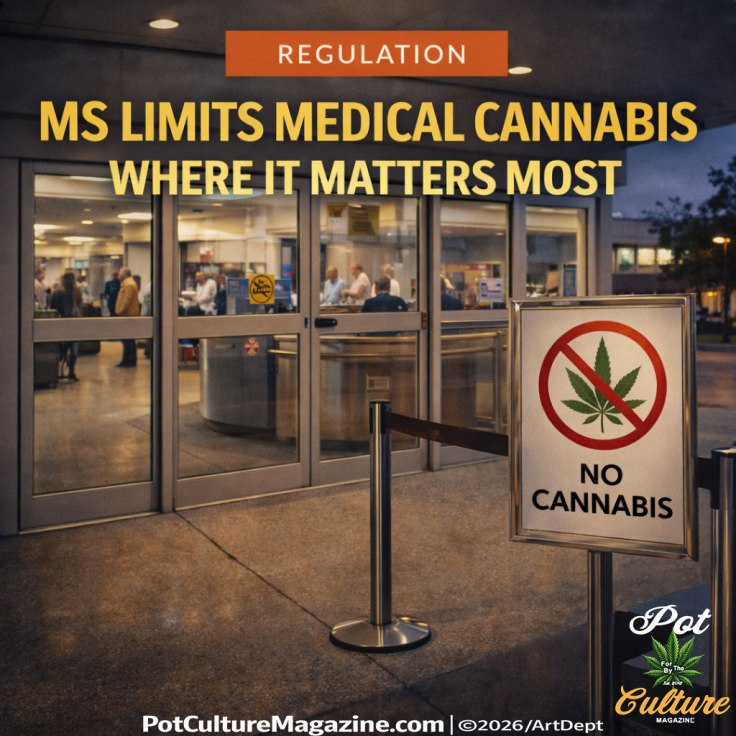
Mississippi has a medical cannabis program that allows qualifying patients to legally obtain and use cannabis under state law. It does not follow patients into the places where care is most critical.
On March 26, 2026, Governor Tate Reeves vetoed two bills that would have expanded access, HB 1152 and HB 895, both passed by large margins in the Legislature. The decision leaves the current system intact, including its most visible gap. Patients can legally use cannabis, but not inside hospitals, nursing homes, or hospice care.
The veto did not create that restriction. It leaves it untouched while rejecting other changes that would have expanded access around it.
HB 1152 aimed to expand access by allowing physicians to petition the state for patients with serious or terminal conditions that are not on Mississippi’s fixed qualifying list. The bill targeted a narrow problem. Some patients suffer from conditions that do not match the state’s categories but produce the same symptoms as those that do.
Reeves acknowledged the intent but rejected the outcome.
“[The bill] could broaden eligibility beyond the program’s intended scope… and poses an unreasonable risk of pushing the medical marijuana program in the direction of facilitating recreational use.”
In his veto message, he warned that the change could open access too broadly and weaken the distinction between medical and recreational use.
NORML had supported the bill before the veto, noting it would give physicians greater discretion to recommend medical cannabis and expand access for patients who fall outside the state’s fixed qualifying list.
HB 895 included provisions to remove mandatory six-month physician recertification requirements, adjust caregiver rules, and modify THC-related limits.
Reeves rejected those changes as well.
“[The bill] seeks to erode three important safeguards.”
He pointed to physician follow-up, caregiver oversight, and potency limits as controls that keep the program tied to medical use.
Those controls remain in place.
Mississippi’s program continues to operate with a fixed list of qualifying conditions. Patients who fall outside that list cannot enter the system, regardless of severity. Doctors cannot override that limitation.
The same applies to hospital access.
A patient can be fully compliant with state law and still lose access to medical cannabis during a hospital stay. Most healthcare facilities do not allow its use on-site. Staff cannot administer it. Storage creates liability concerns. Federal law continues to classify cannabis as illegal, which shapes how hospitals manage risk.
That reality has not changed.
A separate bill, HB 1034, would have expanded access for patients in hospice or end-of-life care settings, including non-smoking forms. It passed the House. It did not advance in the Senate. It never reached the governor.
Nothing in the current law bridges that gap.
Patients who rely on cannabis for symptom management may have to stop when they enter a hospital. Others attempt to work around facility policies, often without clear guidance from providers who are bound by institutional rules.
Advocates say the veto compounds that problem.
The Marijuana Policy Project said both bills had broad legislative support and described the veto as a setback for patients who need expanded access. Advocates focused on the physician petition pathway in HB 1152, which would have allowed doctors to make case-by-case decisions instead of relying on a fixed list.
Opposition to expansion came from a different angle.
Mississippi State Health Officer Dr. Daniel Edney warned that expanding eligibility too far could shift the program away from its intended purpose. That concern was echoed in the governor’s veto language.
“Shifts the intent… away from giving Mississippians the ability to access medical cannabis when all other options have failed.”
The disagreement is not about whether the program exists. It is about how far it should go.
Mississippi’s medical cannabis system is growing within its current limits.
According to state reporting from the Mississippi Medical Cannabis Program, active patients increased from roughly 49,600 in 2024 to 66,041 in 2025.
Sales reached approximately $118.7 million.
Data from the Mississippi Department of Revenue indicate the state collected about $9.0 million in sales tax and $2.18 million in excise tax.
The market is established. Participation is rising. Revenue is measurable.
Expansion would likely increase all three.
Adding patients through HB 1152 would have expanded the pool beyond the current qualifying list. Easing administrative requirements through HB 895 would have reduced friction for existing participants. Modifying THC-related limits would have allowed broader product availability for patients who need it.
Those changes did not move forward.
Reeves’s position is consistent with his past approach to cannabis policy. He supported implementing a medical program after voter approval, but he has resisted efforts to broaden its scope. His veto messages focus on maintaining structure, limiting access to defined medical conditions, and preventing the program from expanding beyond that boundary.
That approach keeps the program controlled.
It also keeps its boundaries intact.
Mississippi now has a medical cannabis system that functions within those boundaries. It serves a defined group of patients, generates revenue, and continues to grow.
It also leaves gaps that patients and providers are still navigating.
Access depends on where a patient is, what condition they have, and how closely that condition aligns with the state’s list.
The law allows medical cannabis.
The system determines when and where it applies.
©2026, Pot Culture Magazine. All rights reserved. This is the property of Pot Culture Magazine and is protected by U.S. and international copyright laws. Unauthorized reproduction, distribution, or transmission of this work, in part or in whole, without the express written permission of Pot Culture Magazine, is strictly prohibited.
F O R T H E C U L T U R E B Y T H E C U L T U R E

CANNABIS LIES Vol. 6: The Driving Apocalypse Lie
Legal cannabis is often blamed for rising traffic deaths, but federal data tells a more complicated story. NHTSA findings, toxicology limitations, and conflicting crash studies reveal that THC presence is not a reliable measure of impairment. This investigation breaks down how flawed testing and policy shortcuts have shaped the narrative around so-called stoned driving.


Thailand Lost Control
Thailand blew open its cannabis market, then tried to force it back under control. This feature tracks the country’s shift from prohibition to medical legalization, decriminalization, and regulatory backlash, exposing how weak enforcement, political pressure, and rushed policy turned a reform headline into a live case study in state correction.

Texas Is Moving to Shut Down the Hemp Market
Texas helped build one of the largest hemp THC markets in the country, then moved to shut it down. As regulators tighten rules and enforcement increases, businesses are left exposed, and the future of hemp-derived cannabinoids hangs in the balance. This is not a simple crackdown. It is a full policy reversal with real economic…
Discover more from POT CULTURE MAGAZINE
Subscribe to get the latest posts sent to your email.

Leave a comment