Filed Under: A Legal Plant in an Illegal Market
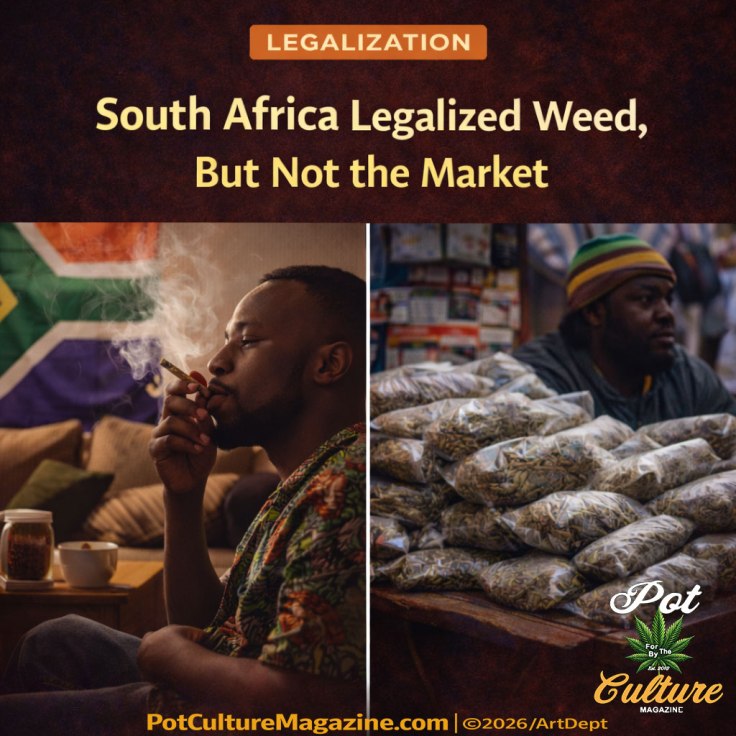
South Africa legalized private adult use, then left buying and selling mostly illegal. Adults can possess cannabis. They can grow it for themselves. The country’s highest court made that clear years ago.
Try to buy it, though, and the law suddenly becomes much less certain.
That contradiction sits at the center of South Africa’s cannabis policy today. A person can legally keep cannabis at home. Growing a few plants for personal use is allowed. But once money enters the picture, the clarity starts to fade. Buying and selling cannabis still live mostly outside the law, leaving the underground market to handle the supply that legalization never organized.
That is what makes South Africa worth watching. Reform did not arrive as one clean legislative package. It came in pieces. Judges moved first. Parliament followed. Regulators are now trying to define the daily rules after the culture had already adjusted to a world where private cannabis use was no longer treated like straightforward criminal conduct.
The break with prohibition began in court, not in Parliament. On September 18, 2018, the Constitutional Court of South Africa ruled in Minister of Justice and Constitutional Development and Others v Prince that criminalizing adult use or possession of cannabis in private for personal consumption, and cultivation in a private place for personal consumption, violated the constitutional right to privacy. The court suspended its order for 24 months so Parliament could rewrite the law, while also granting interim relief so adults would not remain exposed to prosecution during the transition.
The judges also made clear where their role stopped. The Constitutional Court did not set quantity limits and left those limits to Parliament and the executive. That decision continues to shape the debate around possession limits, cultivation rules, and enforcement.
Parliament’s legislative response arrived later. The Cannabis for Private Purposes Act, 2024 (Act No. 7 of 2024) was enacted to respect the right to privacy of an adult person to use or possess cannabis, regulate adult use and possession, prohibit dealing in cannabis, and provide for the expungement of certain criminal records.
The Act created a legal framework for private cannabis use. Adults may possess cannabis for personal use. Adults may cultivate cannabis in a private place for personal consumption. Transportation and storage fall within that private-use framework once detailed regulations are finalized.
The same law draws a sharp line around commerce. Commercial cannabis trade remains largely prohibited domestically under current South African law, though exports are permitted through licensing under existing frameworks.
HELP POT CULTURE MAGAZINE STAY ALIVE, AND INDEPENDENT
That distinction defines the current system. A person with privacy, space, and time can attempt to remain within the law by cultivating cannabis at home. Most people do not live that way. They buy. When a legal supply chain does not exist, the existing market continues to supply demand.
South African lawmakers have now acknowledged that reality publicly. On March 6, 2026, the Portfolio Committee on Trade, Industry, and Competition stated that private use of cannabis is legal for adults, commercial trade remains largely prohibited, and the sector is therefore dominated by the illicit market. The same committee cited estimates placing the illicit cannabis market at approximately R36 billion.
Government departments are now attempting to clarify the operational rules surrounding private use.
****On February 2, 2026, the Department of Justice and Constitutional Development published a notice inviting public comment on draft regulations under the Cannabis for Private Purposes Act in terms of section 6 of the Act. The public comment deadline was March 5, 2026.
These draft regulations attempt to establish the measurable limits that were never defined in the court ruling or the original statute.
The draft regulations propose a maximum of 750 grams for possession by an adult in a private place for private purposes, 750 grams for possession in a public place for private purposes, five cannabis plants for cultivation in a private place for private purposes, and a transport ceiling of 750 grams in a single day. These are proposed limits in draft regulations and have not yet become final law.
Transportation rules also appear in the proposed framework. The draft regulations state that cannabis being transported must be concealed from public view, including placement in a boot, trunk, enclosed storage compartment, or covered container. The rules also limit the quantity that may be transported in a single day.
The Cannabis for Private Purposes Act retains criminal penalties for violations beyond the allowed limits. A person who possesses cannabis in an amount exceeding the prescribed maximum for private purpose may be guilty of an offence and liable on conviction to a fine or imprisonment for up to five years, or both. The same maximum penalty applies to cultivating more plants than the prescribed number.
Several government departments are involved in the broader regulatory structure. The Department of Justice and Constitutional Development is responsible for drafting the regulations under the Act, while the Departments of Trade, Industry and Competition, Agriculture, and Health are involved in broader cannabis policy and commercialization frameworks.
Parliament has already signaled that the current framework is only an intermediate step. On March 6, 2026, the parliamentary committee stated that the government plans to introduce a broader Cannabis Bill to Parliament by mid-2027. That legislation is expected to address the larger commercial framework surrounding cannabis production, licensing, and trade.
South Africa’s experience illustrates how legalization can arrive out of sequence. A court recognized a constitutional privacy right first. Parliament later created a statutory framework for private adult use. Regulators are now defining possession limits, cultivation rules, and enforcement details. The commercial system that would normally accompany legalization has not yet been built.
The result is a country in which the plant is partially legal, but the surrounding market still operates largely outside a regulated domestic framework.
Private adult use is lawful. Home cultivation is lawful within defined limits. Buying and selling inside the country still sit mostly outside a regulated retail system.
Until lawmakers resolve that contradiction, South Africa will remain one of the clearest examples of cannabis reform happening in stages, with private rights recognized first. At the same time, the legal market itself is still being debated.
©2026 Pot Culture Magazine. All rights reserved. This content is the exclusive property of Pot Culture Magazine and may not be reproduced, distributed, or transmitted in any form or by any means without prior written permission from the publisher, except for brief quotations in critical reviews.
F O R T H E C U L T U R E B Y T H E C U L T U R E

NY’s Legal Weed Market Is Running Out of Weed
New York legalized cannabis and opened hundreds of stores, but regulators now warn the legal market may not produce enough weed to keep them stocked. With nearly 600 stores open and sales nearing $3 billion, the state is discovering that legalization alone does not guarantee a functioning market.

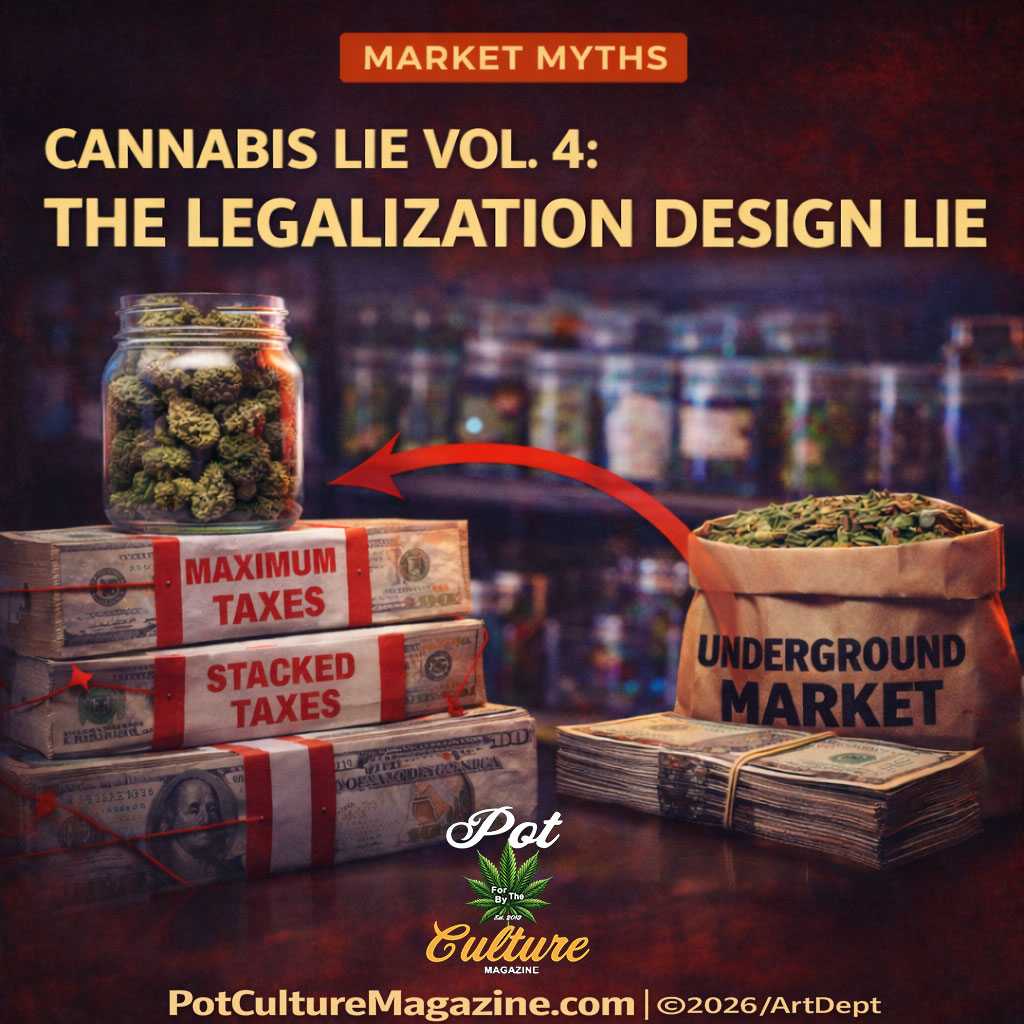
Cannabis Lie Vol. 4: The Legalization Design Lie
Cannabis legalization was sold as the end of the illicit market. Instead, stacked taxes, licensing limits, and local bans created price gaps that allowed underground sales to survive. From California’s cultivation tax to Illinois pricing and Michigan’s price compression, this installment of Cannabis Lie examines how policy design, not the plant, determines who wins and…
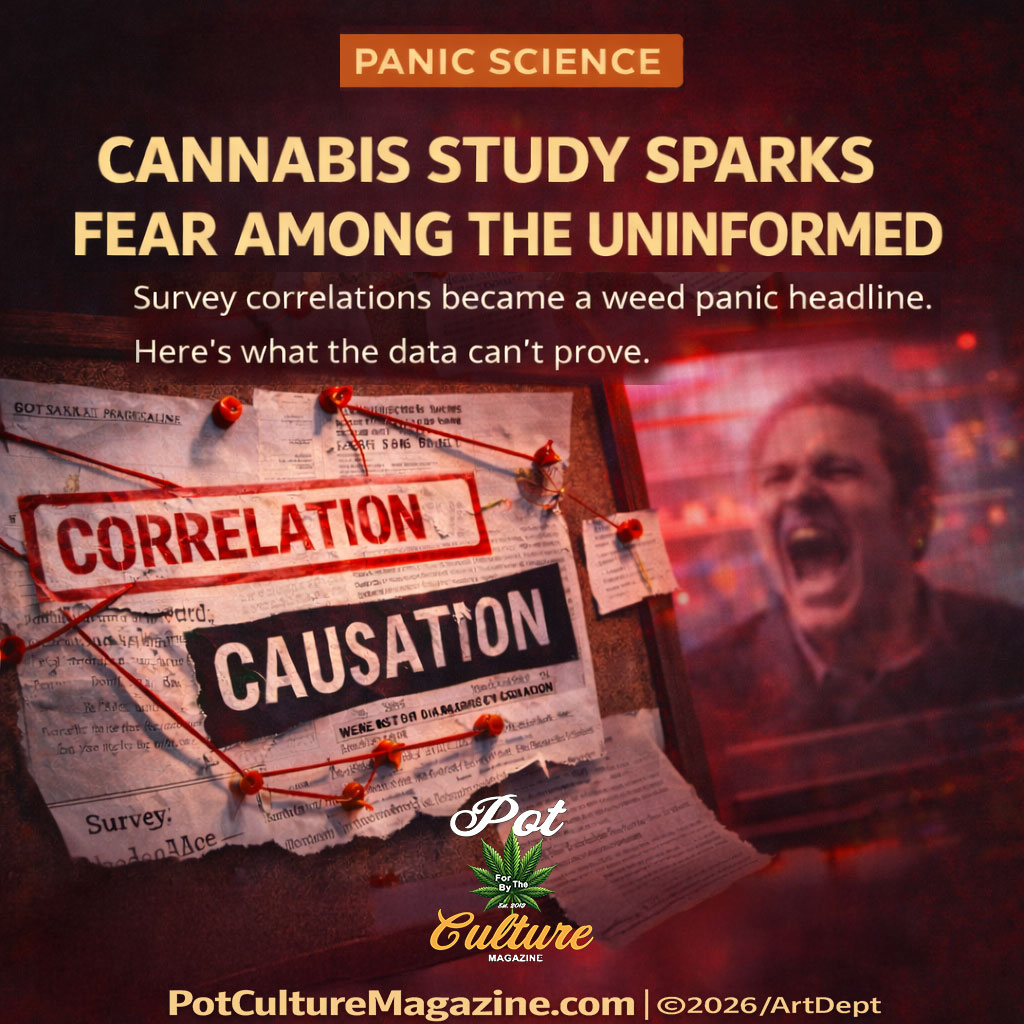
Cannabis Study Sparks Fear Among the Uninformed
A McMaster led analysis of two Canadian mental health surveys is getting recycled as a weed panic story, even though the design can only show association. This piece breaks down what the data can actually support, what it cannot prove, and how headlines turn survey correlations into causal claims that fuel stigma, bad policy, and…
Discover more from POT CULTURE MAGAZINE
Subscribe to get the latest posts sent to your email.

Leave a comment