Filed Under: Market Myths
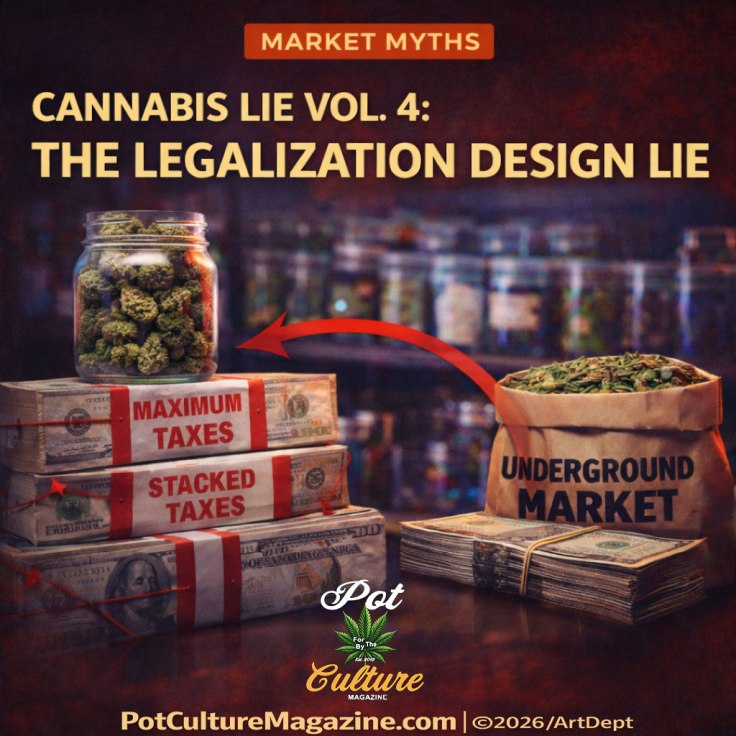
We all want to believe legalization is the shining light of salvation, that once the vote passes, everything clicks into place, and the chaos fades. That fantasy starts to crack the moment taxes stack, licenses shrink, and small operators realize the door was never fully open. Over-taxation, favoritism, backroom compromises, and a stubborn illicit market do not look like failure. They look like a design.
California was supposed to prove the model.
Voters approved adult use in November 2016 under Proposition 64. Legal sales began January 1, 2018. The pitch was simple. Bring cannabis into the light, regulate it, tax it, and the underground fades.
Instead, the underground adapted.
It did not take a genius to see why. A 15 percent state excise tax as outlined by the California Department of Tax and Fee Administration. State and local sales taxes are layered on top. In some jurisdictions, additional cannabis-specific municipal taxes. Testing mandates. Packaging requirements. Track and trace compliance. Application fees. Renewal fees. Consultants to navigate it all.
You can argue that those costs exist for a reason. Accurate labeling. Accountability. Product safety. That is fair. But when the receipt prints, theory gives way to math.
The difference is not ideological. It is financial.
Consumers are not debating regulatory philosophy while the receipt prints. They are looking at the number.
When legal eighths can run $50+ out the door after excise tax, sales tax, and local cannabis business taxes in parts of California, and the unlicensed market offers comparable product for half that, some buyers drift. Not because they oppose legalization. Because budgets are real.
The original framework did not just tax retail. It taxed cultivation by weight before the product was even sold. That cultivation tax ran from January 1, 2018, through June 30, 2022, and ended July 1, 2022, as documented by the California Department of Tax and Fee Administration after sustained pressure from growers who argued it distorted pricing and punished legal operators regardless of whether their product moved.
Repealing it did not fix the structure. It acknowledged that the structure was squeezing the people who tried to comply.
Local control added another pressure point. Cities and counties were permitted to ban cannabis businesses entirely. Hundreds did. As of mid 2025, more than half of California jurisdictions still prohibit retail cannabis storefronts, according to statewide local jurisdiction tracking published by the California Department of Cannabis Control. Demand did not evaporate inside those zip codes. It rerouted. Consumers drove. Or they stayed local and called someone who never applied for a license.
Legalization created a legal lane.
It did not shut down the old road.
California is not alone.
HELP POT CULTURE MAGAZINE STAY ALIVE, AND INDEPENDENT
Illinois launched adult use under the Illinois Cannabis Regulation and Tax Act with limited licensing and high retail prices. The state generated strong tax revenue early. During its initial rollout, consumers routinely faced elevated retail prices in a tightly controlled licensing environment shaped by layered taxes and constrained expansion. When prices remain high and storefront access is restricted, the illicit market does not disappear. It lingers.
Michigan chose expansion under oversight from the Michigan Cannabis Regulatory Agency. More licenses. Aggressive competition. Wholesale prices fell as supply increased. Retail prices followed. By late 2025, average adult-use ounce prices had dropped dramatically compared to early program years. As legal cannabis became more affordable, the gap between licensed shelves and unlicensed sellers narrowed. The underground did not vanish, but its leverage weakened.
Oregon swung toward saturation under a regulatory structure overseen by the Oregon Liquor and Cannabis Commission. Production surged. Prices dropped sharply. Oversupply squeezed businesses. Consumers saw relief at checkout. Legal cannabis became inexpensive enough that many buyers had little incentive to search elsewhere.
The framework matters.
When legal cannabis is widely accessible and priced to compete, more consumers migrate into the regulated system. When it carries stacked taxes, limited licensing, and heavy compliance overhead, the illicit market keeps breathing.
That is not ideology. It is market behavior.
Legalization in many states was not a clean market transition. It was a negotiated settlement.
Law enforcement groups wanted guardrails. Public health advocates pushed for restrictions. Municipalities insisted on local veto power. Established operators lobbied for manageable competition. Budget writers projected tax revenue from day one.
Those negotiations produced friction.
For small operators, friction means capital that they often do not have. Real estate secured before approval. Security buildouts. Application fees and renewal fees. Lab testing contracts. Insurance requirements. Environmental compliance. Labor regulations. Lawyers and consultants to interpret shifting rulebooks.
For well-capitalized companies, those same requirements can function as barriers that thin the field.
Favoritism does not always arrive in an obvious form. Sometimes it is embedded in cost structures that quietly narrow who can realistically participate.
The illicit market carries risk. It does not carry the same administrative overhead.
Politicians now point to persistent unlicensed sales and claim that legalization did not work. In some states, the same lawmakers supported the tax rates, license caps, and municipal veto powers that shaped the outcome.
It is easier to blame the plant than the blueprint.
Legalization was sold as a tool to eliminate the underground economy. In practice, the transition has tolerated illicit sales, with enforcement uneven and politics cautious about looking like a rebooted drug war.
Licensed businesses face inspections and penalties for minor compliance violations. Illicit sellers face sporadic crackdowns that rarely erase demand.
The result is a two-tier system that generates revenue but leaves structural contradictions in place.
This is not an argument against regulation. Product safety matters. Worker protections matter. Community impact matters.
But a regulatory system that prices legal cannabis far above its unregulated competitor does not eliminate competition. It preserves it.
The legalization design lies is simple.
When the illicit market persists, critics say legalization failed.
What often failed was the assumption that you could stack taxes, restrict access, narrow participation, and still outcompete a market that already existed.
Legalization did not enter a vacuum. It entered a culture with decades of supply chains, relationships, and consumer habits built under prohibition.
If the legal system wants to replace that, it must offer something materially better. Accessible storefronts. Competitive pricing. A viable path for small operators to survive without investor armor.
Otherwise, the underground will not disappear.
It will adjust.
And every time that adjustment is cited as proof that legalization was a mistake, the design choices that shaped it will be conveniently ignored.
Legalization is not magic.
It is architecture.
And architecture decides who thrives, who folds, and who never leaves the shadows at all.
©2026 Pot Culture Magazine. All rights reserved. This content is the exclusive property of Pot Culture Magazine and may not be reproduced, distributed, or transmitted in any form or by any means without prior written permission from the publisher, except for brief quotations in critical reviews.
F O R T H E C U L T U R E B Y T H E C U L T U R E

Gov. Abigail Spanberger’s Virginia Sabotage
Virginia legalized possession, but Governor Abigail Spanberger sabotaged the retail market. By delaying sales until 2027 and gutting equity provisions, the Commonwealth institutionalized a half-legal trap. Consumers now navigate a system that treats possession as a right but supply as a crime, fueling an unchecked illicit market while abandoning promised reform. Spanberger’s public safety rhetoric…

4/20 is Dead
4/20 has been hollowed out by branding, corporate silence, and a culture that forgot its own history. While the industry sells holiday merch, Singapore executed a man for cannabis. The movement that once fought for autonomy now treats the plant like a commodity. This piece examines the cost of that betrayal and the culture left…
Ed Rosenthal and the Origins of High Times
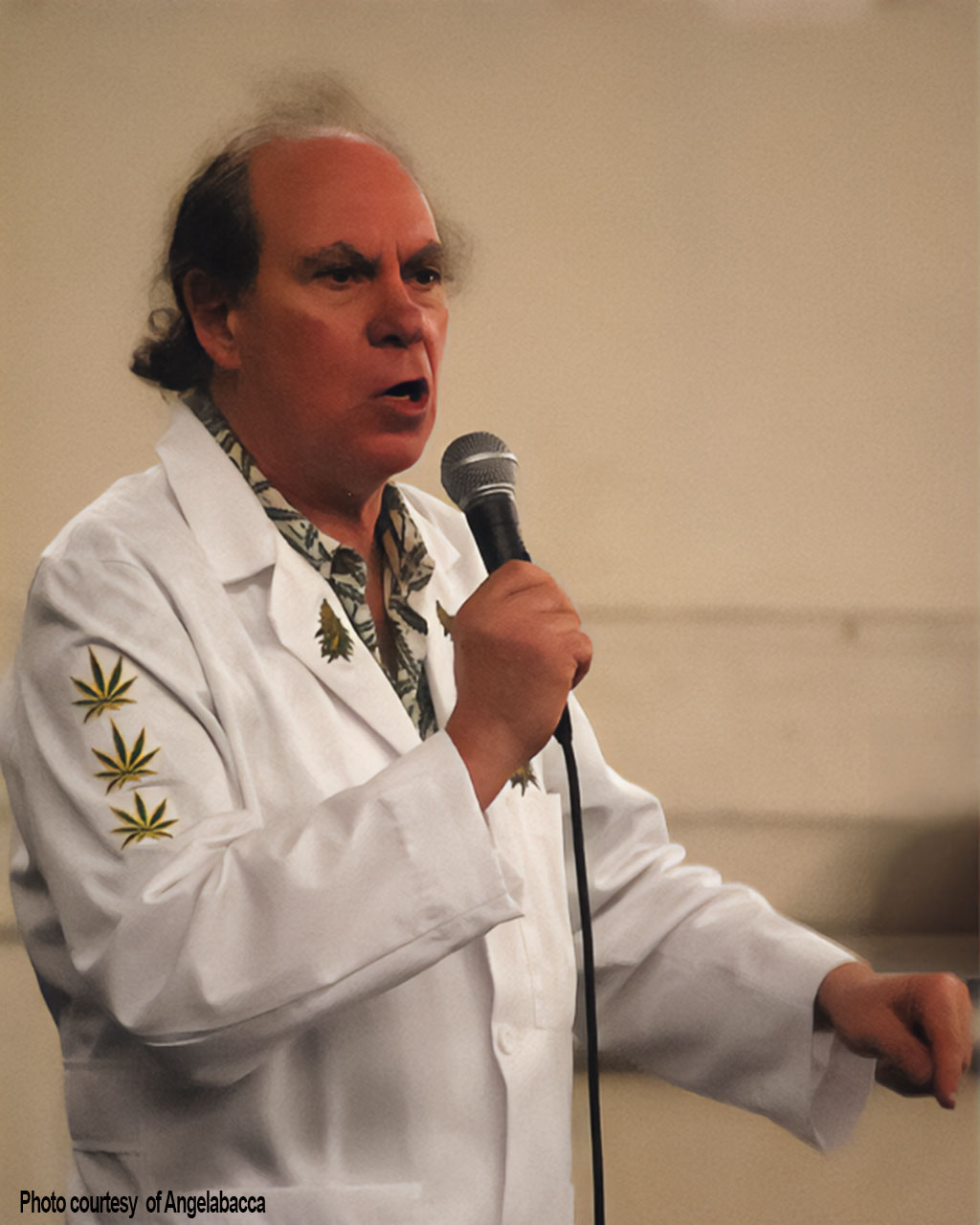
Ed Rosenthal recounts how the magazine was born not from psychedelic myth but from hard numbers. Rolling paper import data, underground press experience, and market logic revealed a massive hidden cannabis audience. His account challenges the romantic origin story and offers a rare firsthand look at the early mechanics behind one of cannabis culture’s most…

Discover more from POT CULTURE MAGAZINE
Subscribe to get the latest posts sent to your email.

Leave a comment