The Fallacy of Potency
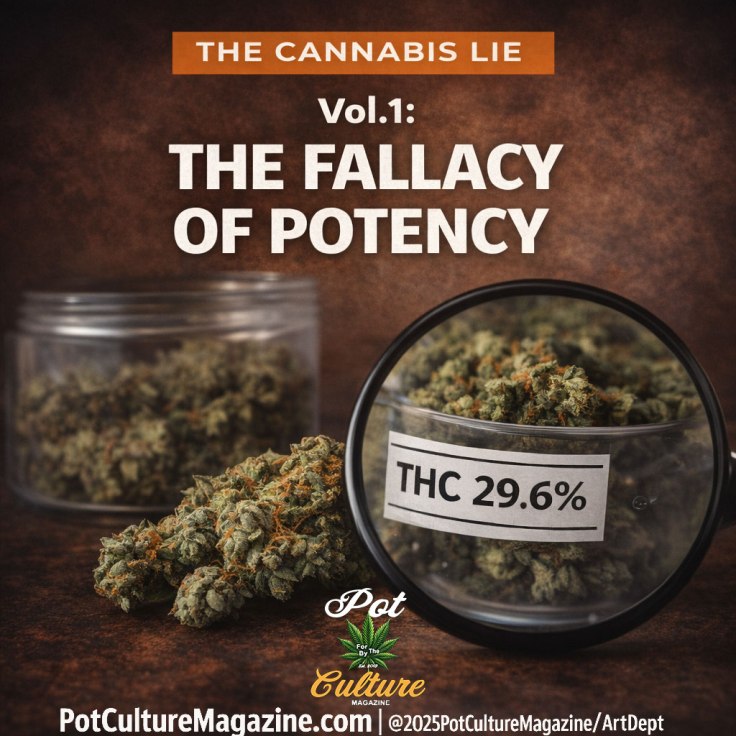
Cannabis did not become more dangerous because the THC number went up.
That idea was never proven. It was installed.
Once THC percentage entered the conversation, it became the easiest shortcut regulators ever found. A clean metric. A courtroom-friendly label. A way to keep prohibition alive without admitting that prohibition failed. The plant stayed suspect, the laws stayed cruel, and the rhetoric simply updated its costume.
Potency replaced evidence.
The Lie is simple:
Higher THC cannabis is inherently more dangerous than lower THC cannabis.
It survives because institutions love numbers that look scientific. A percentage is tidy. It fits inside statutes. It scales across enforcement. It eliminates the harder burden of showing actual harm to actual people.
THC percentage does that work.
Cannabis was swept into international prohibition long before modern potency variation even existed. Classification came first. Justification was bolted on later. When concentrates and stronger flower arrived decades afterward, officials treated strength as confirmation of old assumptions instead of a reason to revisit them.
Domestic drug law followed the same script. Legislatures built tiered penalties around THC thresholds. Prosecutors escalated charges by math alone. Courts rarely demanded proof that ha igher potency created a distinct danger.
The number became enough.
The media helped cement it. Stronger cannabis was framed as a new drug instead of a refined version of the same plant. Psychosis headlines multiplied. Population outcomes were ignored. Fear traveled faster than data ever could.
No conspiracy required. Bureaucracy does this on autopilot.
Here is what has never changed:
No verified medical record has ever documented a fatal overdose caused solely by cannabis.
Decades passed. THC averages rose. Concentrates entered the market. Global use expanded.
That fact remained intact.
In 1988, a DEA administrative law judge reviewed cannabis toxicity directly and concluded that cannabis has no known lethal dose. Researchers could not establish an LD50. Human case literature produced no deaths attributable to cannabis toxicity alone.
That finding still stands.
Federal health agencies acknowledge the same reality. The CDC states that a fatal overdose from cannabis alone is unlikely. The phrasing is cautious. The record is clearer.
It has not happened.
High THC does produce acute effects. Anxiety. Panic. Rapid heart rate. Temporary psychotic like reactions in some individuals. Real experiences, especially among inexperienced users or high-dose edible consumers.
Those episodes resolve. They do not demonstrate a population-wide danger curve tied to THC percentage.
The broader data do not support the potency panic.
HELP POT CULTURE MAGAZINE STAY ALIVE, AND INDEPENDENT
In the United Kingdom, the Advisory Council on the Misuse of Drugs examined hospital admissions during the rise of high THC cannabis and found no increase in acute poisoning aligned with potency shifts. Rates of schizophrenia and psychotic disorders remained stable.
Australian national health data show the same pattern. Cannabis potency increased. Prevalence rose. Schizophrenia incidence did not rise in parallel.
When psychosis risk appears, the dominant factors are frequency of use, early initiation, and individual vulnerability. Once those variables are accounted for, THC percentage alone does not predict outcomes.
Strength is not destiny.
Regulators quietly concede this every time they approve pure THC as medicine.
Synthetic THC has been legally prescribed for decades for nausea and appetite loss. The molecule is acceptable in a capsule. Forbidden in a plant.
That contradiction exposes the fraud.
Dose, route of administration, context, and behavior determine risk. THC percentage alone does not.
In 2020, the United Nations removed cannabis from Schedule IV, its most restrictive category, following a World Health Organization review acknowledging medical value.
In 2023, the U.S. Department of Health and Human Services recommended moving cannabis to Schedule III. That recommendation was issued in the modern high-THC era.
The science did not collapse under potency.
Jurisdictions that legalized cannabis while allowing higher THC products did not experience proportional increases in long term population harm. Some regions saw modest increases in emergency room visits driven largely by overconsumption of edible products among new users. Improved labeling and education reduced those incidents.
Policy adaptation worked. Potency itself was not the villain.
Where strict potency caps were imposed, consumers bypassed legal markets, and illicit distribution persisted. Exposure to untested products increased.
Demand does not vanish because lawmakers fear a number.
The consequences of potency-driven policy are concrete.
Criminal penalties escalate without demonstrated additional danger. Workers are fired over THC metabolites unrelated to impairment. Patients are denied effective treatment because regulators prioritize percentages over outcomes.
Public health resources are misdirected toward enforcement of strength rather than behavior. The real risk factors remain heavy daily use, early initiation, untreated mental illness, and contamination.
Potency became a stand-in for danger because it was convenient.
It allowed institutions to modernize fear without revisiting the rotten foundation underneath it.
Higher THC did not create a new drug.
It exposed how badly the system confuses measurement with meaning.
Cannabis risk exists. It scales with pattern, vulnerability, and circumstance.
It does not scale cleanly with THC percentage.
The potency lie survives through repetition, not proof.
©2025 Pot Culture Magazine. All rights reserved. This content is the exclusive property of Pot Culture Magazine and may not be reproduced, distributed, or transmitted in any form or by any means without prior written permission from the publisher, except for brief quotations in critical reviews.
F O R T H E C U L T U R E B Y T H E C U L T U R E

IDAHO TRIES TO STOP A VOTE BEFORE IT STARTS
Idaho lawmakers passed a resolution urging voters to reject a medical cannabis initiative before it reaches the ballot. The move highlights how officials are shaping public opinion ahead of a vote, while maintaining strict prohibition and blocking even limited access for patients.

MS LIMITS MEDICAL CANNABIS WHERE IT MATTERS MOST
Mississippi maintains strict limits on medical cannabis after Governor Tate Reeves vetoed expansion bills on March 26, 2026. Patients remain unable to use cannabis in hospitals while eligibility and access rules stay tightly controlled. This feature examines what the veto blocks, how it affects patients, and what it means for the state’s growing cannabis market.
CANNABIS LIES Vol. 6: The Driving Apocalypse Lie
Legal cannabis is often blamed for rising traffic deaths, but federal data tells a more complicated story. NHTSA findings, toxicology limitations, and conflicting crash studies reveal that THC presence is not a reliable measure of impairment. This investigation breaks down how flawed testing and policy shortcuts have shaped the narrative around so-called stoned driving.
Discover more from POT CULTURE MAGAZINE
Subscribe to get the latest posts sent to your email.

Leave a comment