Filed Under: Workplace Theater
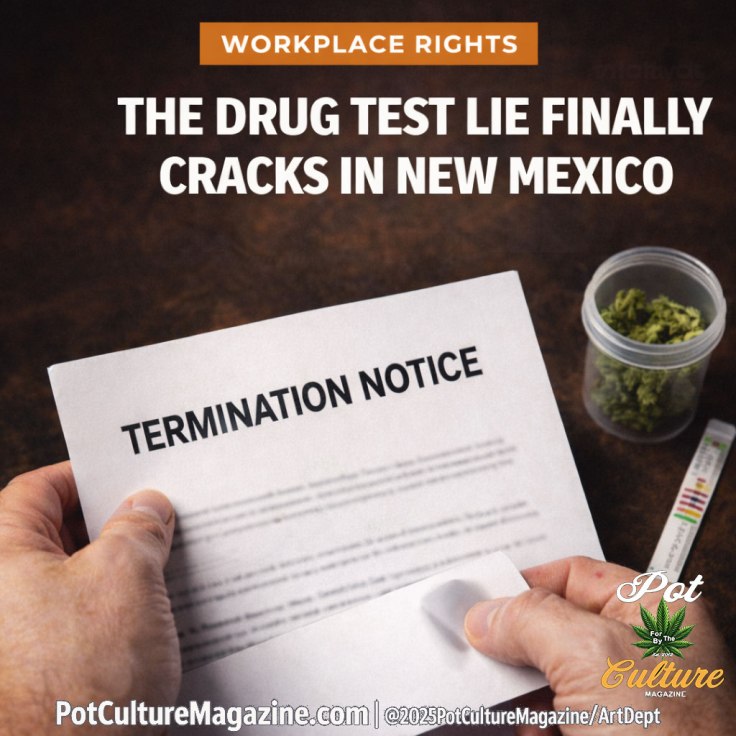
New Mexico spent years telling medical cannabis patients that legalization came with dignity. Register legally. Purchase legally. Possess legally. Then show up to work, fail a urine test that cannot distinguish impairment from past use, and watch those promises disappear.
Senate Bill 129 exists because that contradiction finally became impossible to defend.
At its core, S.B. 129 targets one of the longest surviving myths of the drug war, the assumption that a positive cannabis test proves impairment. That logic is a direct inheritance from federal prohibition under the Controlled Substances Act, and it has never been supported by science.
New Mexico already claims to protect registered patients enrolled in the state’s Medical Cannabis Program from workplace discrimination. On paper, those protections look solid. In practice, they collapse the moment a drug test enters the process. Most employers rely on urine screens that detect non-psychoactive THC metabolites, a limitation acknowledged by the National Institute on Drug Abuse. Those metabolites do not measure intoxication. They confirm historical exposure. That distinction is not controversial. It is foundational.
The system persists because it is convenient.
S.B. 129 does not legalize impairment at work. It does not permit on-site use. It does not prevent discipline when a worker is actually unsafe. What it removes is the shortcut that allowed employers to treat a lab result as evidence of misconduct when no misconduct occurred.
This is not theoretical in New Mexico.
Medical cannabis patients have lost job offers and employment after routine screenings flagged THC with no accompanying allegation of impairment, error, or safety risk. These cases rarely become public. They end quietly, with rescinded offers or terminations framed as policy enforcement rather than discrimination. The outcome is the same. A legal patient pays the chemistry price, not conduct.
Current state law technically bars adverse employment action based solely on a person’s status as a qualified medical cannabis patient under the Lynn and Erin Compassionate Use Act. That language sounds protective until it meets reality. Employers point to a positive test, imply impairment, and move on. The burden then falls on the worker to prove something the test cannot show, that they were not impaired while doing their job.
S.B. 129 draws a line that has long been missing.
A positive cannabis test alone would no longer qualify as evidence of impairment for registered medical patients. Employers could still act when there is reasonable suspicion of on-the-job impairment, when a workplace accident occurs, or when safety-sensitive positions are involved, as defined under the New Mexico Administrative Code. What they would lose is the ability to treat the test result itself as the event.
That shift matters.
Cannabis does not behave like alcohol. Alcohol leaves the body quickly, and blood concentration roughly tracks impairment. THC does not. Its metabolites linger long after any intoxicating effect has faded. A patient can medicate on a Friday night and test positive the following Wednesday without being impaired at any point during work hours. This has been established science for years. The law simply refused to adapt.
S.B. 129 forces that reckoning.
It shifts workplace standards away from chemical residue and toward observable behavior. Away from laboratory certainty, theater, and actual safety assessment. That change is overdue, but it is also limited by design.
The bill does not protect everyone.
HELP POT CULTURE MAGAZINE STAY ALIVE, AND INDEPENDENT
Employees in safety-sensitive positions remain carved out. Federal contractors and workers subject to Department of Transportation drug testing rules are unaffected. At will, employment remains intact. For a significant portion of New Mexico’s workforce, particularly those tied to federal regulation or heavy industry, the landscape does not change.
That limitation matters. So does honesty about it.
Supporters frame the bill as common sense. Workers should not lose their livelihoods over lawful medical treatment that does not affect performance. Employers should focus on safety, not prohibition-era residue. Critics argue the bill complicates enforcement and increases liability. That claim weakens under scrutiny. Nothing in the bill restricts post incident testing. Nothing shields real impairment. What it disrupts is administrative ease.
Drug testing is simple. Observation requires training. Documentation takes effort. Impairment standards demand judgment.
For decades, the drug testing industry, supported by federal guidelines from SAMHSA and risk management culture, sold employers a shortcut. Legislatures allowed it to stand unchallenged. S.B. 129 interrupts that arrangement without pretending it can dismantle it entirely.
Insurance concerns surface whenever cannabis employment protections are discussed. Employers fear exposure if something goes wrong. Yet states that have already adopted impairment-based standards, including New York, New Jersey, and California, have not seen spikes in workplace accidents attributable to cannabis. What they have seen is a decline in pointless testing and a recalibration of how safety is actually assessed.
The bill does not eliminate accountability. It eliminates a false proxy.
The contrast with alcohol makes the imbalance obvious. Most workplaces do not conduct random alcohol testing. They rely on observation, incidents, and performance. Cannabis has been subjected to a harsher regime despite weaker impairment tools. S.B. 129 begins correcting that asymmetry.
There is also a cultural shift embedded in the bill. Medical cannabis patients are no longer treated as tolerated exceptions. They are recognized as workers whose rights extend beyond the dispensary door. That recognition has been slow and uneven. This bill moves it closer to reality.
The real target here is not impairment. It is the testing regime that survived prohibition because no one challenged its assumptions.
None of this guarantees fairness. Employers will adapt. Lawyers will test edges. Workers will still face risk, especially in at-will environments. But direction matters. Replacing a chemical shortcut with a human standard changes the balance of power, even modestly.
Success would not look like universal protection. It would look like fewer silent firings. Fewer rescinded offers. Fewer workers are forced to choose between medical care and a paycheck. It would look like employers abandoning tests that provide no meaningful information and focusing instead on performance and safety, where it actually matters.
New Mexico did not create this problem. It inherited it from a national system that criminalized cannabis first and rationalized the damage later. What makes S.B. 129 worth watching is not that it is radical, but that it finally states the obvious.
A drug test is not a verdict. It never was.
©2025 Pot Culture Magazine. All rights reserved. This content is the exclusive property of Pot Culture Magazine and may not be reproduced, distributed, or transmitted in any form or by any means without prior written permission from the publisher, except for brief quotations in critical reviews.
F O R T H E C U L T U R E B Y T H E C U L T U R E
CANNABIS LIES Vol. 5: The Gateway Lie
For decades, politicians have claimed marijuana is a gateway to heroin and harder drugs. Federal youth surveys, NSDUH data, and NIDA’s own language tell a different story. Cannabis use is widespread, hard drug use remains rare, and most users do not progress. The data dismantles one of prohibition’s most durable fear narratives.

The Study That Pretends Cannabis Does Nothing
A new cannabis study claims marijuana does nothing for anxiety, depression, or PTSD. The reality is far more complicated. Decades of federal restrictions, limited research access, and synthetic substitutes have shaped the science. This breakdown exposes how incomplete data and selective interpretation continue to drive misleading headlines about cannabis and mental health.
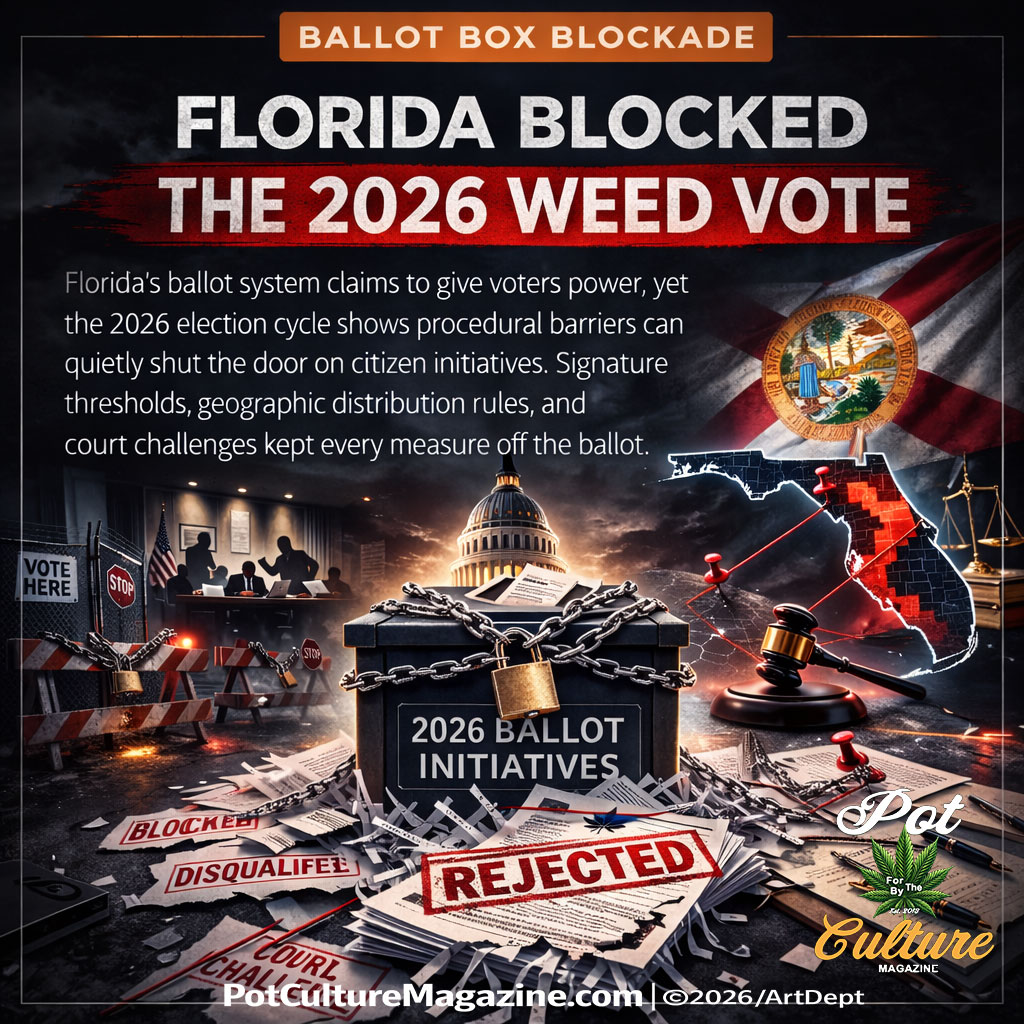
Florida Blocked the 2026 Weed Vote
Florida’s ballot system claims to give voters power, yet the 2026 election cycle shows how procedural barriers can quietly shut the door on citizen initiatives. Signature thresholds, geographic distribution rules, and court challenges blocked every measure from reaching voters, revealing how cannabis legalization fights are often decided by bureaucratic design long before election day.
Discover more from POT CULTURE MAGAZINE
Subscribe to get the latest posts sent to your email.

Leave a comment