Filed Under: Order With Benefits
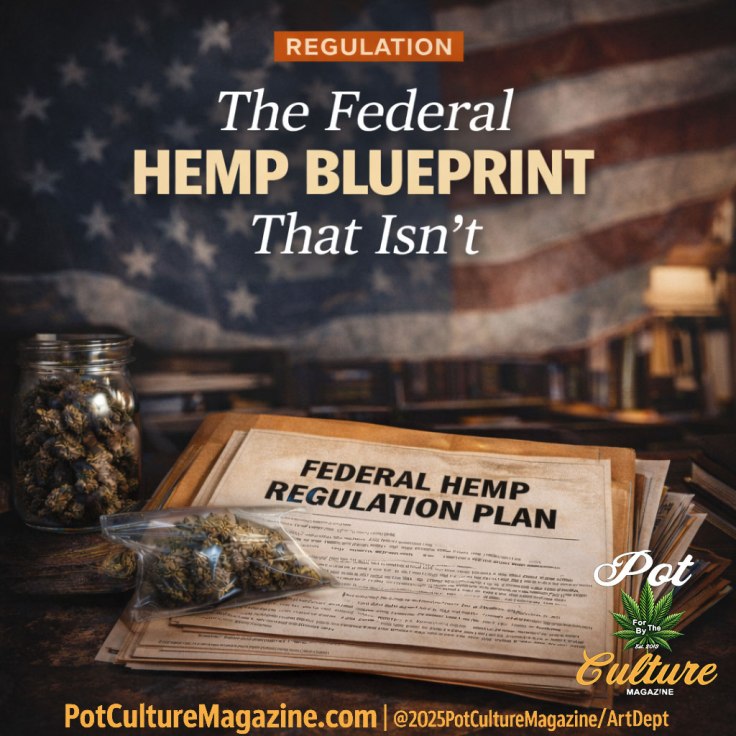
For years, state regulators have repeated the same complaint. They are not asking Washington to run hemp. They want a reference point. A federal baseline clear enough to defend in court and flexible enough to work in the real world. After the 2018 Farm Bill cracked the door open, no one finished the job.
Last week, Congress claimed it finally might.
A proposed federal hemp framework circulating in the House, backed by lawmakers including Rep. Morgan Griffith of Virginia and Rep. Marc Veasey of Texas, is being promoted as the long-overdue answer for hemp-derived cannabinoids. Supporters frame it as clarity at last. National definitions. National dosage standards. One federal model to replace years of state-level improvisation.
That framing is not wrong. It is incomplete.
To understand why this proposal matters, it helps to start with how federal hemp law actually functions today.
The 2018 Farm Bill legalized hemp by defining it as cannabis containing no more than 0.3 percent delta-9 THC on a dry weight basis. Oversight of cultivation moved to the USDA. Drug enforcement authority remained with the DEA. Regulation of finished consumer products was left unresolved, with the expectation that the FDA would eventually establish a pathway for lawful use in food and supplements.
That pathway never materialized.
The FDA declined to create a comprehensive regulatory framework for CBD and other hemp-derived cannabinoids. States filled the vacuum. Some imposed limits. Some issued bans. Others allowed sales under informal guidance. Courts stepped in. Businesses adapted. Consumers never stopped buying. A national market expanded without a coherent federal spine.
That vacuum is real. The demand for federal guidance is legitimate.
The current proposal responds by attempting to draw hard national lines. Draft language proposes national cannabinoid limits across product categories. Oral products would be capped at 10 milligrams per serving and 50 milligrams per package of non-intoxicating cannabinoids. Topical and inhalable products would be permitted higher totals. All categories would be subject to a proposed limit of 5 milligrams of delta 9 THC per serving and 30 milligrams per package.
Supporters describe these proposed limits as safety-oriented and overdue. Large hemp marketplaces and national operators have welcomed the framework as a step toward order in a market shaped more by enforcement uncertainty than policy.
What the proposal delivers, however, is not a blueprint. It is a constraint.
A functional federal framework guides states without erasing them. This proposal replaces state discretion with federal ceilings. States that already operate regulated hemp programs with higher allowable doses would not be given reference ranges to work within. They would be required to conform downward, regardless of local data or consumer behavior.
That is not coordination. It is an override.
HELP POT CULTURE MAGAZINE STAY ALIVE, AND INDEPENDENT
Dosage policy in the proposal is treated as a fixed endpoint rather than a regulatory tool. A workable framework recognizes variation in use, tolerance, and purpose. It allows states to adjust within a federal reference range based on evidence and outcomes. Here, one dosage philosophy is positioned as universal, with deviation treated as noncompliance rather than judgment.
Enforcement remains largely undefined. Oversight authority is implied, but process is not. The proposal does not distinguish clearly between safety risks and technical violations. There is no graduated enforcement model. No defined cure periods. In regulatory systems structured this way, enforcement pressure does not distribute evenly. It concentrates on operators without scale, capital, or legal insulation.
That imbalance is structural.
Uniform caps and standardized product categories favor companies built to operate nationally. They disadvantage smaller producers who built businesses under state rules that allowed more flexibility. The framework does not state this outcome directly, but the architecture makes it predictable.
The proposal also avoids meaningful integration with existing cannabis systems. It does not explain how hemp derived limits would interact with state legal cannabis programs that permit higher doses. Medical use patterns are absent. Consumers who rely on higher-dose products for pain, sleep, or trauma are treated as edge cases rather than part of the market reality.
A blueprint anticipates conflict. This proposal defers it.
What makes this moment especially revealing is that the elements of a workable federal framework are not difficult to identify. Effective guidance starts with reference ranges instead of absolute ceilings, allowing consistency without freezing markets. Authority remains local where systems already function, with federal standards acting as anchors rather than restraints. Product categories reflect real use patterns instead of flattened compliance models. Enforcement pathways are proportional and transparent, separating public safety from paperwork. Compliance obligations scale with company size, preventing regulation from becoming a quiet consolidation engine.
Those elements are absent here.
That omission does not make the proposal hostile. It makes it selective. It answers the call for federal involvement in the narrowest possible way, by defining limits while sidestepping integration, adaptation, and equity.
A blueprint is supposed to help states build. This one redraws the boundaries first and tells everyone else to adjust.
That difference is not cosmetic. It is the story.
©2025 Pot Culture Magazine. All rights reserved. This content is the exclusive property of Pot Culture Magazine and may not be reproduced, distributed, or transmitted in any form or by any means without prior written permission from the publisher, except for brief quotations in critical reviews.
F O R T H E C U L T U R E B Y T H E C U L T U R E

Zurich’s Black Market Problem
Zurich’s Züri Can pilot is giving cannabis reformers something stronger than slogans. New interim findings show regulated, nonprofit access reduced several reported health problems while pulling demand away from the illegal market, giving Switzerland fresh evidence for national cannabis reform and putting prohibition panic on weaker ground.


Vegas Knew, Vegas Looked Away
Las Vegas sold tourists the illusion of legal cannabis while fake dispensary style hemp shops operated near the Strip. Vegas Knew, Vegas Looked Away exposes how Nevada’s casino separation rules, weak hemp oversight, delayed Clark County action, and tourist confusion created a loophole economy hiding in plain sight.
CANNABIS LIES Vol. 10: The Medical Lie
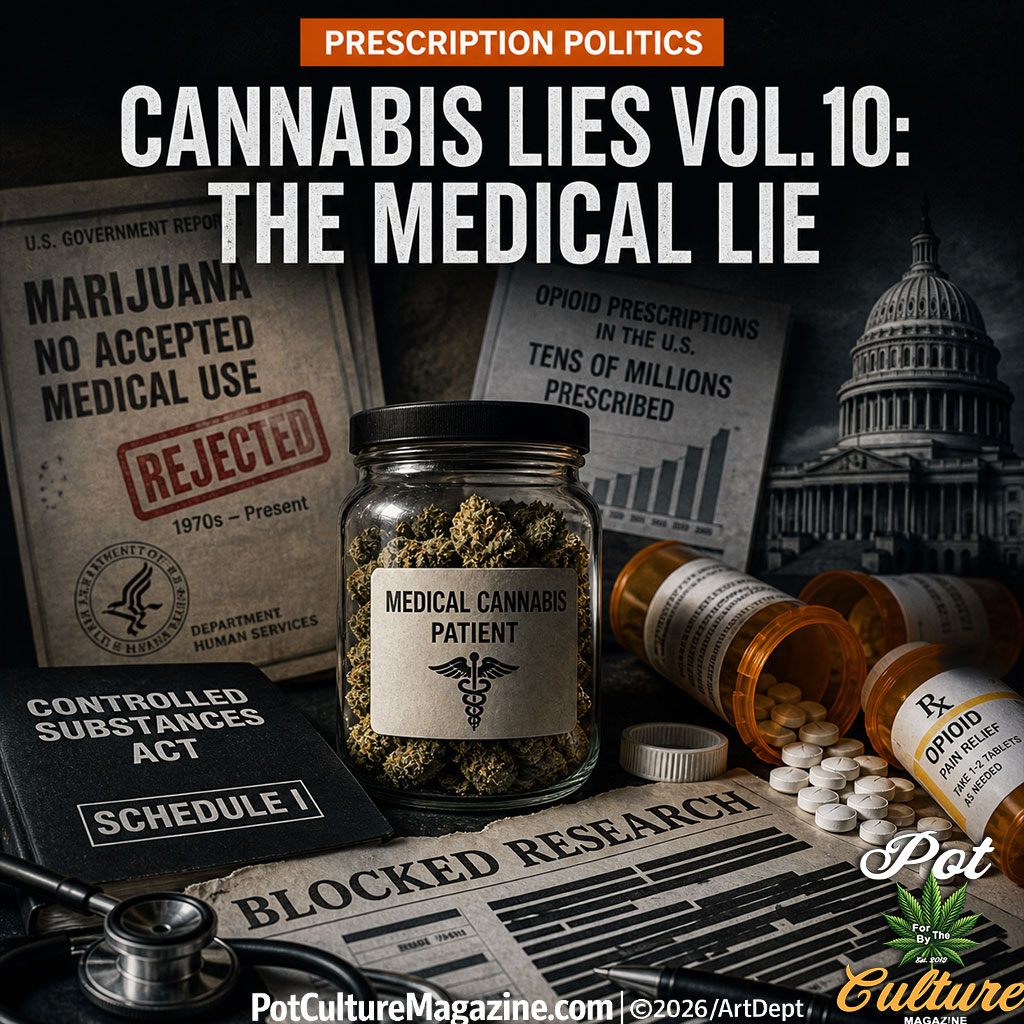
For decades, federal policy claimed cannabis had no accepted medical use while opioid prescriptions moved through the health care system by the tens of millions. Cannabis Lies Vol. 10 exposes the contradiction behind Schedule I, blocked research, medical cannabis patients, and the institutions that spent years pretending politics was medicine.
Discover more from POT CULTURE MAGAZINE
Subscribe to get the latest posts sent to your email.

Leave a comment