Filed Under: System Malfunction

A man leaves a dispensary with a legal purchase and a receipt in his pocket. He does not hide it. He does not rush. Minutes later, he is stopped. The law that allowed the sale does not shield him from suspicion, scrutiny, or consequence. Legal on paper does not mean safe in practice.
This is not an anomaly. It is the system functioning as designed.
Legalization promised an end to prohibition. What it delivered was a redesign. The storefronts changed. The language softened. The enforcement logic remained. Cannabis moved from contraband to commodity without shedding the assumptions that once justified punishment.
That continuity shows up in the numbers.
More than 200,000 people are still arrested for marijuana offenses each year in the United States, the vast majority for simple possession rather than trafficking, according to data compiled by the FBI and summarized by NORML.
The burden of that enforcement remains uneven.
Black Americans are nearly four times more likely to be arrested for marijuana possession than white Americans, despite comparable usage rates across racial groups, a disparity documented repeatedly by the American Civil Liberties Union.
Advertisement
F O R T H E C U L T U R E B Y T H E C U L T U R E

Zurich’s Black Market Problem
Zurich’s Züri Can pilot is giving cannabis reformers something stronger than slogans. New interim findings show regulated, nonprofit access reduced several reported health problems while pulling demand away from the illegal market, giving Switzerland fresh evidence for national cannabis reform and putting prohibition panic on weaker ground.


Vegas Knew, Vegas Looked Away
Las Vegas sold tourists the illusion of legal cannabis while fake dispensary style hemp shops operated near the Strip. Vegas Knew, Vegas Looked Away exposes how Nevada’s casino separation rules, weak hemp oversight, delayed Clark County action, and tourist confusion created a loophole economy hiding in plain sight.
Advertisement
Legalization did not interrupt the pipeline. It rerouted it.
Workers in legal states continue to lose jobs for off-duty cannabis use. In most U.S. states, employers can still terminate workers for cannabis use even when that use is legal under state law, a reality shaped by workplace drug testing rules and federal prohibition, as outlined by the National Conference of State Legislatures.
Federal workers and contractors face stricter limits. Cannabis remains illegal under federal law, which means anyone tied to federal funding, contracts, or security clearances is effectively excluded from legal use. Legal weed exists. Legal workers remain vulnerable.
This is how prohibition logic survives. It no longer relies solely on arrests. It operates through HR departments, insurance policies, and compliance manuals.
The racial consequences are not abstract.
Black Americans continue to face arrest rates for cannabis that far exceed those of white Americans in states with legal marijuana, a pattern the ACLU has described as a failure of reform rather than an accident of enforcement.
Social equity programs were introduced as a corrective. Their outcomes reveal a different reality.
Across multiple states, equity applicants face high application fees, capital requirements, zoning restrictions, and limited access to financing. Studies examining early legalization markets show that only a small share of cannabis licenses have gone to equity applicants, despite public commitments to repair past harm, as documented in peer-reviewed research published by the National Institutes of Health.
The NAACP warned that legalization without repair would fall short. “Legalization and decriminalization legislation must include individual remedies for those who have been arrested or convicted, including release from incarceration and automatic pardon and expungement of records,” the organization stated in its policy guidance on cannabis reform.
Those remedies remain uneven, delayed, or incomplete.
Medicine reflects the same contradiction.
HELP POT CULTURE MAGAZINE STAY ALIVE, AND INDEPENDENT
Patients reporting nausea, vomiting, and abdominal pain are increasingly diagnosed with Cannabinoid Hyperemesis Syndrome based on symptoms and self-reported use alone. The cannabis products involved are rarely tested for pesticides, mold, heavy metals, or residual solvents, despite documented contamination recalls in legal markets reported by state regulators.
Blame is assigned without verification. Liability is avoided. The patient leaves with a permanent label and unanswered questions.
Regulation reinforces the same logic. Licensed operators operate under surveillance regimes that resemble probation more than commerce. Compliance requirements multiply. Costs rise. Smaller operators are squeezed out while large firms absorb the burden.
Consumers feel it as well.
Prices increase under tax structures designed to maximize revenue. Purchases are tracked. IDs are scanned. Driving laws punish presence rather than impairment. Cannabis remains illegal on federal land, creating hidden traps for legal users.
Federal policy completes the picture.
Rescheduling is promised, delayed, and withdrawn. Health and Human Services recommendations sit idle. The Drug Enforcement Administration stalls. Congress hides behind appropriations riders. Delay is framed as caution while preserving control.
Legalization did not dismantle prohibition. It rebranded it.
The same communities remain exposed. The same workers remain vulnerable. The same patients are blamed. The same consumers are monitored.
Until legalization confronts the prohibition mindset embedded in law, medicine, employment, and regulation, it will continue to function as containment rather than freedom.
This is what legalization is.
And this is what it is not.
©2025 Pot Culture Magazine. All rights reserved. This content is the exclusive property of Pot Culture Magazine and may not be reproduced, distributed, or transmitted without prior written permission from the publisher, except for brief quotations in critical reviews.
F O R T H E C U L T U R E B Y T H E C U L T U R E
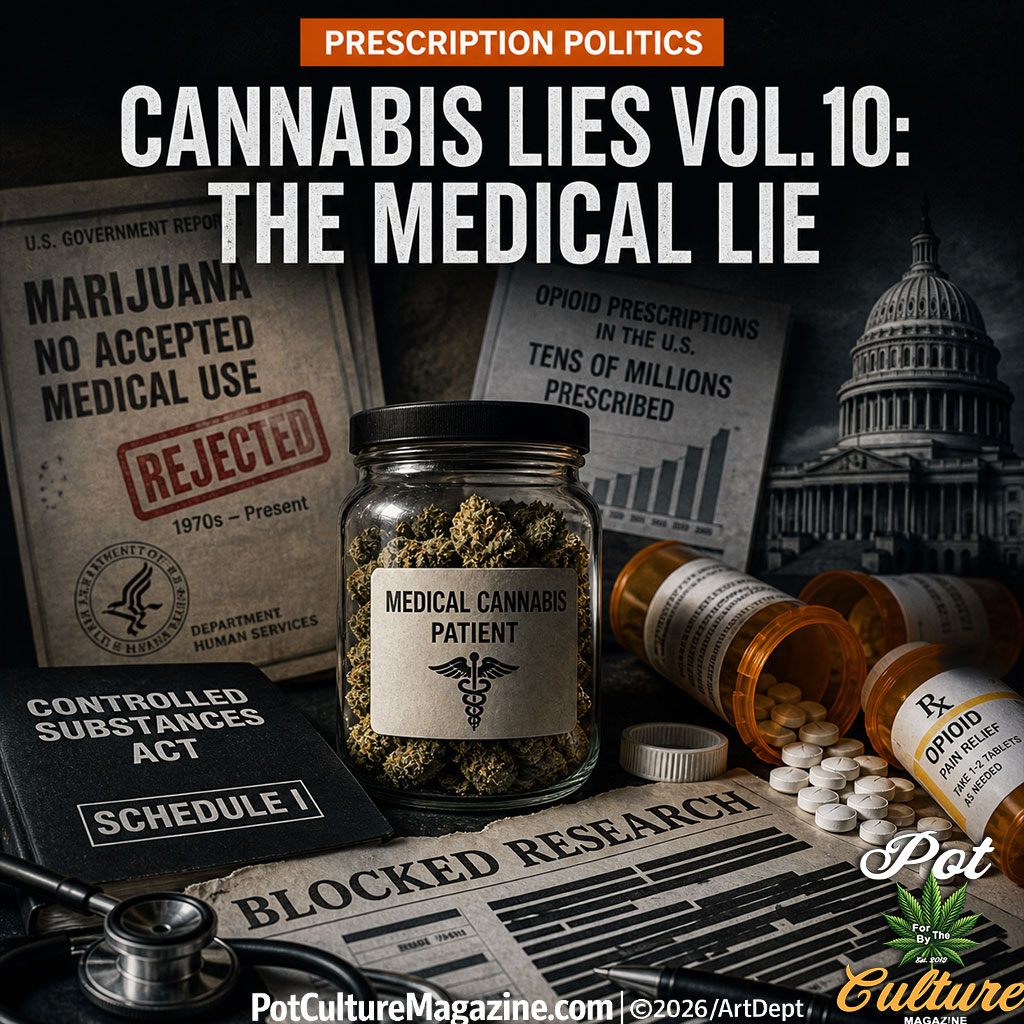
CANNABIS LIES Vol. 10: The Medical Lie
For decades, federal policy claimed cannabis had no accepted medical use while opioid prescriptions moved through the health care system by the tens of millions. Cannabis Lies Vol. 10 exposes the contradiction behind Schedule I, blocked research, medical cannabis patients, and the institutions that spent years pretending politics was medicine.

Jersey’s New Cash Crop
Jersey reinvented itself. A forty-five square mile island once known for offshore finance is now exporting pharmaceutical-grade cannabis into Germany’s booming medical market. With strict regulation, heavy investment, and a government eager for diversification, Jersey has become an unlikely European powerhouse. The contradiction between local policing and global commerce tells the real story.

A State of the Union on the State of Cannabis Media
Cannabis media is undergoing a predictable institutional decay. The movement’s original architects have transformed from revolutionary contributors into defensive gatekeepers, protecting their legacy rather than fostering future growth. This manifesto examines the four archetypes of decay: the Gatekeeper, the Mercenary, the Scavenger, and the Shill, that currently stifle the industry’s independent voice and threaten the…
Discover more from POT CULTURE MAGAZINE
Subscribe to get the latest posts sent to your email.

Leave a comment