Filed Under: Genetic Warfare

Cannabis in the United States has endured every kind of pressure that law enforcement, legislators, and profit seekers could create. Courts attempted to eradicate it. Police forces treated it as an enemy. Political figures used it as a rhetorical weapon. Corporations reshaped markets around it without understanding what the plant meant to the people who kept it alive. Through all these forces, the culture persevered. Not because the system protected it, but because growers, breeders, and patients refused to let it disappear.
Today, the federal government is experimenting with a quieter strategy. Instead of criminalizing cultivation outright or launching headline‑driven raids, lawmakers have chosen to target the beginning of the plant. A single seed, the smallest and most essential piece of the genetic chain. A seed that contains no intoxicating chemical concentration, no direct health threat, and no commercial risk. Through a line hidden inside a federal appropriations bill, the government has opened the door to federal action against seeds produced by plants that test above the national THC ceiling. The seed becomes subject to scrutiny not because of any trait it carries, but because of the chemical profile of its parent.
This maneuver is not framed as a prohibition. It is framed as clarification inside a legislative document full of unrelated financial language. That framing hides the truth. This policy reaches into the genetic foundation of cannabis and places federal authority over the plant’s ancestry. It threatens diversity, weakens cultivation options, and narrows the future of the plant before it can even reach soil.
The process behind this change is nearly as concerning as the change itself. There were no public hearings before the language appeared. Lawmakers did not request testimony from breeders or agricultural experts. No scientific review accompanied the decision. People responsible for stabilizing lines, preserving heritage genetics, or guiding medical cultivation practices were completely absent from the conversation. The entire shift took place in bureaucratic silence.
Attorneys who follow hemp and cannabis policy were among the first to sound alarms. Seed banks, which maintain extensive collections of genetic material, quickly recognized how severe the consequences might be. Breeders who typically avoid government attention understood immediately that their work could be placed under federal threat. The medical cultivation community identified an even more urgent problem. Many patients rely on strains that never entered commercial circulation. These strains exist because individuals protected them in garages, farm sheds, private greenhouses, and makeshift gardens. Federal interference with seeds places those strains at risk of extinction.
PLEASE HELP POT CULTURE MAGAZINE STAY ALIVE, AND INDEPENDENT
A seed is a blueprint, not a consumable. It does not create intoxication. It does not carry THC levels that place consumers at risk. The government’s decision to treat seeds as potential contraband based on their lineage contradicts agricultural logic. No other crop is treated this way. The classification creates a legal fiction that grants enforcement agencies the power to police the future of the plant rather than its present use.
The first casualties of this shift will not be multinational companies. They have legal departments, laboratory facilities, and the ability to pivot into tissue culture processes that do not rely on traditional seeds. The people who will experience the real damage are the individuals and small groups who maintain genetic diversity. Their operations run on limited budgets. They rely on traditional breeding practices. They do not have the resources to navigate ambiguous federal policy. Many may shut down to avoid being caught in an enforcement wave. Others may move underground, which will undermine transparency and harm consumers who rely on verified genetics.
Medical growers are positioned to lose even more. The wider market ignores many cultivars that patients depend on because commercial operations prefer yield or aesthetic appeal over therapeutic consistency. If seed availability becomes restricted, medical growers lose the ability to match patients with the specific cultivars that work for their conditions. Pharmaceutical companies offer synthetic alternatives, but the effects rarely match those of cultivars refined through real‑world use. Patients end up with fewer options, higher costs, and less stability.
Legal analysts have pointed out that the enforcement timeline inside the bill requires verification. Some interpretations describe a one‑year delay before enforcement begins. Others argue that agencies may be authorized to act sooner. The only reliable answer comes from examining the statutory language itself because agency interpretations often shape policy more aggressively than Congress intends. Growers plan cultivation seasons months ahead. Seed banks track inventory by season and region. Breeders plan generational development years in advance. Ambiguity disrupts entire calendars.
advertisement
F O R T H E C U L T U R E B Y T H E C U L T U R E

Zurich’s Black Market Problem
Zurich’s Züri Can pilot is giving cannabis reformers something stronger than slogans. New interim findings show regulated, nonprofit access reduced several reported health problems while pulling demand away from the illegal market, giving Switzerland fresh evidence for national cannabis reform and putting prohibition panic on weaker ground.


Vegas Knew, Vegas Looked Away
Las Vegas sold tourists the illusion of legal cannabis while fake dispensary style hemp shops operated near the Strip. Vegas Knew, Vegas Looked Away exposes how Nevada’s casino separation rules, weak hemp oversight, delayed Clark County action, and tourist confusion created a loophole economy hiding in plain sight.

CANNABIS LIES Vol. 10: The Medical Lie
For decades, federal policy claimed cannabis had no accepted medical use while opioid prescriptions moved through the health care system by the tens of millions. Cannabis Lies Vol. 10 exposes the contradiction behind Schedule I, blocked research, medical cannabis patients, and the institutions that spent years pretending politics was medicine.
advertisement
The question of whether clones remain legal adds another layer of confusion. Some breeders believe clones might avoid classification because they are not seeds. Others argue that agencies will expand authority to include any plant material derived from high‑THC cannabis. No clear guidance has been published. Until federal agencies provide written clarification, growers cannot operate under assumptions. A misunderstanding could lead to confiscation, financial loss, or even criminal exposure.
This policy also creates tension between state and federal governance. States with strong agricultural programs may attempt to protect their growers. Some may choose to ignore federal guidance and rely on state‑level enforcement. However, seeds frequently cross borders, whether for commercial sales, breeding collaboration, or simple exchange among growers. The moment a seed crosses a state line, federal authority applies. This undermines state autonomy and places growers in legal danger regardless of local protections.
A crackdown on seeds will not reduce demand. It will push the market deeper into the underground. The underground has always been part of cannabis culture. It expands when legal access contracts. Consumers and growers turn to informal networks when the official system becomes hostile or impractical. This shift creates risk because informal networks cannot offer the transparency or testing that regulated systems provide. The government creates the very problem it claims to solve.
There is a larger narrative running beneath this policy. Every time cannabis approaches cultural normalization, the government or corporate sector attempts to reshape it. They do not view the plant through the eyes of the people who grow it, use it, or rely on it. They view it as a commodity to extract value from or a threat to control. They consistently sideline the voices that protected cannabis through its most dangerous eras. The people who risked the most now face a new kind of erasure, one that arrives through paperwork instead of police vans.
Genetic diversity is the soul of cannabis. Every seed carries a lineage of human choices and environmental adaptation. Every cultivar reflects a history of selection, patience, and experimentation. When lawmakers decide which seeds can legally exist, they decide which histories matter. The government gains the power to determine which traits survive into the next era. This is a profound shift in authority that reaches far beyond regulatory convenience.
The industry must respond with clarity. The statutory language needs to be dissected. The enforcement window must be pinned down. State agencies must decide how they will protect local growers. Legal challenges must be explored. Seed banks and breeders must speak publicly before enforcement begins. The public deserves a factual explanation of what this policy means. Confusion benefits the government. Clarity protects the culture.
This is not a dispute about hemp loopholes or market trends. The final decision always comes back to the same question.
Who controls the future of cannabis?
The people who preserved it, or the people who only discovered it in boardrooms and government buildings.
Seeds are not just ingredients. They are inherited. They carry the history and the identity of a culture that existed long before the policy makers chasing it now.
The fight begins with genetics.
And that fight is already here.
©2025 Pot Culture Magazine. All rights reserved. This content is the exclusive property of Pot Culture Magazine and may not be reproduced, distributed, or transmitted in any form or by any means without prior written permission from the publisher, except for brief quotations in critical reviews.
F O R T H E C U L T U R E B Y T H E C U L T U R E

Jersey’s New Cash Crop
Jersey reinvented itself. A forty-five square mile island once known for offshore finance is now exporting pharmaceutical-grade cannabis into Germany’s booming medical market. With strict regulation, heavy investment, and a government eager for diversification, Jersey has become an unlikely European powerhouse. The contradiction between local policing and global commerce tells the real story.

A State of the Union on the State of Cannabis Media
Cannabis media is undergoing a predictable institutional decay. The movement’s original architects have transformed from revolutionary contributors into defensive gatekeepers, protecting their legacy rather than fostering future growth. This manifesto examines the four archetypes of decay: the Gatekeeper, the Mercenary, the Scavenger, and the Shill, that currently stifle the industry’s independent voice and threaten the…
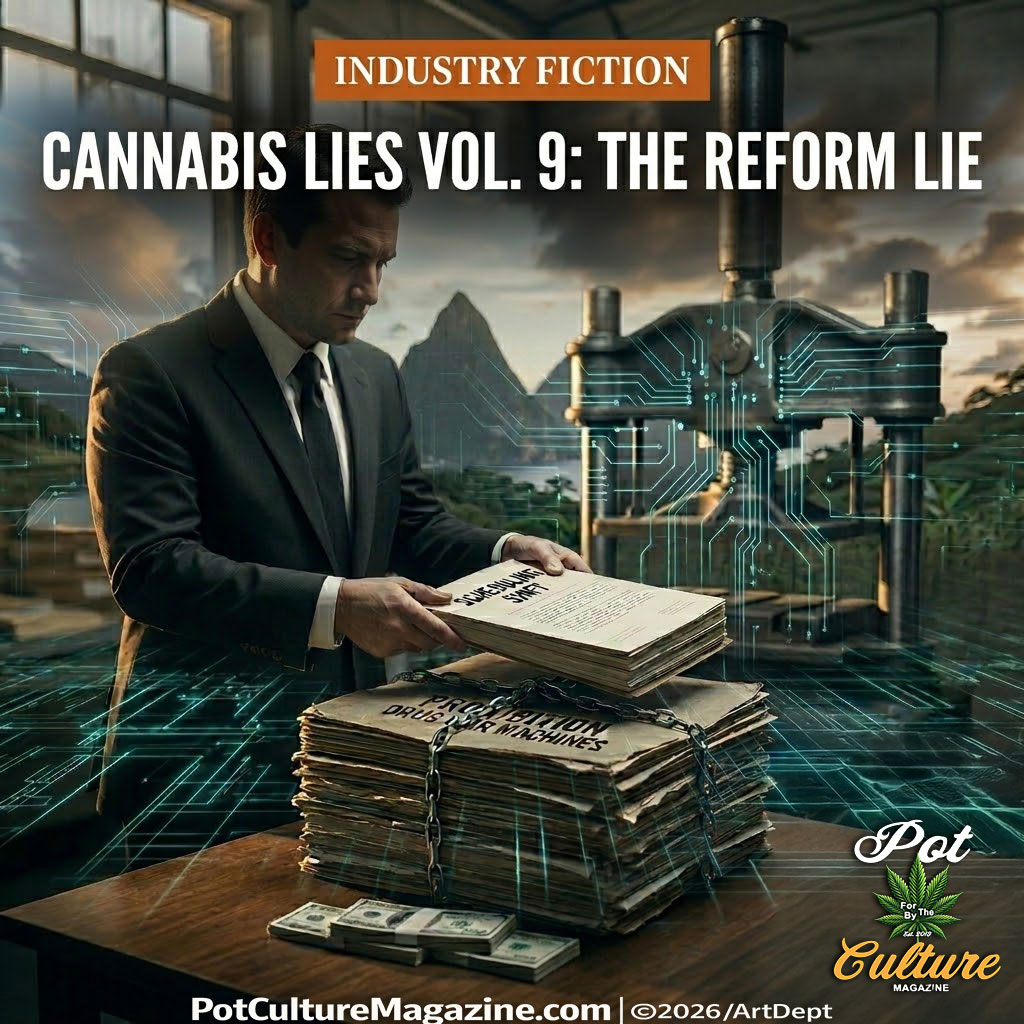
Cannabis Lies Vol. 9: The Reform Lie
The federal move to Schedule III is a masterclass in bureaucratic maintenance. While corporations celebrate tax relief, the core structure of the drug war remains untouched. This analysis deconstructs the Reform Lie, exposing how the state uses symbolic gestures to professionalize a privilege for the few while keeping the machinery of punishment active for everyone…
Discover more from POT CULTURE MAGAZINE
Subscribe to get the latest posts sent to your email.

Leave a comment