Filed Under: Fear Mongering Shitstains
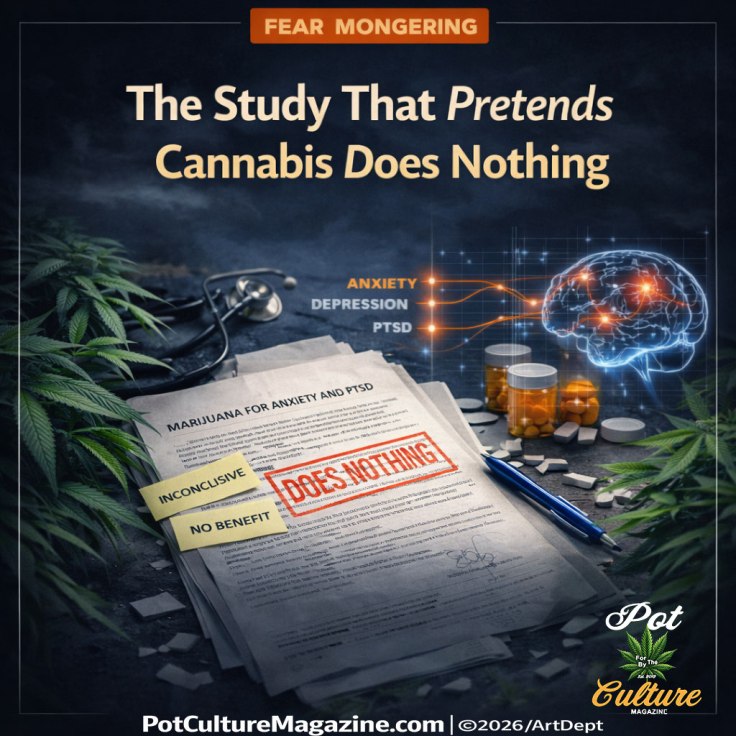
For nearly a century, cannabis has been studied, regulated, restricted, demonized, and dragged through more political theater than almost any plant on Earth. Yet every few months a headline appears declaring marijuana useless, dangerous, or both.
This week the cycle repeats again.
A new analysis is being waved around the internet claiming cannabis does nothing for anxiety, depression, or PTSD. The headlines are predictable. The conclusions sound dramatic. The implication is clear. The culture has been wrong about cannabis all along.
The problem is not the plant.
The problem is how the study is being sold.
Because when you actually read the research behind the headline, the conclusion is far less dramatic and far more revealing. The study does not prove that cannabis fails to help mental health. It exposes how decades of prohibition made serious cannabis research nearly impossible in the first place.
And that context matters.
For most of modern history, cannabis has been locked behind the strictest research restrictions in American drug law. For decades it sat in Schedule I under the Controlled Substances Act, a classification defined under federal law as having no accepted medical use and a high potential for abuse. Researchers who wanted to study it had to navigate a bureaucratic maze involving the Drug Enforcement Administration, the Food and Drug Administration, and, for decades, a single federally approved cannabis supply grown under government contract.
That supply came from one place.
The University of Mississippi.
For decades, it produced the federally legal research cannabis supply used in most studies in the United States through the National Institute on Drug Abuse Drug Supply Program. Many researchers have criticized that material as low potency, inconsistent, and poorly representative of the cannabis available in legal markets.
This matters because many of the studies cited in the new analysis are not examining real cannabis at all.
They are examining isolated compounds, synthetic cannabinoids, or pharmaceutical sprays that only partially mimic the plant. THC capsules. CBD isolates. Lab created cannabinoid analogs.
That is not the same thing as studying whole plant cannabis.
Imagine trying to judge whether coffee helps people focus by studying only caffeine pills. The chemical may be similar, but the experience is not the same. The surrounding compounds matter. The delivery method matters. The dose matters. The context matters.
Cannabis works the same way.
The plant contains more than 140 cannabinoids and dozens of aromatic compounds known as terpenes. These compounds interact with the human endocannabinoid system, identified in the late 1980s and early 1990s, a regulatory network involved in mood, stress response, sleep cycles, appetite, and memory.
That interaction is complex. It varies by strain, dosage, and individual biology. Which is exactly why many patients report using cannabis for symptoms like anxiety, trauma related sleep disruption, and chronic stress even while clinical research is still catching up.
But the research environment has never been neutral.
For decades the federal government made studying cannabis extremely difficult while much federally funded research focused on identifying risks. Positive or therapeutic outcomes were harder to explore because researchers often lacked access to appropriate plant material or funding.
The result was predictable.
A scientific literature filled with fragments.
Small sample sizes. Inconsistent products. Synthetic substitutes. And regulatory hurdles that slowed the field for generations.
Now those fragments are being bundled together and presented to the public as definitive proof that cannabis does nothing for mental health.
That is not science.
That is spin.
Even the authors of many cannabis reviews acknowledge the limitations. Large scale randomized clinical trials remain limited, including those published in The Lancet Psychiatry, because researchers have only recently seen expanded approval to study higher potency cannabis or products that resemble what consumers actually use.
Meanwhile more than 150 million Americans now live in states where cannabis is legal in some form, either medical or adult use, according to NORML.
Patients report using cannabis for sleep disorders, trauma recovery, anxiety management, and mood stabilization every day.
Some find relief.
Some do not.
That is how medicine works.
A treatment can be helpful for many people while still failing others. The absence of perfect clinical data does not automatically prove a substance is ineffective. It often means the research environment has not caught up with reality yet.
Cannabis sits squarely in that gap.
The science is still developing because prohibition slowed the field for half a century. Researchers are only now beginning to more widely study the plant under conditions that resemble how people actually use it.
Yet the headlines keep arriving.
Every few months the same script returns. A complicated scientific review is flattened into a simple claim. Cannabis does nothing. Cannabis causes everything. Cannabis is the new public health threat.
The pattern is familiar because it echoes the propaganda that defined the drug war.
For decades, government campaigns and media coverage frequently claimed cannabis caused insanity, violence, addiction epidemics, and social collapse. Those claims fueled arrests, prison sentences, and political campaigns built on fear.
Many of them collapsed under scrutiny.
Today the rhetoric has evolved. The language sounds more scientific. The warnings come wrapped in statistical charts instead of moral panic.
But the underlying pattern remains.
Selective interpretation. Overstated conclusions. Headlines that travel faster than the actual research.
Cannabis is not a miracle cure.
Anyone who claims it solves every medical problem is selling fantasy.
But pretending it offers no benefit at all requires ignoring both patient experience and the complicated history of how cannabis research has been restricted, delayed, and distorted for decades.
The plant did not suddenly stop working.
What keeps failing is the way the conversation around it gets manipulated.
Every time a new headline declares cannabis useless, the real story is usually hiding one layer deeper.
And once you read the actual research, the panic tends to dissolve.
The fear, it turns out, was manufactured long before the study ever appeared.
©2026 Pot Culture Magazine. All rights reserved. This content is the exclusive property of Pot Culture Magazine and may not be reproduced, distributed, or transmitted in any form or by any means without prior written permission from the publisher, except for brief quotations in critical reviews.
F O R T H E C U L T U R E B Y T H E C U L T U R E
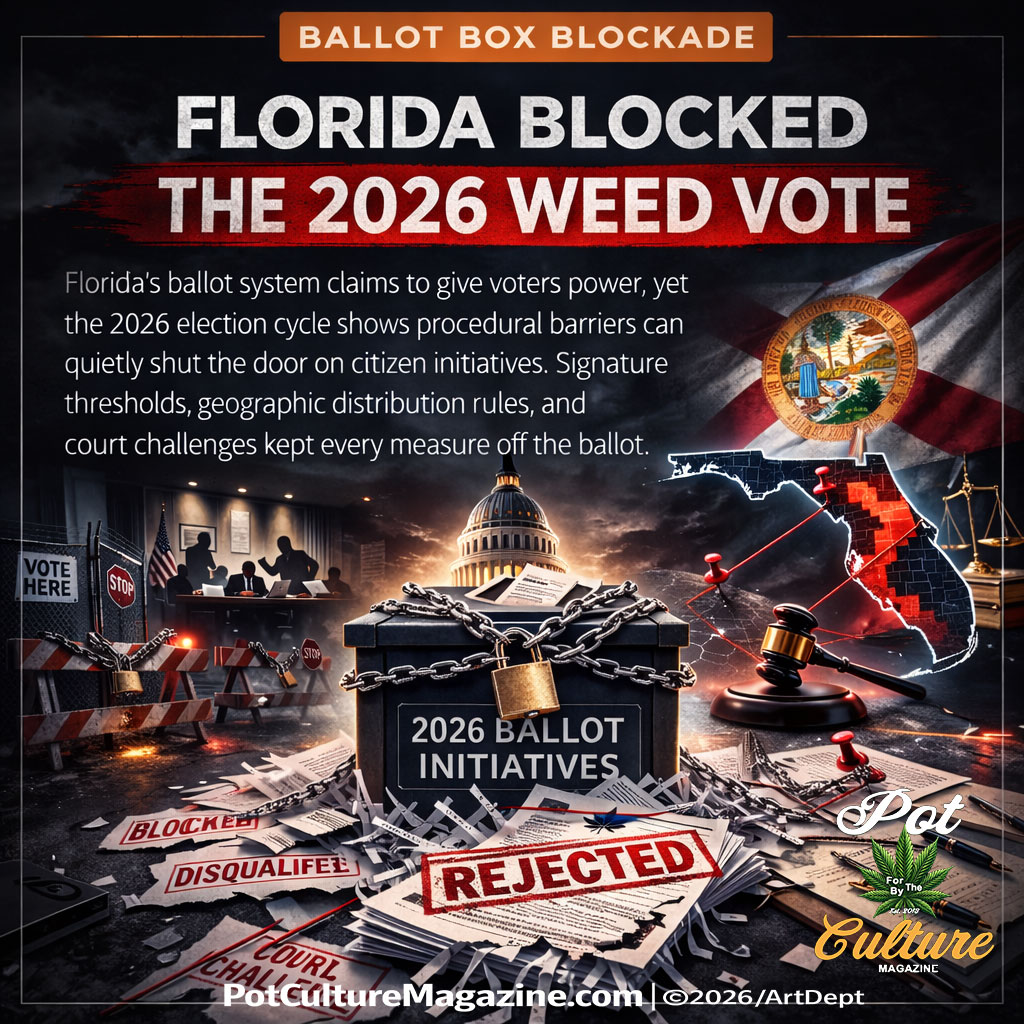
Florida Blocked the 2026 Weed Vote
Florida’s ballot system claims to give voters power, yet the 2026 election cycle shows how procedural barriers can quietly shut the door on citizen initiatives. Signature thresholds, geographic distribution rules, and court challenges blocked every measure from reaching voters, revealing how cannabis legalization fights are often decided by bureaucratic design long before election day.

The Cannabis Lie: Vol. 4 — The Crime Wave Lie
Politicians and pundits warned that legal cannabis would unleash a crime wave. The data tell a different story. From Colorado’s violent crime trends to DOJ time-series research and statewide arrest declines, the evidence shows no consistent long-term surge tied to legalization. The numbers never matched the panic.
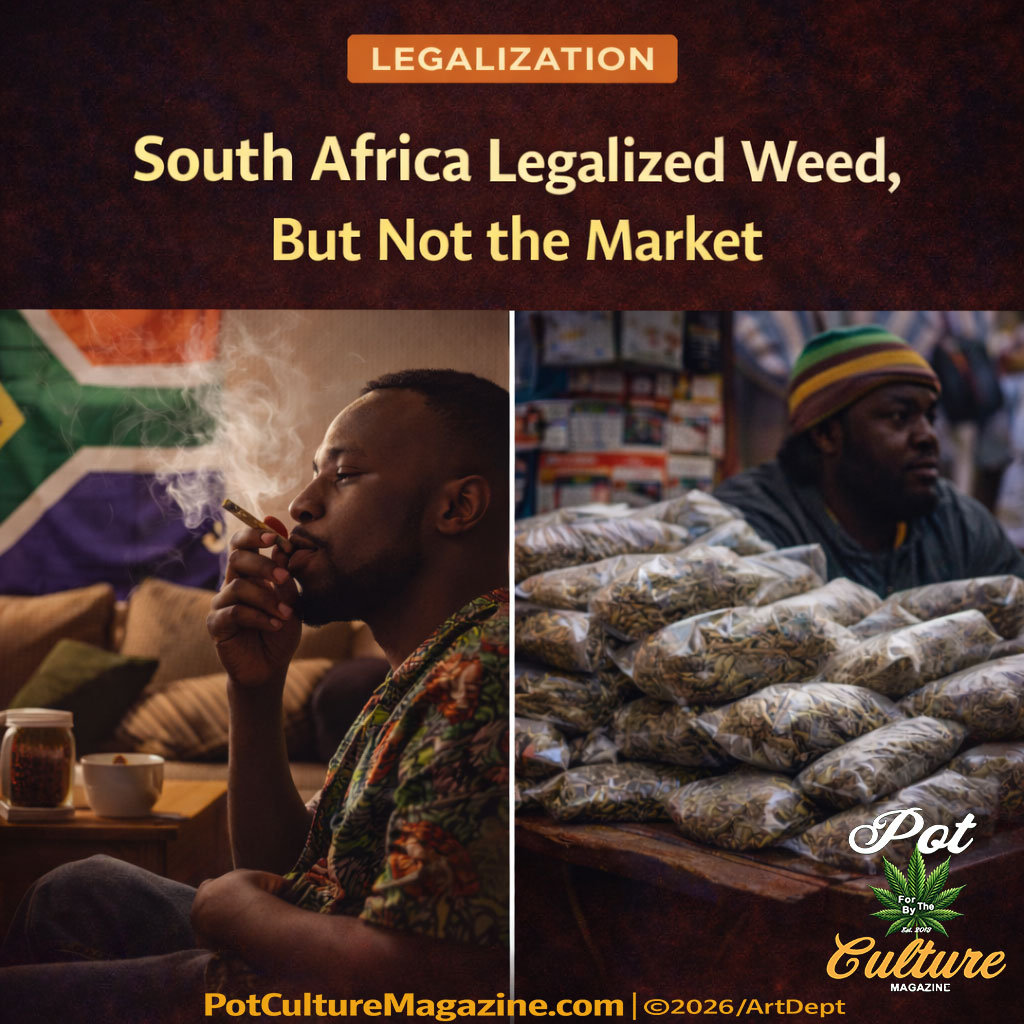
South Africa Legalized Weed, But Not the Market
South Africa recognized private adult cannabis use and home cultivation, but never built a legal domestic market around them. With buying and selling still largely outside the law, the illicit trade remains dominant while regulators scramble to set limits, draft rules, and prepare a broader Cannabis Bill that could finally address commerce.
Discover more from POT CULTURE MAGAZINE
Subscribe to get the latest posts sent to your email.

Leave a comment