Filed Under: Federal Fog, Rights and Wrongs
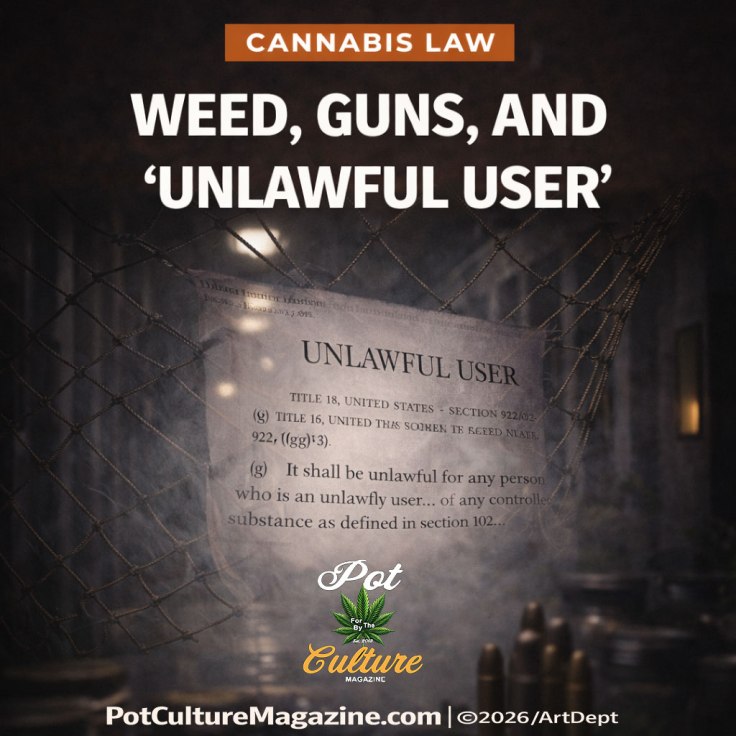
The Second Amendment says, “a well-regulated militia, being necessary to the security of a free state, the right of the people to keep and bear arms, shall not be infringed.” Unless you smoke pot. Once, twice, every day, it does not matter because the federal rule is a fog machine. “Unlawful user” is vague, it is arbitrary, and it can turn otherwise lawful gun owners into criminals by definition. On March 2, 2026, the Supreme Court will hear United States v. Hemani, a case built on that exact contradiction.
This is one of the Court’s biggest Second Amendment fights this term. But if you are reading this in a weed magazine, the gun part is not the point. The point is what happens when the government writes a law that never bothers to define the phrase that does all the work. “Unlawful user” sounds like a clean category until you try to live inside it. Then it becomes a trap door, a moving target, a status crime you can fall into without knowing where the edge is.
The law at the center of the case is 18 U.S.C. § 922(g)(3), which bars gun possession by anyone who is “an unlawful user of or addicted to” a controlled substance. That one phrase drags federal drug policy into a constitutional fight, then pretends the phrase is self-explanatory. It is not. The whole case turns on a term Congress left undefined, and enforcement offices turned into a flexible tool.
Here is the accountability problem in plain English. Criminal laws are supposed to draw lines that normal people can see. The government is supposed to tell you what is legal before it puts you in cuffs for doing the opposite. That is not a courtesy; it is basic due process. When a criminal statute is so unclear that people cannot tell what it prohibits, the law stops acting like a law and starts acting like a net. A net is not meant to inform you. A net is meant to catch you when the government wants to catch you.
“Unlawful user” is the net.
These laws create a quagmire of vague confusion around use and timing, and that confusion is not an accident. If “unlawful user” has no clear boundary, then the boundary becomes whatever a prosecutor says it is on the day you get dragged into court. That sweeps in edge cases that should never be edge cases, a teenager who tried weed once, a working adult who uses it occasionally, a veteran using cannabis to manage PTSD symptoms or pain from service-related injuries. The statute does not distinguish between any of them. It threatens to strip constitutional rights based on a definition that cannot even stay consistent from one federal circuit to the next.
And the courts have been complaining about this for years. One appellate court in the Fifth Circuit era noted the basic defect plainly: federal law defines “controlled substance,” and it defines “addict,” but it does not define “unlawful user.” The result is predictable: courts and prosecutors fill the blank case by case, and the blank becomes a weapon.
So what fills the vacuum? Not Congress. Not a bright line in the statute. The vacuum gets filled by judges trying to reverse engineer meaning, and by regulators writing definitions that can drift with politics.
That is why the same words produce different outcomes depending on where you live.
Federal courts have struggled to apply § 922(g)(3) consistently because the statute does not tell them how. Some judges treat “unlawful user” like a pattern, meaning regular use over time. Others treat it like proximity, meaning they use close in time to gun possession. Others treat it like an inference game, where the government piles up scraps, a prior arrest, a stale admission, a test, a photo, and asks the jury to guess what the defendant’s status was at the relevant moment.
If you want to call that a technical dispute, fine. In real life, it means the same person can be legal in one circuit and a felon in another. That is not uniform law; it is criminal roulette.
This is where the regulatory definition matters. Because Congress left the key term undefined, regulators tried to supply a working language in the rules.
Under 27 C.F.R. § 478.11, an “unlawful user” is framed as someone who regularly uses a controlled substance over an extended period of time continuing into the present, while isolated or sporadic use does not qualify. The regulation also says an inference of current use may be drawn from specified recent indicators, including certain convictions, arrest patterns, or a drug test within the past year.
That is closer to a usable definition, but it still leaves room for argument, because words like “regularly,” “extended period,” and “continuing into the present” are elastic. Elastic language may be convenient for enforcement, but it is a problem when the consequence is criminal liability and the loss of rights.
Here is the rub. The fact that the definition can swing proves the bigger point: Congress wrote a criminal prohibition without defining the key term, then left it to agencies and courts to improvise. When that improvisation gets challenged, the government can argue a narrow reading in one forum and rely on a broader inference posture in another. The law becomes whatever is most convenient in the moment.
That is not how criminal justice is supposed to work. It is how power works when it has no guardrails.
This is where the piece stops being about guns and starts being about the American habit of writing vague criminal categories and calling it governance. A vague law is an invitation to selective enforcement. Selective enforcement is an invitation to unequal outcomes. Unequal outcomes are how a legal system keeps its hands clean while its incentives stay dirty.
HELP POT CULTURE MAGAZINE STAY ALIVE, AND INDEPENDENT
When a law is vague, enforcement is a choice. When enforcement is a choice, it becomes political. It becomes uneven. It becomes whatever the local office wants it to be.
And in a country where marijuana enforcement has always been selective, that should set off alarms.
Let’s be honest about how this plays out in real courtrooms. The government does not sweep the whole world with § 922(g)(3) every day. It uses it when it wants leverage. It uses it when it wants an extra count. It uses it when it wants a plea. It uses it when it wants to raise exposure. In that context, vagueness is not a defect. Vagueness is leverage.
A clearly defined law limits the state’s ability to improvise. A vague law expands it. A vague law lets the government find guilt in the gaps.
If the Supreme Court wants to stay consistent with basic due process principles, it has a cleaner exit than a history scavenger hunt. It can treat the vagueness problem as a real constitutional defect. A vagueness ruling would not be a culture war win for gun people or weed people. It would be a demand that Congress write laws as it means. If the government is going to strip a constitutional right and attach criminal penalties, it has to define the key term so ordinary people can understand it, and courts can apply it the same way in every state.
This case also lands in the shadow of the Court’s post-Bruen Second Amendment framework, which pushed gun cases into a “historical tradition” test that lower courts have struggled to apply consistently. That inconsistency is part of why Hemani matters.
As Paul Armentano, NORML Deputy Director, put it:
“There is no credible justification for a ‘marijuana exception’ to the US Constitution.”
When doctrine becomes a choose your own adventure, vague statutes get even more dangerous, because the two vaguenesses multiply.
And there is a cannabis specific twist that is easy to miss if you keep staring at the gun headline. The federal government still treats marijuana like a controlled substance in the same category system that powers the rest of federal drug enforcement. States can normalize it, tax it, and regulate it, but federal law still treats the user category as unlawful by default. That mismatch keeps spilling into other areas of life, employment, housing, parenting, immigration, and now gun rights.
So when people ask, “How far can Congress go?” the sharper question is, “How far can Congress go while refusing to define its terms?” How far can the government go while keeping the definition fuzzy enough to flex when it wants?
Because that is what § 922(g)(3) becomes in practice. Not a targeted rule with a narrow purpose, but a broad status label. A law that can be used hard against one defendant and ignored for another, depending on where the case lands, what the prosecutor wants, and what evidence is easiest to wave in front of a jury.
This is not about being pro-gun or anti-gun. It is about being anti-trap. A vague criminal prohibition attached to a constitutional right is not precise government. It is sloppy power.
The cannabis angle is not a tangent. It is the case study.
America has spent decades running marijuana through the respectable corruption machine. Moral panic, junk science, political theater, selective enforcement, and then, once the money shifted, a slow, partial retreat that never fully cleans up the wreckage. We have states that sell cannabis like a commodity and a federal government that still treats the user as a criminal category. That mismatch spills into everything, and Hemani is the latest reminder that “legalization” has been sold as closure while federal punishment logic is still operating in the background.
If the Supreme Court wants to act like a court and not a weather vane, it has to confront the real question hiding inside this case.
If the government cannot define “unlawful user,” it is not a law. It is a net.
©2026 Pot Culture Magazine. All rights reserved. This content is the exclusive property of Pot Culture Magazine and may not be reproduced, distributed, or transmitted in any form or by any means without prior written permission from the publisher, except for brief quotations in critical reviews.
F O R T H E C U L T U R E B Y T H E C U L T U R E
MS LIMITS MEDICAL CANNABIS WHERE IT MATTERS MOST
Mississippi maintains strict limits on medical cannabis after Governor Tate Reeves vetoed expansion bills on March 26, 2026. Patients remain unable to use cannabis in hospitals while eligibility and access rules stay tightly controlled. This feature examines what the veto blocks, how it affects patients, and what it means for the state’s growing cannabis market.

CANNABIS LIES Vol. 6: The Driving Apocalypse Lie
Legal cannabis is often blamed for rising traffic deaths, but federal data tells a more complicated story. NHTSA findings, toxicology limitations, and conflicting crash studies reveal that THC presence is not a reliable measure of impairment. This investigation breaks down how flawed testing and policy shortcuts have shaped the narrative around so-called stoned driving.

Thailand Lost Control
Thailand blew open its cannabis market, then tried to force it back under control. This feature tracks the country’s shift from prohibition to medical legalization, decriminalization, and regulatory backlash, exposing how weak enforcement, political pressure, and rushed policy turned a reform headline into a live case study in state correction.
Discover more from POT CULTURE MAGAZINE
Subscribe to get the latest posts sent to your email.

Leave a comment