Filed Under: Rights Sold Separately
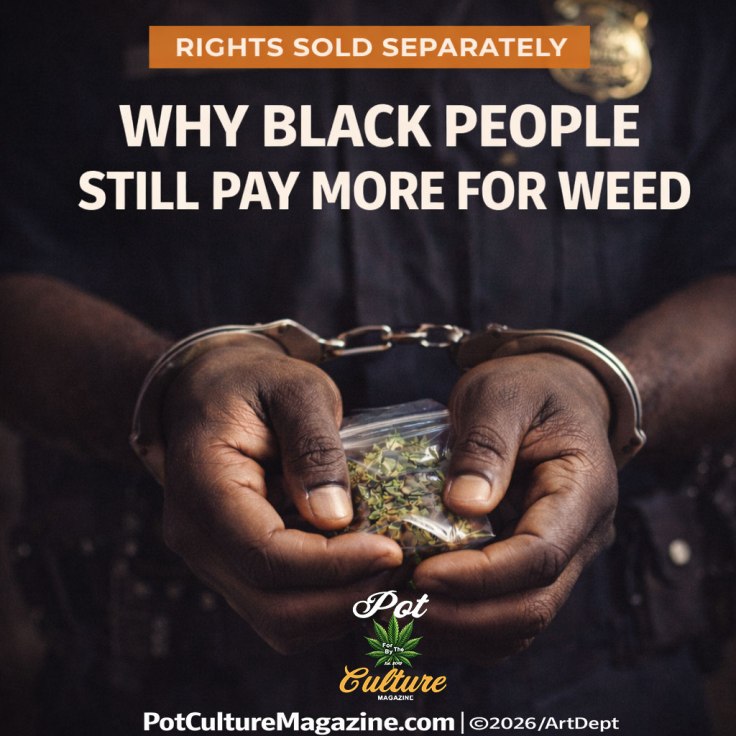
Cannabis use in the United States does not break cleanly along racial lines. Arrests do. National surveys have repeatedly shown that Black and white Americans use marijuana at roughly similar rates, as documented by the Pew Research Center, a finding that has held steady across decades and methodologies. Enforcement outcomes tell a different story. Black people are arrested for marijuana possession at approximately three-and-a-half to four times the rate of white people nationwide, a ratio that persists regardless of shifts in public opinion or state law. That disparity is not speculative. It is documented, stable, and measurable.
The scale of cannabis enforcement sharpens the picture. In recent national crime reporting, hundreds of thousands of marijuana-related arrests still occur each year, according to FBI Uniform Crime Reporting data, even as legalization spreads. More than eighty-five percent of those arrests are for simple possession, a pattern tracked consistently by the ACLU, not sale or trafficking. In some reporting years, the share climbs closer to ninety percent. This matters because it defines what the system is actually doing. Cannabis policing in the United States is not aimed primarily at organized crime. It is aimed at people holding a small amount of a plant, often during encounters that begin for reasons unrelated to drugs.
When enforcement concentrates on possession, outcomes depend heavily on where police look and how often they look there. Possession charges are easy to generate. They require little investigation, minimal proof, and wide officer discretion. That discretion determines who receives a warning and who receives a citation, whose citation escalates into an arrest, and whose arrest carries lasting consequences. Those decisions do not occur evenly across communities.
Public opinion data helps explain why the gap has become harder to ignore. A 2022 analysis by the Pew Research Center found that clear majorities of Black Americans favor marijuana legalization and easing criminal penalties, as found by the Pew Research Center, reflecting long experience with how cannabis laws are applied. Pew also confirmed what earlier national surveys had already established: reported marijuana use among Black and white adults is comparable. The arrest gap cannot be explained by behavior. It is explained by enforcement.
Arrest records illustrate the imbalance plainly. In recent national data, Black Americans accounted for around forty percent of marijuana possession arrests while representing roughly thirteen percent of the population, according to combined ACLU and federal arrest data. In some states, particularly in parts of the Midwest and Upper South, the ratio widens further, exceeding five-to-one. These differences appear in legal states and non-legal states alike, though total arrest numbers fall where possession has been legalized. The gap narrows in some places, but it rarely disappears.
The persistence of this pattern points to structure rather than intent. Cannabis laws grant officers broad authority to initiate contact based on minor indicators such as odor, appearance, or proximity. That authority is exercised most frequently in neighborhoods already shaped by dense policing. Where patrols are constant, contact multiplies. Where contact multiplies, arrest counts rise. The resulting statistics then reinforce the perception that certain areas have higher drug activity, justifying continued attention. The cycle sustains itself without requiring overt bias.
Possession enforcement fits neatly into proactive policing models that reward activity. Stops produce searches. Searches produce citations. Citations generate data points that can be cited as proof of effectiveness. None of this requires a serious threat to public safety. Cannabis possession offers an easy metric. It fills quotas without the complications of complex investigations. It also produces consequences that extend far beyond the initial encounter.
An arrest for possession rarely ends with the moment itself. Criminal records complicate employment prospects. Housing applications stall or fail. Professional licenses become harder to obtain. Educational aid can be delayed or denied. For non-citizens, even low-level cannabis convictions can trigger immigration consequences. These penalties attach automatically. They do not scale to the conduct. They scale to the record.
Because Black Americans are arrested for possession at several times the rate of white Americans, they also absorb several times the collateral damage. The effect compounds over time. One arrest alters the trajectory of an individual. Thousands reshape neighborhoods. Families adapt around lost income, restricted mobility, and lingering stigma. The disparity becomes generational.
Legalization was expected to interrupt this process. In some respects, it has. Arrest totals drop sharply in states that fully legalize possession. Jail populations fall. Police resources shift. These changes matter. They do not erase disparity. Studies from early legalization states found that racial gaps in cannabis enforcement often persist for offenses that remain illegal, such as public consumption, possession above legal limits, or unlicensed sales. When the legal boundary moves, enforcement follows it. The same communities remain under scrutiny.
HELP POT CULTURE MAGAZINE STAY ALIVE, AND INDEPENDENT
Illinois provides a telling example. During the period when cannabis was decriminalized but not yet legal, racial disparities in marijuana arrests widened. Black residents were arrested at several times the rate of white residents, even as penalties were reduced. Lawmakers later cited this outcome when drafting legalization legislation that included automatic expungement and equity provisions. The state acknowledged that legalization without repair would leave the underlying imbalance intact.
The industry that emerged alongside legalization reflects similar patterns. Entry into the legal cannabis market requires capital, regulatory fluency, and access to financing. Communities most harmed by prohibition often lack those resources. Early legalization programs in several states produced industries dominated by well-funded operators, while people with prior cannabis convictions remained excluded. Social equity programs were introduced to address this gap, offering licensing preferences, fee waivers, and reinvestment funds. Results have been uneven. Legal challenges, capital barriers, and administrative delays have limited impact in many jurisdictions.
The historical roots of cannabis enforcement explain why the gap has proven durable. Marijuana prohibition in the United States was shaped early by racialized narratives that tied the plant to marginalized groups. Those narratives justified expanded police authority long before modern drug-war rhetoric took hold. By the time cannabis was folded into broader federal drug policy in the 1970s, it had already become an ideal enforcement tool: widely used, easy to detect, and heavily stigmatized.
That history matters because policy carries memory. Enforcement habits formed under prohibition do not dissolve when statutes change. They persist through training, culture, and incentive structures. Legalization alters the law on paper. It does not automatically rewire daily practice. Without deliberate intervention, patterns continue.

Read More on Kevin Allen Here
February invites reflection, but the disparity attached to cannabis enforcement is not seasonal. It is ongoing. The temptation to frame the issue as historical does not survive contact with current data. Arrest ratios remain skewed. Possession still dominates enforcement. Collateral consequences still attach. Precision matters because it prevents the issue from being reduced to abstraction.
Saying that Black people are more likely to be arrested is insufficient. Three-and-a-half to four times more likely is a defined condition. Saying that cannabis enforcement targets low-level conduct is vague. More than eighty-five percent of arrests for possession are a specific practice. These numbers clarify what is happening and who is paying the price.
Some states have taken steps toward repair. Automatic expungement laws have cleared large numbers of past cannabis convictions, including programs documented in states like Illinois and California. Reinvestment programs direct tax revenue toward communities harmed by enforcement. Licensing reforms aim to broaden participation. Progress exists. It remains fragile. Many people still carry records for conduct that is now legal. Many communities still experience disproportionate surveillance.
At the federal level, proposals to deschedule cannabis and expunge federal convictions acknowledge the problem directly. They also face resistance rooted in narratives that emphasize hypothetical risks over documented harm. The debate continues to revolve around fear rather than evidence.
The persistence of racial disparity in cannabis enforcement is not mysterious. It endures because the mechanisms that produce it remain intact. Discretionary stops still dominate. Possession laws still offer easy points of contact. Collateral consequences still follow automatically. Until those structures change, legalization alone will not deliver equity.
The phrase rights sold separately fits because cannabis freedom arrives conditionally. Legal possession exists on paper while enforcement continues to sort people by place and perception. Access to the legal market expands for some, while others carry the weight of old convictions. The cost of cannabis for many Black Americans has never been limited to price. It has included exposure to police contact, risk of arrest, and long-term consequences that outlast the moment.
The data does not require interpretation to be understood. Comparable use. Disparate arrests. Overwhelming possession. Persistent collateral damage. These are features of the present. If cannabis policy is going to move beyond symbolism, it must confront that reality directly, with specificity and repair. Until then, legalization will remain uneven, and the bill will keep landing in the same hands.
©2025 Pot Culture Magazine. All rights reserved. This content is the exclusive property of Pot Culture Magazine. It may not be reproduced, distributed, or transmitted in any form or by any means without prior written permission from the publisher, except for brief quotations in critical reviews.
F O R T H E C U L T U R E B Y T H E C U L T U R E

South Africa Legalized Weed, But Not the Market
South Africa recognized private adult cannabis use and home cultivation, but never built a legal domestic market around them. With buying and selling still largely outside the law, the illicit trade remains dominant while regulators scramble to set limits, draft rules, and prepare a broader Cannabis Bill that could finally address commerce.

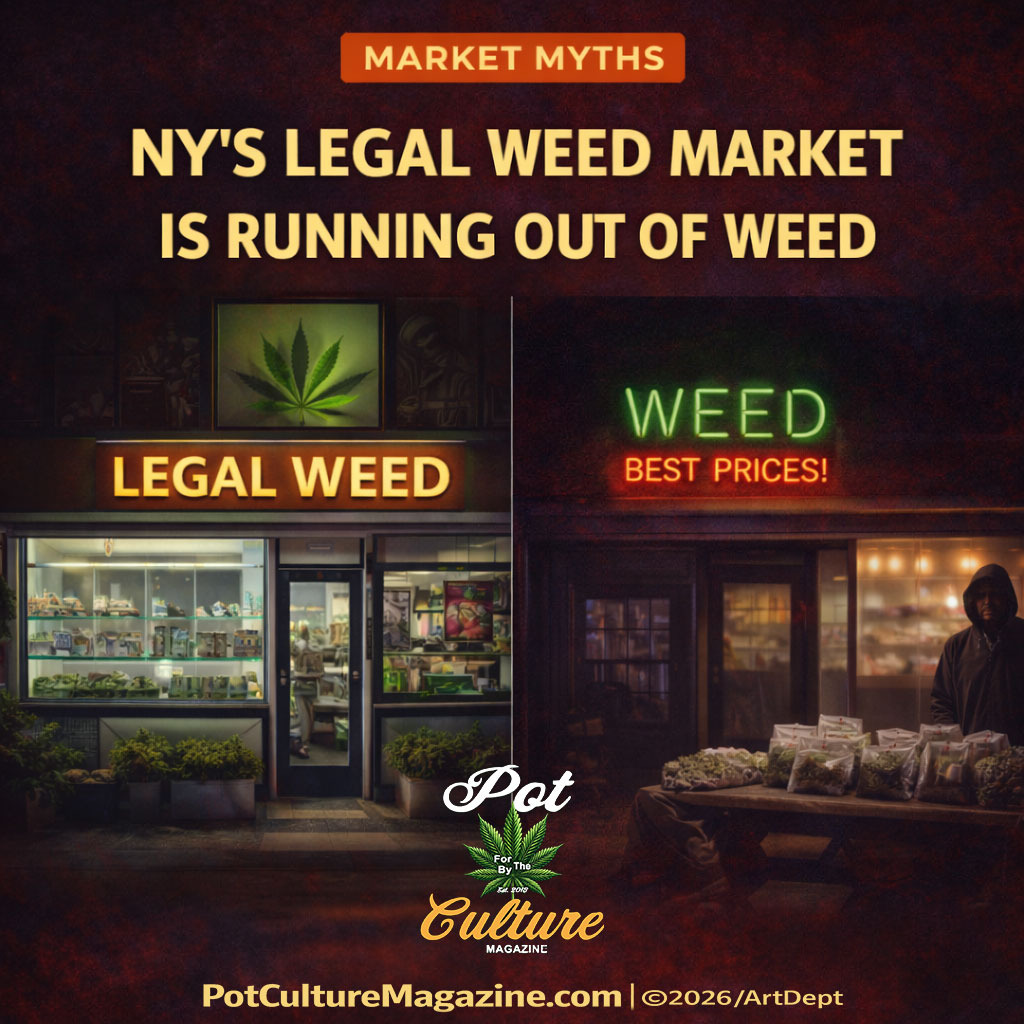
NY’s Legal Weed Market Is Running Out of Weed
New York legalized cannabis and opened hundreds of stores, but regulators now warn the legal market may not produce enough weed to keep them stocked. With nearly 600 stores open and sales nearing $3 billion, the state is discovering that legalization alone does not guarantee a functioning market.
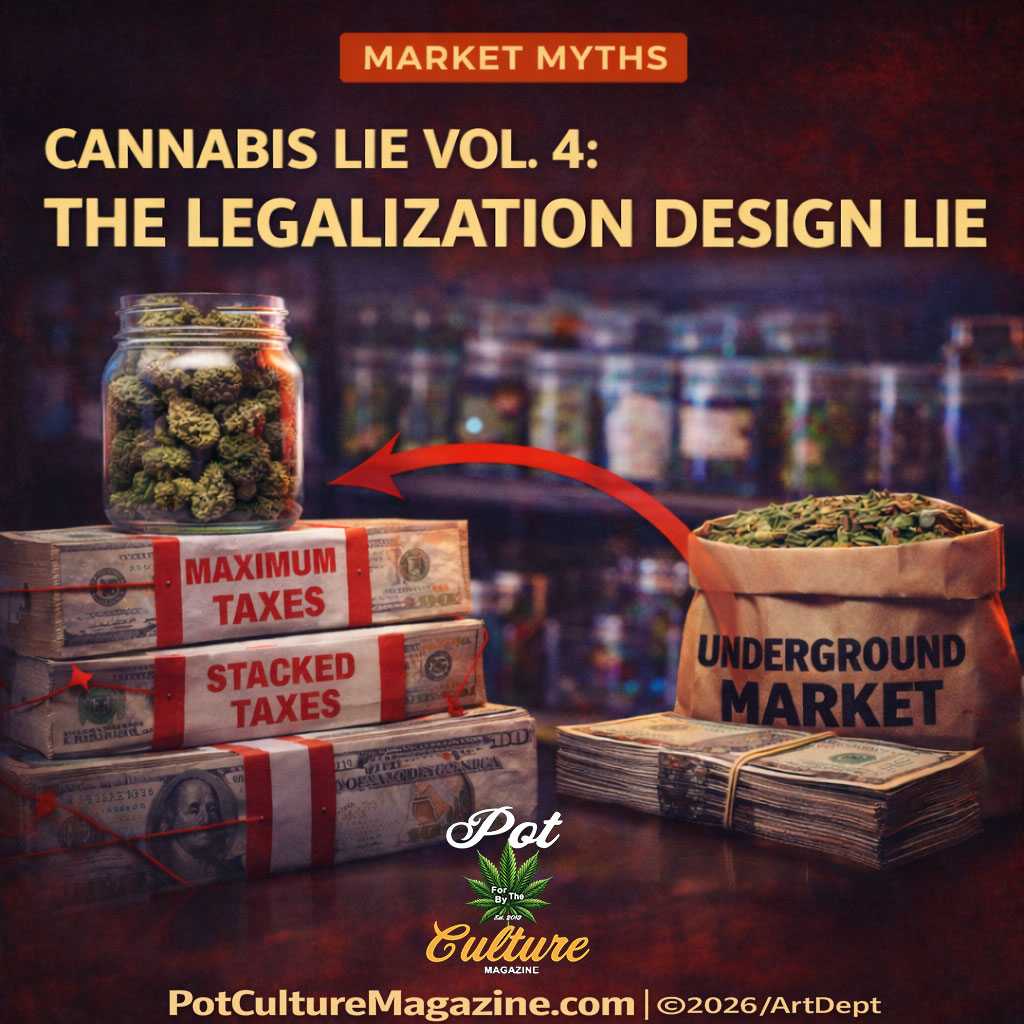
Cannabis Lie Vol. 4: The Legalization Design Lie
Cannabis legalization was sold as the end of the illicit market. Instead, stacked taxes, licensing limits, and local bans created price gaps that allowed underground sales to survive. From California’s cultivation tax to Illinois pricing and Michigan’s price compression, this installment of Cannabis Lie examines how policy design, not the plant, determines who wins and…
Discover more from POT CULTURE MAGAZINE
Subscribe to get the latest posts sent to your email.

Leave a comment