Week Ending January 30, 2026
Filed Under: The Week in Weed
This was not a week of progress. It was a week of postponement. Cannabis policy once again stalled in place as lawmakers circled familiar territory without committing to action. Headlines suggested motion. The reality was hesitation. Reform did not advance. It simply waited.

STATEHOUSE HEADLINER
The most significant development of the week was not legalization or enforcement. It was delayed.
Federal lawmakers moved to postpone action on hemp-derived THC, extending uncertainty rather than resolving it. The proposal neither clarified legality nor established a regulatory framework. It avoided banning products outright while refusing to define boundaries.
Industry groups warned that continued ambiguity puts retailers, farmers, and consumers at risk. Without clear federal standards, states continue writing conflicting rules, enforcement remains uneven, and legal exposure grows. Everyone involved acknowledges that the market exists. No one wants ownership of it.
The message from Washington was familiar. Not yet. Not now. Maybe later.
Grade: D

GOVERNMENT CLOWN CAR AWARD
Federal agencies spent the week speaking in circles.
Public statements emphasized “review,” “process,” and “evaluation” while avoiding timelines or commitments, particularly from agencies operating under the Controlled Substances Act. The same agencies that have insisted for years that cannabis reform requires more study now appear content to let uncertainty serve as policy.
This is governance by delay. Nothing illegal occurs. Nothing useful happens either.
When regulators refuse to act, they force courts and states to fill the vacuum. That path has never produced stability.
Grade: D

REGULATOR ROULETTE
State governments continued to demonstrate how fragile legalization remains.
Several legislatures floated proposals aimed at rolling back regulated cannabis markets while leaving possession technically legal. The pitch is simple. Remove oversight. Remove licensing. Remove taxation.
What disappears is accountability.
Regulated systems exist to protect consumers, workers, and municipalities. Removing those systems does not eliminate cannabis. It recreates the unregulated conditions that legalization was meant to replace.
Grade: D-

PATIENT RIGHTS WATCH
Patients were once again left behind.
Federal protections remain unchanged under federal law. Employment policies still penalize lawful cannabis use under drug-free workplace rules. Housing and benefit restrictions continue to expose patients to punishment despite state legality.
Medical cannabis exists in theory. In practice, patients are still forced to navigate a system that treats them as liabilities.
Nothing this week improved access. Nothing reduced risk. Nothing acknowledged reality.
Grade: D

INTERNATIONAL HEAT CHECK
Abroad, the contrast continues to grow.
Other countries are adjusting policy slowly, sometimes clumsily, but with intention, including reforms tracked by Reuters. Even when reforms stumble, they are refined rather than abandoned.
The United States, meanwhile, continues to argue with itself over problems other governments have already decided to solve.
Grade: C
FINAL GRADE
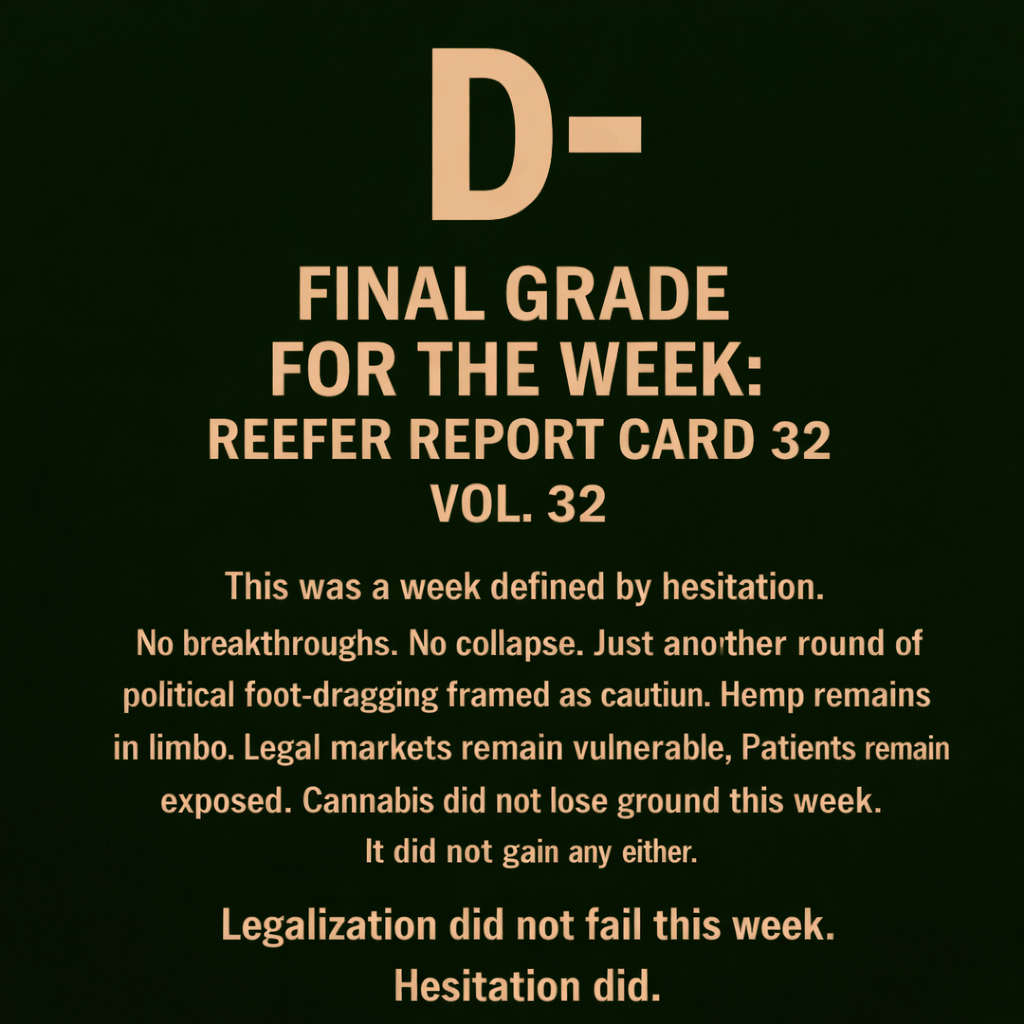
This was a week defined by hesitation.
No breakthroughs. No collapse. Just another round of political foot-dragging framed as caution. Hemp remains in limbo. Legal markets remain vulnerable. Patients remain exposed.
Cannabis did not lose ground this week. It did not gain any either.
Final Grade: D-
©2026 Pot Culture Magazine. All rights reserved. This content is the exclusive property of Pot Culture Magazine and may not be reproduced, distributed, or transmitted in any form or by any means without prior written permission from the publisher, except for brief quotations in critical reviews.
F O R T H E C U L T U R E B Y T H E C U L T U R E
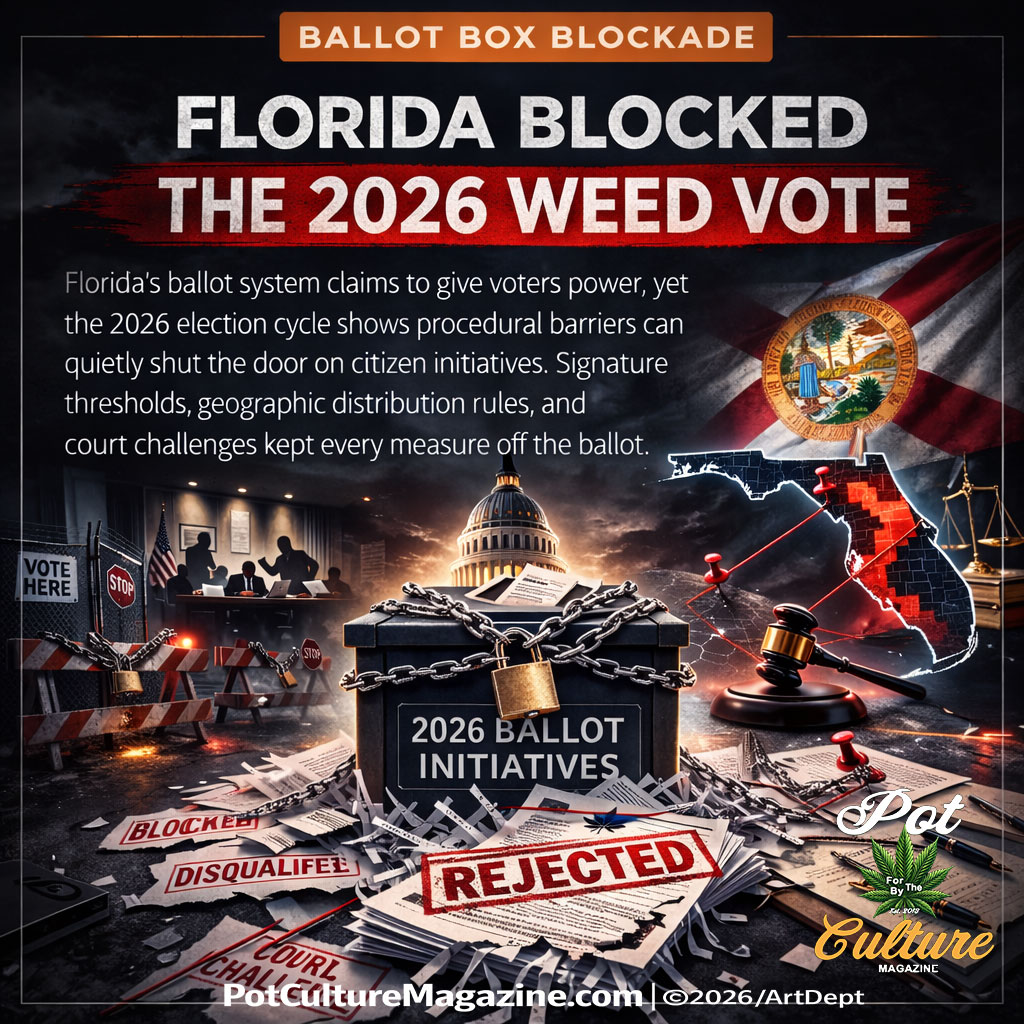
Florida Blocked the 2026 Weed Vote
Florida’s ballot system claims to give voters power, yet the 2026 election cycle shows how procedural barriers can quietly shut the door on citizen initiatives. Signature thresholds, geographic distribution rules, and court challenges blocked every measure from reaching voters, revealing how cannabis legalization fights are often decided by bureaucratic design long before election day.


The Cannabis Lie: Vol. 4 — The Crime Wave Lie
Politicians and pundits warned that legal cannabis would unleash a crime wave. The data tell a different story. From Colorado’s violent crime trends to DOJ time-series research and statewide arrest declines, the evidence shows no consistent long-term surge tied to legalization. The numbers never matched the panic.

South Africa Legalized Weed, But Not the Market
South Africa recognized private adult cannabis use and home cultivation, but never built a legal domestic market around them. With buying and selling still largely outside the law, the illicit trade remains dominant while regulators scramble to set limits, draft rules, and prepare a broader Cannabis Bill that could finally address commerce.
Discover more from POT CULTURE MAGAZINE
Subscribe to get the latest posts sent to your email.

Leave a comment