Filed Under: One toke over the line
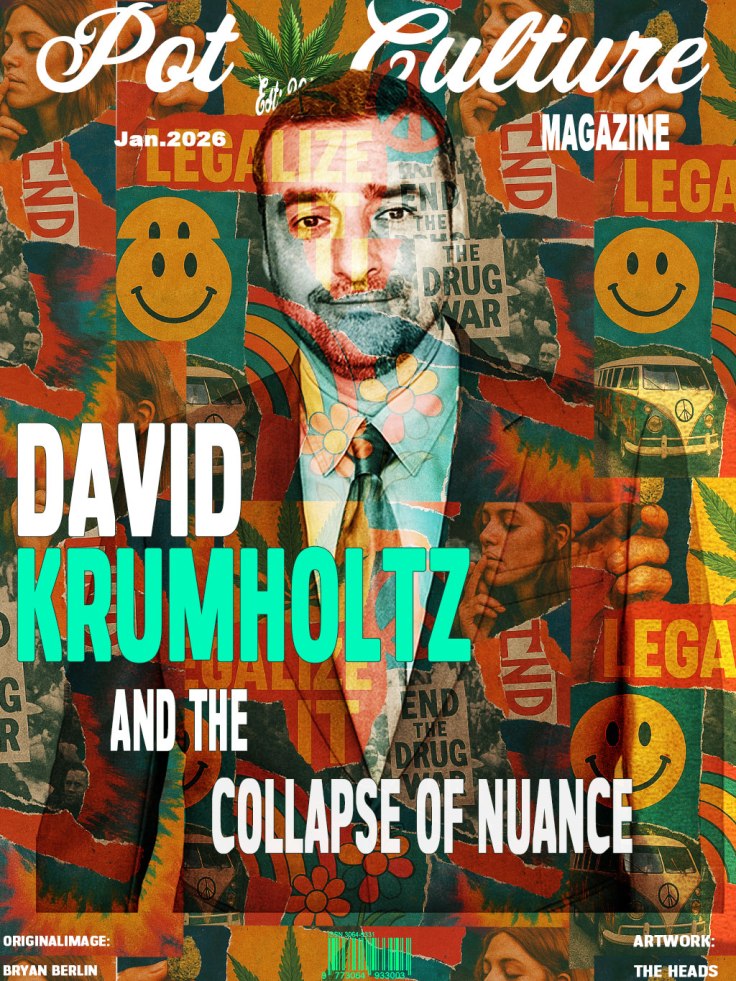
There is a difference between talking about cannabis honestly and turning a human being into a warning sign.
That line gets crossed more often than anyone wants to admit, and when it does, the conversation collapses into camps instead of facts. That is what happened after actor David Krumholtz spoke publicly about his experience with Cannabinoid Hyperemesis Syndrome, a rare and still poorly understood condition associated with chronic cannabis use.
Back in March, Pot Culture Magazine covered Krumholtz’s story for a reason. Not because it was sensational, and not because it threatened cannabis culture, but because it was real. A former cannabis user developed a medical condition. His experience mattered. So did the need for proportionality.
What followed is worth examining, not to defend or prosecute anyone, but to understand how quickly nuance disappears once fear, identity, and misinformation enter the room.
CHS exists. That should not be controversial. It is rare, it is not well understood, and it presents real symptoms for the people who experience it. Acknowledging that reality does not weaken cannabis culture. Pretending it does not exist does.
At the same time, CHS is not representative of the average cannabis user, and it is not a public health crisis on the scale some advocacy messaging would have people believe. Both things can be true at once. That is the adult position.
Krumholtz himself has never framed his experience as an attack on cannabis or the people who use it. When asked recently about the way his story has been circulated, he was blunt and resigned.
HELP POT CULTURE MAGAZINE STAY ALIVE, AND INDEPENDENT
“Nothing I can do. If it helps one person, I’m ok with it.”
That response does not come from someone looking to dismantle a community. It comes from someone who experienced something real and has chosen not to police how others interpret it.
He was equally candid about the reaction he had received from parts of cannabis culture.
“Reading the comments, I just think it’s funny how up in arms potheads are about peeps talking about CHS, as if it threatens their very existence.”
“And that cliché paranoia: ‘he’s being paid by Anheuser Busch, etc.’”
Whether readers agree with his phrasing or not, the frustration itself is telling. What he is describing is not a scientific debate. It is an emotional one. A segment of cannabis culture reacts defensively to uncomfortable information, not because it is inaccurate, but because it feels like an existential threat.
That reaction is understandable in a culture that has spent decades fighting prohibition, stigma, and outright lies. But understandable does not mean helpful.
At the same time, there is a parallel problem that often goes unaddressed. Stories like Krumholtz’s are routinely stripped of context and repurposed by anti cannabis advocacy groups as proof that legalization itself is reckless or dangerous. Rare conditions are presented as norms. Individual experiences are treated as population-wide outcomes. Complexity is replaced with alarm.
This is where the damage multiplies.
When fear-driven narratives dominate, entire communities disappear from the conversation. Veterans who rely on cannabis to manage PTSD, chronic pain, and sleep disorders are rarely acknowledged in prohibition messaging. Cancer patients using cannabis to ease nausea, stimulate appetite, and manage pain are often reduced to footnotes. Families navigating pediatric epilepsy, who already live inside impossible risk calculations, are erased entirely.
For many chronic pain patients, cannabis became an alternative after opioids failed them or harmed them. Rolling back access or amplifying panic does not send those people back to safety. It pushes them toward worse options.
None of that negates CHS. It simply restores scale.
Public health conversations break down when they allow only one angle to exist. When conditions like CHS are treated as taboo within cannabis culture, misinformation flourishes. When those same conditions are weaponized by prohibition-aligned actors, patients become collateral damage.
Public figures like Krumholtz get caught in the middle. They become symbols instead of people. Their stories are either dismissed outright or inflated beyond recognition, depending on who is telling them. Neither approach serves truth.
The more productive question is not whether cannabis culture should feel threatened by conversations about CHS. It is why those conversations keep collapsing into absolutes. Why nuance is treated as betrayal. Why is acknowledgment mistaken for surrender?
Cannabis is not a monolith. Its users are not a single tribe. Its risks are real, but so are its benefits. A culture that cannot speak honestly about its edges will always be defined by its loudest critics, not its most thoughtful advocates.
Krumholtz is not the enemy of cannabis culture. He is not a prohibition spokesperson. He is a former user who experienced a medical condition that warrants understanding in its context. Treating him as anything other than himself misses the point entirely.
The real failure is not that CHS is discussed; rather, it is that CHS is not discussed. The failure is how quickly discussion turns into panic, pile-ons, and bad-faith messaging on both sides. That environment makes it impossible for veterans, patients, families, and even researchers to speak without being reduced to symbols.
Cannabis deserves better conversations than that. So do the people who use it. So do the people who can no longer use it because of conditions like CHS.
Understanding has never required torches. It requires proportion, humility, and the willingness to sit in uncomfortable truths without turning them into weapons.
That is still the conversation we need.
After being informed of this article, David Krumholtz clarified his position directly to Pot Culture Magazine.
“I am not anti cannabis. I’m pro useful and in many ways, direly needed information about the potential for health risks.”
Krumholtz stressed that his experience with Cannabinoid Hyperemesis Syndrome was neither theoretical nor ideological. “My life experience taught me that I had a severe allergy to it, and that’s after resisting the CHS diagnosis for years.”
He emphasized that cannabis use is not going away, legally or otherwise, noting that it has existed for centuries. His concern, he explained, is that increased potency naturally brings an increased risk of side effects, while much of the recreational market remains outside meaningful medical oversight. Access to accurate information, in his view, is harm reduction, not prohibition. He rejected the notion that doctors are fabricating diagnoses or acting in concert to stigmatize patients.
David’s position is not anti cannabis and not aligned with fear-driven agendas. It is grounded in lived experience, medical reality, and the belief that information helps people make better decisions, not worse ones.
©2026, Pot Culture Magazine. All rights reserved. This is the property of Pot Culture Magazine and is protected by U.S. and international copyright laws. Unauthorized reproduction, distribution, or transmission of this work, in part or in whole, without the express written permission of Pot Culture Magazine is strictly prohibited.
F O R T H E C U L T U R E B Y T H E C U L T U R E
Cannabis Study Sparks Fear Among the Uninformed
A McMaster led analysis of two Canadian mental health surveys is getting recycled as a weed panic story, even though the design can only show association. This piece breaks down what the data can actually support, what it cannot prove, and how headlines turn survey correlations into causal claims that fuel stigma, bad policy, and…

Louisiana’s Cannabis Pilot Gamble
Louisiana HB 373 would create a tightly controlled adult-use cannabis pilot overseen by the Louisiana Department of Health. The bill limits participation to existing medical marijuana dispensaries, imposes permit renewal fees and a 3.5 percent wholesale assessment, and sunsets July 1, 2030, forcing lawmakers to decide whether to make legalization permanent.
Cannabis Lies Vol. 3: The Nuisance Lie
Arizona lawmakers are advancing legislation that would criminalize “excessive” marijuana odor detectable across property lines. Cannabis Lie Vol. 3 examines SB 1725 and SCR 1048, the proposed misdemeanor penalties, the legal implications of State v. Sisco, and why critics argue this is a backdoor attempt to reintroduce cannabis criminalization under the banner of nuisance law.
Discover more from POT CULTURE MAGAZINE
Subscribe to get the latest posts sent to your email.

Leave a comment