Filed Under: Post Primes Parents with Pot Poison Propaganda

The New York Post wants you to believe New York is drowning in cannabis poisoned teenagers. They want you to picture high school kids collapsing in emergency rooms, emergency doctors sounding alarms, and legalization turning the state into a youth casualty ward. They sold that panic with confidence. They sold it with authority. And they sold it with numbers that collapse the moment you check them.
The New York Post did not report a crisis. The New York Post engineered one.
The entire piece leans on a report from Smart Approaches to Marijuana, a group that has opposed legalization everywhere it appears. The New York Post treated the report like gospel. They did not scrutinize it. They did not contextualize it. They did not compare its claims against state health data. They did not even quote the numbers correctly. They printed the version that created the maximum amount of fear and left out everything that spoiled the illusion.
The New York Post claims cannabis poisoning cases among people under nineteen jumped from 649 in 2021 to 1,104 in 2023. They claim that there is a 70 percent surge. The real number is 1,014, not one thousand one hundred four. The New York Post **inflated the number by **90 cases. The real percentage is 56 percent, not seventy. You cannot misquote your own source by ninety cases and pretend you are doing journalism. You are doing theater. You are doing propaganda. You are bending the data until it screams so your headline can scream louder.
Even worse, The New York Post called these incidents poisonings. That is medically false. Poison control centers track exposures. Exposure has one definition. Contact with a substance. That is it. It might be a parent calling because a toddler licked a gummy. It might be a teacher calling for advice. It might be a nurse seeking information about a drug interaction. Exposure is not a synonym for poisoning. The New York Post used the word poisoning anyway because it creates fear. Fear is their currency. Precision is not.
Then The New York Post committed the most dishonest move in the entire piece. They blamed teenagers for numbers that largely belong to toddlers. Poison centers across the country have said repeatedly that most accidental cannabis exposures involve children under six. Not teens. Not older minors. Toddlers. Kids who find gummies and eat them the way kids eat anything that looks like candy. The New York Post hid this fact because it destroys their headline. You cannot claim a surge in teenage poisonings when the bulk of cases involve preschoolers.
So, The New York Post cheated. They took every case from age zero through eighteen and sold it as a teen overdose crisis. They know the difference. They chose not to use it. Because the panic only works if the public believes teenagers are overdosing. Once the public learns these calls involve mostly toddlers who got into edibles left out by adults, the entire narrative falls apart.
Then comes the part that The New York Post absolutely needed the public not to know.
Teen cannabis use in New York is lower now than it was a decade ago, which is the context missing from the Post narrative.
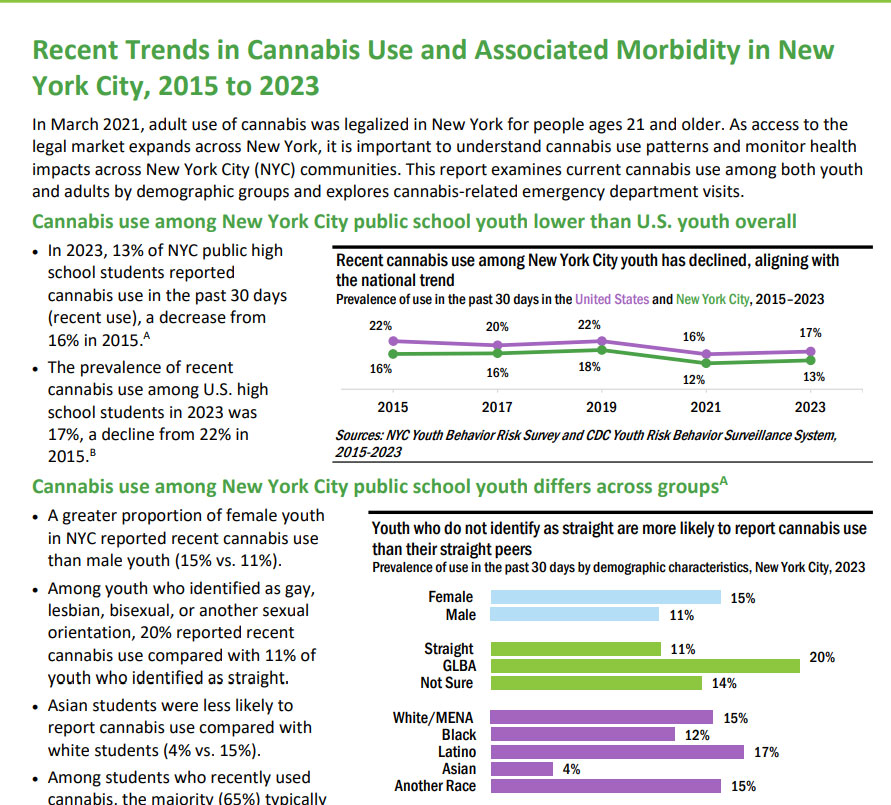
According to the New York City Health Department, 13 percent of public high school students used cannabis in the past thirty days in 2023. In 2015, that number was 16 percent. Outside the city, the state Youth Risk Behavior Survey shows past thirty-day high school cannabis use dropping from 17.9 percent in 2019 to 12 percent in 2023. That is a sharp decline. It is the opposite of the claim The New York Post wants you to believe. Teen use is lower after legalization than it was before legalization. The New York Post did not mention this because it kills their entire story in one sentence.
The New York Post also tried to use a statistic claiming nearly one in five kids under twenty-one are using cannabis. That statistic combines legal adults aged eighteen through twenty with minors and then labels the entire group as kids. That is statistical fraud. The New York Post used it because the real teen numbers contradict the panic they are selling.
Once you examine the data, the story becomes obvious. The New York Post did not report facts. They assembled a panic in three moves.
First, inflate the top line number.
Second, relabel exposures as poisonings.
Third, take toddler data and sell it as teen harm.
This is not journalism. This is manufactured.
Then there is the next inconvenient fact that The New York Post chose to bury. Pediatric cannabis exposures have been rising nationwide for more than a decade in both legal states and prohibition states. Illegal states have experienced a similar general upward trend. The rise tracks the growth of the edible market, not the legalization map. That single fact detonates the entire premise of The New York Post narrative. If states that still ban cannabis are seeing the same increase in pediatric edible exposures, legalization cannot be the cause. The cause is obvious. Brightly colored, high-potency gummies that look like candy and adults who do not store them safely.
advertisement
F O R T H E C U L T U R E B Y T H E C U L T U R E
CANNABIS LIES Vol. 5: The Gateway Lie
For decades, politicians have claimed marijuana is a gateway to heroin and harder drugs. Federal youth surveys, NSDUH data, and NIDA’s own language tell a different story. Cannabis use is widespread, hard drug use remains rare, and most users do not progress. The data dismantles one of prohibition’s most durable fear narratives.


The Study That Pretends Cannabis Does Nothing
A new cannabis study claims marijuana does nothing for anxiety, depression, or PTSD. The reality is far more complicated. Decades of federal restrictions, limited research access, and synthetic substitutes have shaped the science. This breakdown exposes how incomplete data and selective interpretation continue to drive misleading headlines about cannabis and mental health.

Florida Blocked the 2026 Weed Vote
Florida’s ballot system claims to give voters power, yet the 2026 election cycle shows how procedural barriers can quietly shut the door on citizen initiatives. Signature thresholds, geographic distribution rules, and court challenges blocked every measure from reaching voters, revealing how cannabis legalization fights are often decided by bureaucratic design long before election day.
advertisement
The New York Post also leans on the old talking point that cannabis today is genetically engineered and far stronger than the weed of the seventies. Potency has increased. That part is true. It increased because of selective breeding and cultivation, not laboratory modifications. It is still cannabis. It is not a gene-spliced superweed. The New York Post knows that line is outdated scare rhetoric, but scare rhetoric fits the headline, so they ran with it.
The New York Post also left out the most important fact any responsible reporter would mention in a story about pediatric cannabis cases. Cannabis does not cause lethal toxicity the way opioids and alcohol do. Poison control data shows thousands of sick kids, but only one pediatric death in more than a decade has even been reported as cannabis related, and toxicologists still dispute whether cannabis caused it. The New York Post treats edibles as if they carry the fatality risk of fentanyl, even though the risk profile is not even in the same universe. That is reckless. That is dishonest. That is textbook drug war sensationalism.
The New York Post could have focused on the real story. They could have shown how New York’s slow legal rollout allowed thousands of illegal stores to flood the market with untested edibles sold in packaging designed to mimic brand-name candy. They could have explained how these stores sell to anyone without an ID. They could have explained how safe storage campaigns are underfunded. They could have explained how edible packaging still skirts responsible design standards. They could have explained that New York created a perfect storm where illegal markets filled the vacuum left by slow licensing and slow enforcement. But the truth does not create fear. Fake crisis does.
The New York Post also ignores the role of regulation in states that approached legalization with discipline. States with strong packaging rules, strong enforcement, and strong education campaigns see fewer pediatric cases. That is what happens when a state does the work. That is what New York is beginning to learn. But The New York Post needs chaos, not nuance.
Every part of the youth panic collapses under its own weight once the facts are laid out. Teen use is down. Most exposures involve toddlers. The numbers were inflated. The percentages were cooked. The national trend exists regardless of legalization. Poisoning was the wrong word. Exposure was the right one. The New York Post ignored every single piece of this because accuracy was never the point.
And here is the line The New York Post never wants printed.
The New York Post did not report data. They engineered a crisis. They inflated the numbers. They mislabeled the age groups. They misdefined exposures as poisonings. They ignored the falling teen use trend. They ignored national patterns that contradict their premise. They ignored the illegal edible market that actually drives risk. They ignored the state’s own health agencies. They ignored the medical definition of poisoning. They ignored every fact that makes the story less frightening because fear is the only commodity they sell.
The crisis is not cannabis. The crisis is media manipulation. The crisis is a newspaper turning public confusion into a weapon. The crisis is misinformation taking root before the facts can speak. The crisis is the ease with which an old drug war narrative can be revived when a newsroom chooses fear over truth.
New York deserves better than a panic story built on misquotes and distortions. Parents deserve better. Readers deserve better. The culture deserves better. If the goal is to protect children, you lead with accuracy. If the goal is to inform the public, you do not hide the data. If the goal is truth, you do not inflate numbers that do not inflame enough.
The New York Post chose the panic because panic is profitable. The culture chooses the receipts because the receipts do not lie.
There is no exploding teen cannabis crisis in New York. There is only the fear that The New York Post tried to sell.
©2025 Pot Culture Magazine. All rights reserved. This content is the exclusive property of Pot Culture Magazine and may not be reproduced, distributed, or transmitted in any form or by any means without prior written permission from the publisher, except for brief quotations in critical reviews.
F O R T H E C U L T U R E B Y T H E C U L T U R E

The Cannabis Lie: Vol. 4 — The Crime Wave Lie
Politicians and pundits warned that legal cannabis would unleash a crime wave. The data tell a different story. From Colorado’s violent crime trends to DOJ time-series research and statewide arrest declines, the evidence shows no consistent long-term surge tied to legalization. The numbers never matched the panic.

South Africa Legalized Weed, But Not the Market
South Africa recognized private adult cannabis use and home cultivation, but never built a legal domestic market around them. With buying and selling still largely outside the law, the illicit trade remains dominant while regulators scramble to set limits, draft rules, and prepare a broader Cannabis Bill that could finally address commerce.

NY’s Legal Weed Market Is Running Out of Weed
New York legalized cannabis and opened hundreds of stores, but regulators now warn the legal market may not produce enough weed to keep them stocked. With nearly 600 stores open and sales nearing $3 billion, the state is discovering that legalization alone does not guarantee a functioning market.
Discover more from POT CULTURE MAGAZINE
Subscribe to get the latest posts sent to your email.

Leave a comment