Filed Under: Welcome Mat, Meet Trap Door

They opened the door, took your money, invited the world to the party, then told you to get the hell out. That is Thailand right now. A country that turned itself into the most progressive cannabis market in Asia in 2022. A country that built a legal industry worth around one billion dollars in a few quick years. A country that is now yanking the rug and calling the whole thing a mistake.
This is not just policy fatigue. This is a reversal of casualties. Growers who invested in greenhouses and lights. Budtenders who became the face of a new economy. Farmers who swapped low-margin crops for a cash crop they were promised would lift their villages. Entrepreneurs who paid rent on high street storefronts in Bangkok and Chiang Mai because the government told them there was a future here. Now they are watching that future get erased in real time.
Start at the beginning. In 2018, Thailand legalized medical cannabis. In June 2022, the government removed cannabis from the narcotics list, effectively decriminalizing it. That made Thailand the first in Asia to step into the sunlight, and it triggered a national gold rush of weed culture and commerce. The government did not build adequate rules before the switch. They figured they would write them as they went. What happened instead was a full-blown gray market burst where tens of thousands of shops opened fast and investors raced to fill the vacuum.
By the time the dust settled, there were thousands of storefronts, and some outlets counted the total number of cannabis businesses in the five figures. The Washington Post cites an Associated Press tally of roughly 18,000 shops across the country. That figure tells you how fast the market grew and how deep legalization reached in a very short window.
Then came the turn. In May 2024, the Prime Minister said plainly that he wanted the Health Ministry to amend the rules and relist cannabis as a narcotic. He said it should be allowed for health and medical purposes only. Those were his words, and they were not ambiguous.
After months of political maneuvering, the new Health Minister signed an order in late June 2025 to bar sales without a medical prescription and to push cannabis back toward narcotic status. Local guidance told shops to convert to medical dispensaries and follow stricter rules. The government framed this as a public health decision to protect youth and curb what it called widespread unregulated use. The order came into effect, and the message was clear. Recreational sales are over. Prescriptions only. The reclassification as a narcotic would follow once the legal procedure was complete.
advertisement
F O R T H E C U L T U R E B Y T H E C U L T U R E
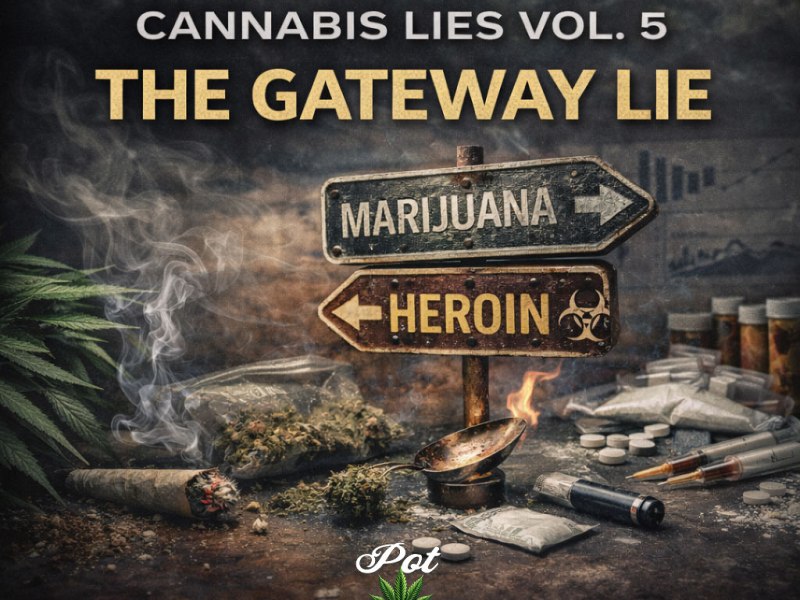
CANNABIS LIES Vol. 5: The Gateway Lie
For decades, politicians have claimed marijuana is a gateway to heroin and harder drugs. Federal youth surveys, NSDUH data, and NIDA’s own language tell a different story. Cannabis use is widespread, hard drug use remains rare, and most users do not progress. The data dismantles one of prohibition’s most durable fear narratives.

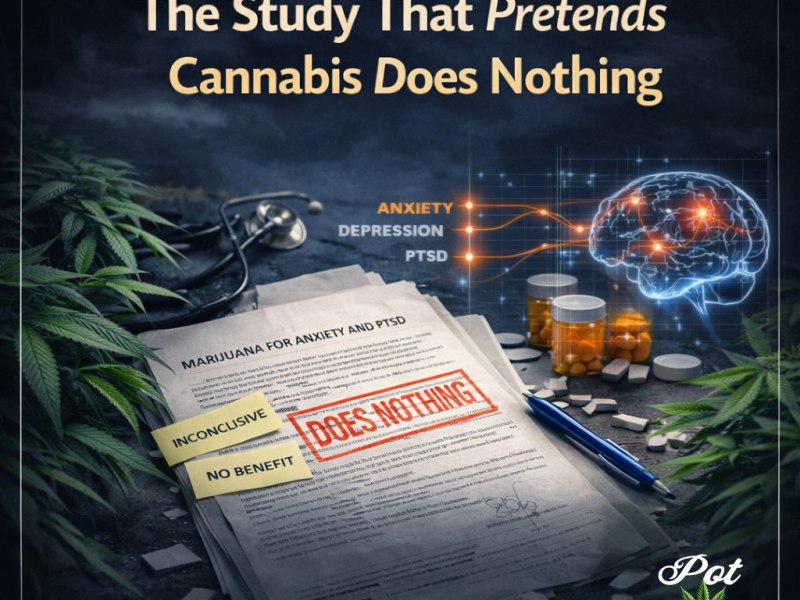
The Study That Pretends Cannabis Does Nothing
A new cannabis study claims marijuana does nothing for anxiety, depression, or PTSD. The reality is far more complicated. Decades of federal restrictions, limited research access, and synthetic substitutes have shaped the science. This breakdown exposes how incomplete data and selective interpretation continue to drive misleading headlines about cannabis and mental health.
advertisement
The number that gets tossed around is one billion dollars. That is what the industry was estimated to be worth by mid-2025. The Thai Chamber of Commerce had projected the sector could reach $1.2 billion by 2025. That gives you a sense of the money in play and the size of the crater this reversal has just blown in the middle of it.
Officials say there was a lack of regulation after 2022. They say minors could access the product. They say dependence rates are high. They also point to embarrassing smuggling cases that made headlines in the United Kingdom and beyond. The Health Minister and the Prime Minister both landed on the same line. Medical use only. Critics inside the country call this politics dressed up as protection. Activists have rallied** outside the Health Ministry demanding real regulation rather than a return to criminal penalties.**
So what actually changed on the ground? Shops that once sold flower for tourists on Sukhumvit or around Thonglor now face a prescription requirement and a medical front end. Online sales and vending machines are out. Marketing is curtailed. The Health Ministry’s order is moving in lockstep with a plan to re-list the plant as a narcotic. That would drag criminal penalties back into the picture and shut down what remains of the gray market once the re-listing appears in the Royal Gazette. That is not an if. It is a when.
If you are a small grower, you do not need a flow chart to understand what this means. Investments sunk into climate control and genetics now sit under a legal cloud. If you are a landlord, you now hold leases whose legal purpose may not exist in three months. If you are a farm worker who jumped to a better-paying job trimming buds for a new local dispensary, you are staring at a pay cut or a layoff. If you are a patient who was buying quality products face-to-face from a regulated shop, you may be back to the days of calling a number and hoping what you get is not mold or mids.
You can spot the political logic behind this reversal if you pay attention to the parliamentary math. The party that pushed decriminalization is not the one calling the shots today. That party left the ruling coalition this summer. Once they walked, the door opened for the Prime Minister’s party to move the policy in the direction it had promised during the election. The result is not a tweak. It is a pivot back toward a controlled medical regime with criminal penalties looming over anything that looks like casual use.
None of this absolves the first wave. Thailand welcomed cannabis without building the scaffolding to hold a real industry. There should have been licensing guardrails for cultivation. There should have been lab testing rules with enforcement power. There should have been a track and trace that kept the product honest without turning shops into police outposts. There should have been zoning rules that allowed adult use while protecting schools and family spaces. Instead, there was chaos, and the chaos handed prohibitionists their talking points for free.
The scariest part of this story is not that a government changed its mind. Governments do that every day. The scariest part is how fast a legal environment can vanish when it rests on political sand instead of statute and stable regulation. Businesses did what they were asked to do. They invested. They hired. They built supply chains. They paid taxes. They built a culture of responsible adult use in the open. The government then rewrote the rules and told them to start over or shut down.
The human piece gets lost in the money talk. Some Thai farmers moved into cannabis because the state pitched it as a new path for rural development. There are shop owners who did not try to play games with the gray market. They paid for licenses, and they tried to follow the changing rules. There are budtenders who learned terpenes and dosing so tourists would have a safe time. Some local patients found a consistent supply for the first time. All of them now live under a cloud that policymakers created and then called an act of health protection.
You can look around the region and see how this echoes. Germany passed decriminalization and personal cultivation** while planning a club system.** That club system is crawling under bureaucracy and local politics. Berlin had only a handful of approved clubs by mid-summer 2025. Reform on paper does not mean access in the street. Governments can stall you without even saying no.
You can keep looking and find the United Kingdom trapped in its own polite panic. Public opinion is shifting, but not enough to overcome the political fear. Polling suggests** a slight majority for decriminalization of possession.** Meanwhile, agencies throw money at messaging and pretend the debate is about youth safety while the illicit market hums along. The global pattern writes itself. Promise. Hype. Then freeze or rollback when the headlines turn.
Thailand illustrates what happens when a government adopts this pattern with both hands. Industry leaders will tell investors that the public health framework was not a surprise. The surprise was speed. They will say that medicine can only work if the rules are clear and pragmatic. They will say that the prescription requirement and the push to re-list the plant as a narcotic means the medical lane is going to be small and possibly captured by players who can afford doctors, compliance teams, and lobbying. The small shops that created the cannabis street culture that tourists loved will be told to become clinics or disappear.
Here is what you tell your readers and your crew. Reform is not forever. It lasts only as long as the coalition that backs it. If that coalition shifts, your business plan is not worth the paper it is printed on. If you have money in play, do not trust vibes. Trust vote counts, cabinet lineups, and who chairs the committees that write the rules.
The Thai state is now seeking to project its competence. It wants to say it is cleaning up a mess. But the mess is one it built. When a government removes a plant from the narcotics list and allows an industry to expand without clear lines, that government is responsible for what follows. When it then blames the people who followed their lead, that is not health policy. That is a betrayal.
If you are an operator in Thailand right now, you need a quick survival list, even if it hurts to read. Convert to medical compliance if you can. That means documentation and a doctor-patient relationship. It means supply chain controls that pass a prescription audit. Do not rely on old assumptions about enforcement. Assume compliance checks will become very real very soon. If you cannot convert, wind down with care and keep your team safe. The gray market is going to tempt a lot of people. Remember that the Health Ministry is pushing reclassification back to narcotic status. That means the penalties will not be symbolic. They will be criminals.
If you are a consumer, there is one rule. Do not assume yesterday’s rules apply. Ask for prescriptions if you plan to buy at a shop. Pay attention to travel advisories from your embassy because international attention is now fixed on Thai cannabis. Keep receipts. Keep packaging. And do not even think about moving product through an airport. The smuggling headlines are part of the political theater that got us here. You do not want to be their next example.
If you want the wider lesson for the global cannabis community, write it plain. Reform that rests on vibes can evaporate in a single season. Reform that rests on statute, clear regulation, and credible enforcement survives. Germany shows the slow grind. Thailand shows a sudden snap. The United Kingdom shows how political caution can be a quiet form of prohibition. The only thing that protects a grower or a patient, or a shop owner, is a law that is written well and enforced fairly. Anything less is a stage set.
Here is the closer. Thailand promised a new era. Thailand cashed in on that promise. Then Thailand called the promise a mistake and told the people who believed it to get back in line. That is the betrayal. Not the pivot. Not the health language. The betrayal is telling people they were safe, then turning the lights out and calling the cops.
©2025 Pot Culture Magazine. All rights reserved. This content is the exclusive property of Pot Culture Magazine and may not be reproduced, distributed, or transmitted in any form or by any means without prior written permission from the publisher, except for brief quotations in critical reviews.
FOR THE CULTURE BY THE CULTURE
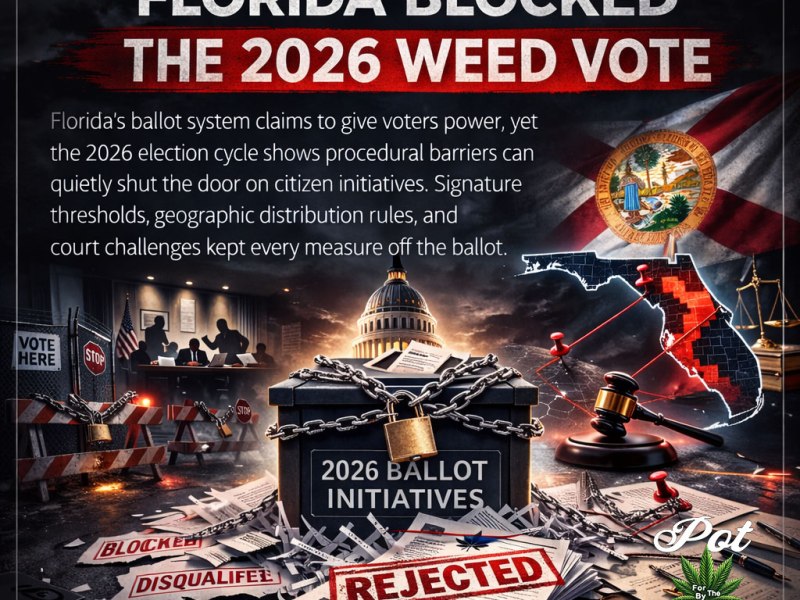
Florida Blocked the 2026 Weed Vote
Florida’s ballot system claims to give voters power, yet the 2026 election cycle shows how procedural barriers can quietly shut the door on citizen initiatives. Signature thresholds, geographic distribution rules, and court challenges blocked every measure from reaching voters, revealing how cannabis legalization fights are often decided by bureaucratic design long before election day.
The Cannabis Lie: Vol. 4 — The Crime Wave Lie
Politicians and pundits warned that legal cannabis would unleash a crime wave. The data tell a different story. From Colorado’s violent crime trends to DOJ time-series research and statewide arrest declines, the evidence shows no consistent long-term surge tied to legalization. The numbers never matched the panic.
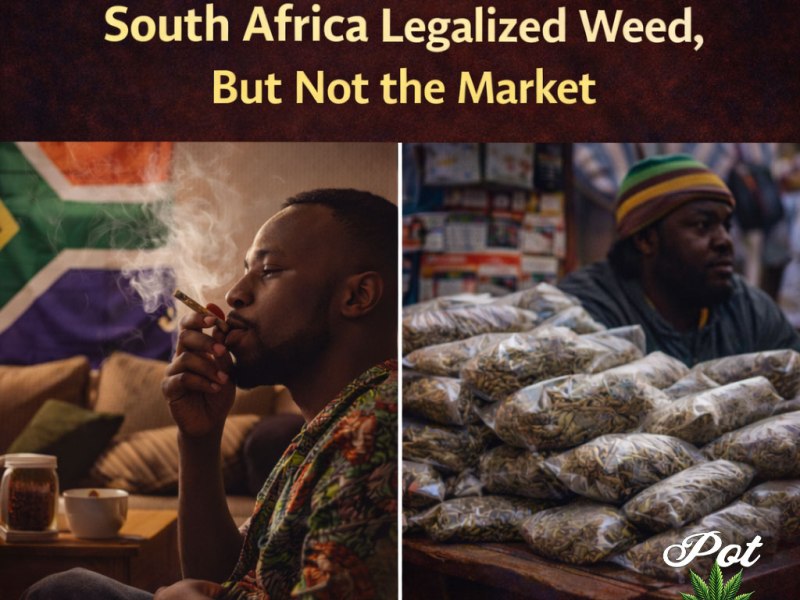
South Africa Legalized Weed, But Not the Market
South Africa recognized private adult cannabis use and home cultivation, but never built a legal domestic market around them. With buying and selling still largely outside the law, the illicit trade remains dominant while regulators scramble to set limits, draft rules, and prepare a broader Cannabis Bill that could finally address commerce.
Discover more from POT CULTURE MAGAZINE
Subscribe to get the latest posts sent to your email.

Leave a comment