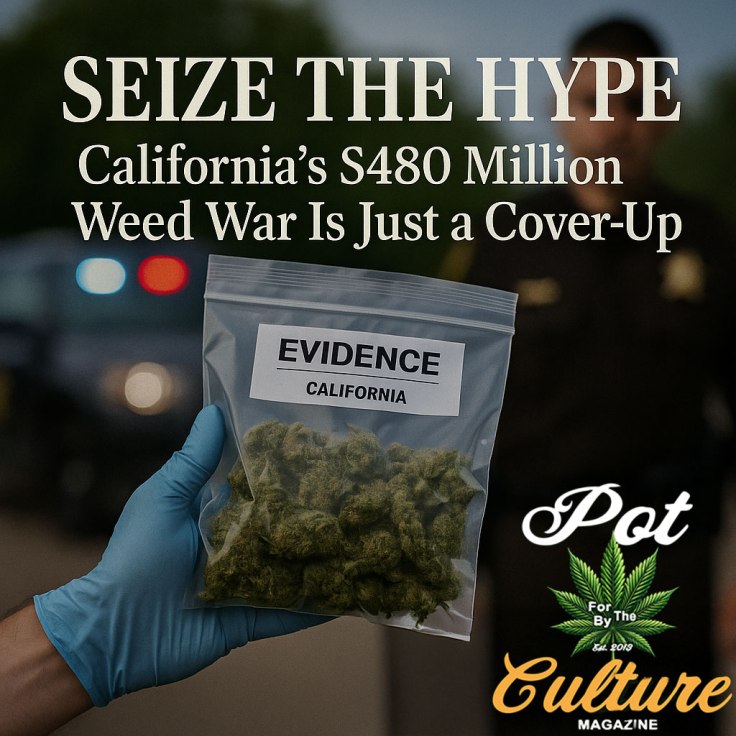
They say it like it is a triumph. Nearly half a billion dollars in illegal cannabis have been seized since January. Over 270,000 pounds of flower confiscated. 260,000 plants uprooted. Dozens of raids across the state. A hundred-plus arrests. Firearms. Cash. Headlines.
It is meant to sound like victory. Like order has returned to the wild hills of Humboldt and the concrete trap houses of East Oakland. Like, legalization is finally doing its job.
But the numbers do not lie, and they do not mean what the state wants you to think they mean.
California’s latest seizure blitz, led by Governor Gavin Newsom and the Department of Cannabis Control, is not a sign of progress. It is the clearest proof yet that the state’s legal weed system is broken. This is not a war against crime. It is a cleanup crew for a failed promise.
And that $480 million? It is not valuable. It is vapor.
What They Seized and What They Did Not Say
Let’s look at the official story first. According to the governor’s August 5 announcement, California law enforcement conducted 111 takedowns in 2025, netting
- 270,000 pounds of unlicensed cannabis
- 260,000 eradicated plants
- $230,000 in cash
- 112 arrests
- 52 firearms
- And a headline-grabbing estimate of nearly $480 million in illegal product
But here is what they did not tell you.
That $480 million figure is based on inflated retail valuation, often assuming boutique dispensary pricing for sun-grown mids pulled from a trailer in the desert. Wholesale street prices for unregulated weed are nowhere near those numbers. Any experienced cultivator, broker, or trap line runner will tell you, $1,800 a pound for unlicensed flower in 2025? Not even close. In the current saturated market, illegal product moves for a fraction of that.
So what we are really seeing is not $480 million in value. We are seeing $480 million in optics.
The state knows the numbers are not real. But they also know they do not have to be. Because in the court of public opinion, the illusion of enforcement is more important than the outcome.
The Real Numbers Show Decline, Not Dominance
If enforcement were truly ramping up, we would expect a rising pattern. More raids, more seizures, more arrests. But a closer look tells a different story.
In 2022, the state seized 144,000 pounds and eradicated over 264,000 plants. In 2024, they grabbed 154,000 pounds and 236,000 plants. By Q2 of 2025, they had taken 185,000 pounds and 413,000 plants, but mostly in just a handful of high-profile raids.
The pattern is not consistent. The numbers swing wildly from quarter to quarter. What is steady is the messaging. The photo ops. The press releases. The illusion that enforcement is working.
But if it were working, the illegal market would not still control an estimated 60 percent of all cannabis sales in California. That is not a theory. That is government data. Despite all the raids, the seizures, the headline numbers, most weed in the state is still sold outside the legal system.
So what is really going on?
The War Is Not Against Crime. It Is Against Survival.
advertisement
F O R T H E C U L T U R E B Y T H E C U L T U R E
CANNABIS LIES Vol. 5: The Gateway Lie
For decades, politicians have claimed marijuana is a gateway to heroin and harder drugs. Federal youth surveys, NSDUH data, and NIDA’s own language tell a…

The Study That Pretends Cannabis Does Nothing
A new cannabis study claims marijuana does nothing for anxiety, depression, or PTSD. The reality is far more complicated. Decades of federal restrictions, limited research…
advertisement
The truth is that most of the people being raided are not cartels. They are not trafficking guns. They are not poisoning water supplies or running human smuggling operations.
They are farmers. They are growers. Some are legacy operators who have been cultivating since before legalization. Some are new school risk takers who could not afford the state’s endless fees and inspections. Some are just broke, trying to feed families in a state that promised them a path to legitimacy and then pulled the rug out.
California’s legal weed system is built on financial quicksand. Licensing fees, environmental compliance costs, metric tracking, testing, packaging, zoning, it is a mountain of red tape designed to keep smaller players out. And it worked.
Between 2022 and 2024, thousands of legal operators shut down. At the same time, the few that remained scaled up, resulting in massive oversupply, collapsing wholesale prices, and a new wave of failed farms.
And when those failures happened, the state did not step in to help. They sent in the task force.
Enforcement Is the Cover for a Policy Failure
This is where the picture comes into focus. California legalized cannabis with one hand while criminalizing it with the other. The legal system was supposed to transition the underground economy into a licensed marketplace. What it did instead was create a new class of criminal, people who once operated in the open, now forced back underground by cost and regulation.
The state needs a villain for this story. Because it cannot blame itself. So it blames the illegal market.
And then it inflates that market’s value with seizure stats, rolls out press conferences about civil and criminal enforcement, and pretends that the problem is bad actors instead of bad laws.
The Firearms and Fear Factor
You will notice that every press release mentions firearms seized, 52 this year so far. Sounds scary until you realize that in 111 operations, that averages less than one weapon every two raids. Meanwhile, no one is publishing how many cannabis business owners have been robbed or killed during legal operations.
Legal growers are armed because the state abandoned them. And unlicensed growers? Many of them operate in the same rural, unpatrolled zones where enforcement shows up only to destroy, not to protect.
So if we are talking safety, let’s talk about who is really at risk. It is not the consumers. It is not the state. It is the people trying to survive in a system that gave them two choices: get licensed or get raided.
What They Call Illegal, We Call Reality
The biggest lie in this entire operation is the word illegal. Because what it really means is unaffordable compliance. It means zoning restrictions that bar weed in weed-legal counties. It means cities that took the tax money but banned retail anyway.
In some parts of California, it is still easier to open a liquor store than a dispensary. Still easier to get a gun permit than a cultivation license. Still easier to operate in the shadows than to play by rules designed for corporations, not communities.
The $480 million bust is not a show of power. It is a confession. It tells us that the state has failed to make the legal market viable, and instead of fixing it, they have chosen to criminalize the people they left behind.
Burn the Pile, Save the Lie
Every photo of seized plants is a political act. Every warehouse raid is a press release. Every inflated valuation is a distraction from the truth.
This is not enforcement. It is marketing.
And the thing being marketed is not justice. It is a failure.
The state will keep burning weed to pretend it is in control. But the real problem is not the grow ops they are raiding. It is the system they built that made those raids inevitable.
Until California stops treating weed like a trophy and starts treating the culture with respect, the numbers will keep climbing, the raids will keep coming, and the industry will keep bleeding.
And no amount of seized flower will ever change that.
©2025 Pot Culture Magazine. All rights reserved. This content is the exclusive property of Pot Culture Magazine and may not be reproduced, distributed, or transmitted in any form or by any means without prior written permission from the publisher, except for brief quotations in critical reviews.
F O R T H E C U L T U R E B Y T H E C U L T U R E
Florida Blocked the 2026 Weed Vote
Florida’s ballot system claims to give voters power, yet the 2026 election cycle shows how procedural barriers can quietly shut the door on citizen initiatives. Signature thresholds, geographic distribution rules,…

The Cannabis Lie: Vol. 4 — The Crime Wave Lie
Politicians and pundits warned that legal cannabis would unleash a crime wave. The data tell a different story. From Colorado’s violent crime trends to DOJ time-series research and statewide arrest…

South Africa Legalized Weed, But Not the Market
South Africa recognized private adult cannabis use and home cultivation, but never built a legal domestic market around them. With buying and selling still largely outside the law, the illicit…
Discover more from POT CULTURE MAGAZINE
Subscribe to get the latest posts sent to your email.

Leave a comment