Filed Under: High Art, Higher Purpose
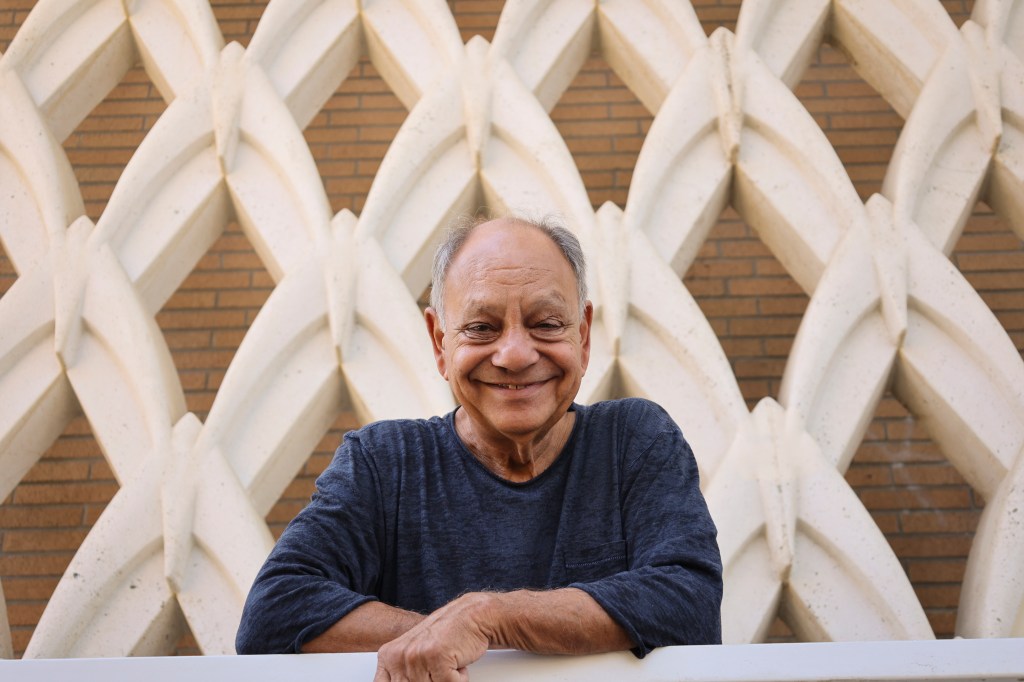
They said it couldn’t be done. That Chicano art didn’t have the market. The word Chicano was too loaded. That museums wouldn’t touch it. That nobody wanted to see brown faces on gallery walls unless it was through a colonial lens. Cheech Marin heard all of it and still walked straight through the smoke with a plan. He built it himself. From the ground up. Funded by weed, culture, grit, and vision. Not hype.
The Cheech Marin Center for Chicano Art and Culture opened in Riverside, California, in 2022. A mid-century library converted into a cathedral for everything mainstream institutions ignored. The first of its kind. Not an exhibit tucked in the back corner of a white-walled museum. Not a borrowed collection with a closing date. This is permanent. This is for real. This is a declaration that Chicano art is American art. And it was built by a stoner they tried to laugh off as a joke.

Left: Una Tarde en Meoqui (An Afternoon in Meoqui) by Wayne Alaniz Healy, 1991
Acrylic on canvas, 53 ¾ x 53 ½ in.
Courtesy of Cheech Marin.
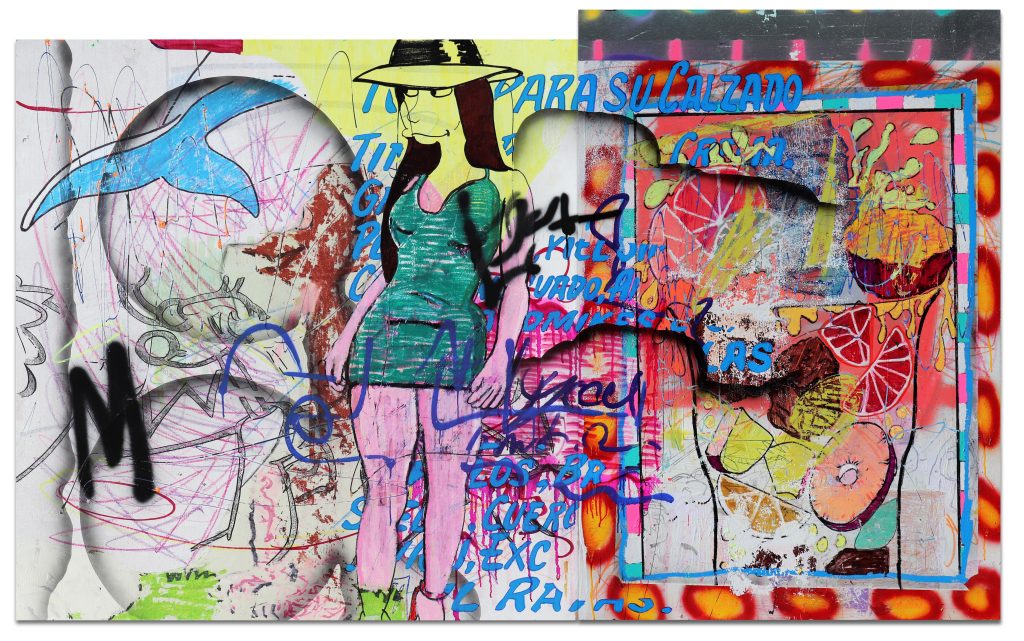
Right: La Novia Del Verde by Cande Aguilar, barrioPOP, 2021
Multimedia painting with transfers on panels, 53 x 84 in.
Courtesy of Cheech Marin
Most people know Cheech for the weed. The joint is the size of a baseball bat. The van is made of bud. The laugh. The movies. The albums. The iconic stoner blueprint that he and Tommy Chong created when Ronald Reagan was still pretending weed was more dangerous than Wall Street. What they miss is the mission behind the smoke. Cheech wasn’t just cashing checks. He was building something. While America freaked out about hippies and gang culture, he was collecting art. For decades. He saw what nobody else wanted to show.
“If you haven’t seen it, you should. It’s not just about him. It’s about all of us.”
That story finally got the screen treatment it deserved in the PBS documentary The Cheech. Quietly released, brilliantly built, it stripped away the punchlines and gave people the real blueprint. A portrait of the man who never stopped working, never stopped collecting, and never stopped believing his culture was worthy of a museum.

The museum he built with that belief is known simply as The Cheech. It sits at 3581 Mission Inn Avenue in the heart of Riverside. It used to be a public library. Now it’s a vault of resistance, color, chaos, and memory. The walls speak louder than the labels. The Fire Room burns with saturated ghosts. The galleries twist with glass and protest. And unlike most institutions, the staff actually gives a damn about the people whose stories they’re telling.
It’s all anchored by Cheech’s private collection, 500 deep and still growing. Names like Carlos Almaraz, Patssi Valdez, Judithe Hernández, Frank Romero, and Margaret García. Paintings. Pastels. Installations. Collages. Glass. Sculpture. Photography. Work that got shut out of elite galleries for years because it was too brown, too barrio, too political, too real. Now it’s center stage.

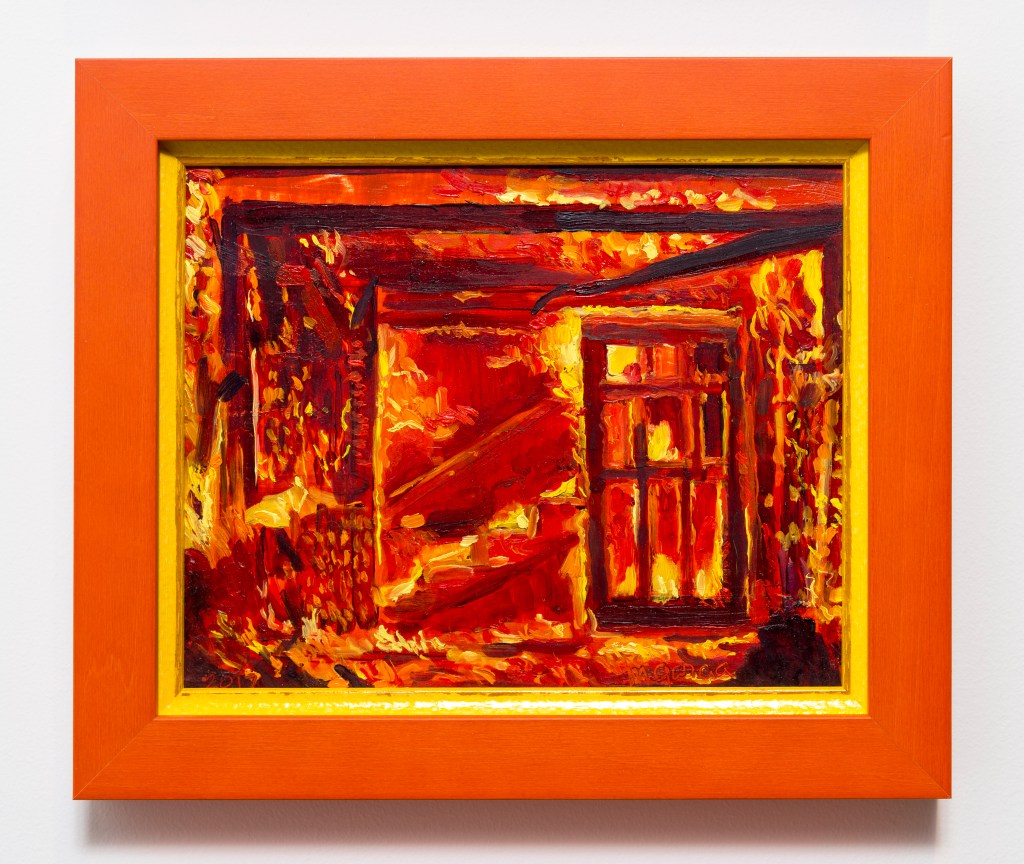
Left: Drought Fire by Margaret García, 2023
Oil on canvas, 60 x 48 in.
Courtesy of Cheech Marin.
Right: Fire Within by Margaret García, 2023
Oil on canvas, 60 x 48 in.
Courtesy of Cheech Marin
Cheech didn’t just hand over some work and walk away. He shows up. He still talks about the artists. Still remembers where he got the pieces. Still buys new work. Still pushes the curators to go harder. This isn’t legacy preservation. It’s forward momentum.
The annual Cheech Collects show has become a cultural event. The 2025 edition, Cheech Collects IV, blew the doors open with pastel portraits that glowed like neon saints. Pieces from Rupert García, John Valadez, Leo Limón, and Adán Hernández held the wall like soldiers. Sculptures from Jaime Guerrero and Frank Romero bent gravity. New acquisitions slid in from Texas voices like Ricardo Ruiz, Carlos Donjuán, and Cande Aguilar. Nobody here is performing for the market. They’re making art to stay alive.
“Each edition of Cheech Collects reveals new layers of Chicanx creativity.” — Cheech Marin
The museum’s artistic engine is María Esther Fernández, a real-deal curator with the credentials to command attention and the soul to pull it off without compromise. She’s not babysitting a donor list. She’s shaping a movement. Her exhibitions stretch from UC Davis to The Cheech to the Berkeley Art Museum. She’s not chasing art world approval. She’s setting the bar.
Outside the collection, The Cheech is pushing even harder. It hosted the premiere of Collidoscope, a retro-perspective by Einar and Jamex de la Torre that detonated every rule of museum decorum. These guys don’t make glass art. They weaponize it. Lenticular prints that shift as you move. Exploded altars. Myth meets My Little Pony meets Aztec apocalypse. Born in Guadalajara, raised on both sides of the border. They build visual noise that dares you to look away. Their work is touring the country now through a Smithsonian partnership, but it started at The Cheech, where it belongs.
“The complexities of the immigrant experience and contradicting bicultural identities really propel our narrative and aesthetics.” — Einar de la Torre
Advertisement
F O R T H E C U L T U R E B Y T H E C U L T U R E

CANNABIS LIES Vol. 5: The Gateway Lie
For decades, politicians have claimed marijuana is a gateway to heroin and harder drugs. Federal youth surveys, NSDUH data, and NIDA’s own language tell a…


The Study That Pretends Cannabis Does Nothing
A new cannabis study claims marijuana does nothing for anxiety, depression, or PTSD. The reality is far more complicated. Decades of federal restrictions, limited research…
Advertisement
This isn’t just about legends. The Cheech is plugged into its city. Hecho en Park Avenue brought local artists from Riverside’s Eastside into the spotlight. Paintings, murals, and mixed media built with the neighborhood, for the neighborhood. Curated by Michelle Espino and Juan Navarro, it wasn’t some token inclusion. It was a declaration. The Eastside is part of the canon. No apologies. No translations.
The space itself is built for this kind of fluidity. Atriums, rooftops, flexible galleries. It used to house books. Now it houses memory. You don’t walk through The Cheech like a traditional museum. You move through it like a house party and a funeral and a protest and a dream.
And none of this happens without weed.
Let’s be honest. The system didn’t bankroll this. Weed culture did. The same culture that funded Cheech’s movies, records, tours, and now cannabis brand—Cheech’s Stash. It’s not some celebrity grift. It’s a way to recycle the power back into the community that built him. Without weed, Cheech doesn’t get a microphone. Without the microphone, the art stays hidden. Without the art, the movement gets memory-holed.
This is what happens when a cultural outlaw builds his own damn institution.
The Cheech isn’t a museum. It’s a rebuke. A fortress. A transmission tower built from the bones of a library and filled with the faces the establishment left out. It’s not here to explain itself. It’s not asking for validation. It’s open six days a week for anybody who wants to see what Chicano art looks like when it isn’t begging for a seat at someone else’s table.
Cheech didn’t ask permission. He just did it.
And in doing so, he made sure nobody could ever again say Chicano art didn’t belong.
©2025 Pot Culture Magazine. All rights reserved. This content is the exclusive property of Pot Culture Magazine and may not be reproduced, distributed, or transmitted in any form or by any means without prior written permission from the publisher, except for brief quotations in critical reviews.
Discover more from POT CULTURE MAGAZINE
Subscribe to get the latest posts sent to your email.

Leave a comment