Filed Under: D.A.R.E to Be Lied To
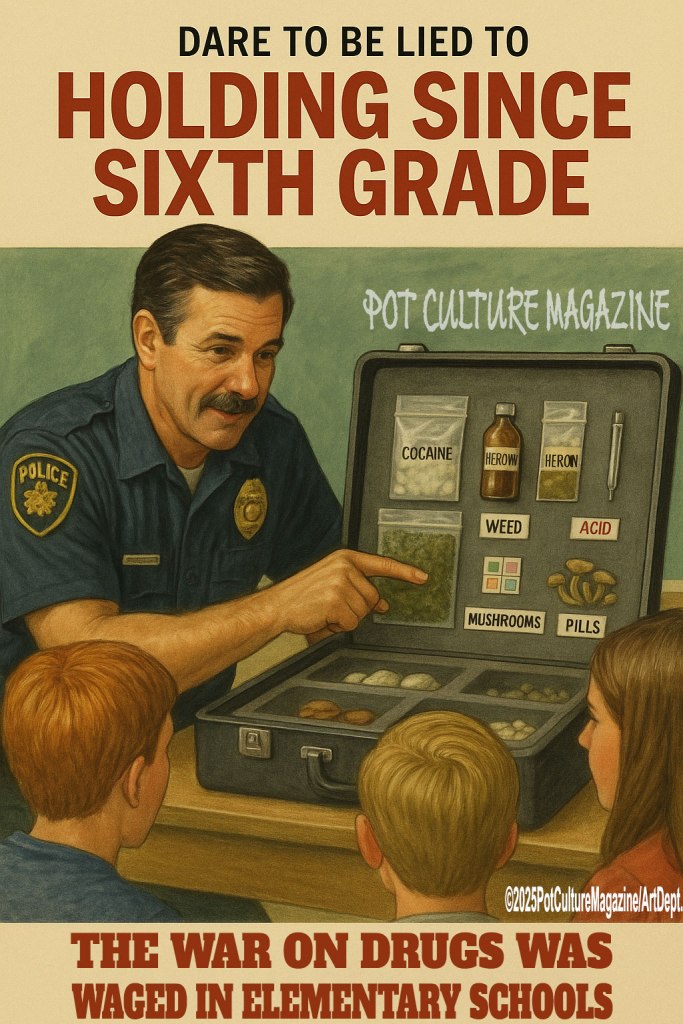
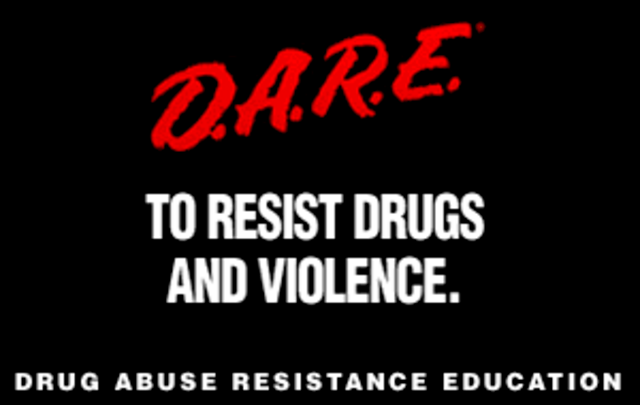
They let us hold real drugs in elementary school. That is not hyperbole. That is America. One spring afternoon in 1986, a police officer walked into our classroom with a black briefcase full of cocaine, heroin, weed, acid, pills, and powder, then calmly told us that if we ever touched any of it, we would die. The D.A.R.E. Officer had a thick handlebar mustache and the laid-back energy of a guy who probably owned a few bootleg Grateful Dead tapes. He smiled, told us it was all real, and pointed to a hard plastic lid screwed over the narcotics. This was DARE, the government’s bright idea to keep kids off drugs by putting drugs directly in front of them.

Already jaded by the bullshit of Just Say No and the glowing virtue of Nancy Reagan’s plastic grin on every classroom wall, I probably snickered. Even at that age, I knew they were selling something. Up to that point, I had only been around weed twice. Once, when I was maybe five or six, I crouched behind a door while my older cousin and his friend passed a joint in the garage like they were trading state secrets. The other was when my sister had friends over, that late-night laughter and music with a towel jammed under her door, the sweet scent of rebellion seeping through the vents. Nobody OD’d. Nobody freaked out. Nobody turned into a public service announcement. They just laughed, listened to music, and ate everything in the kitchen. The horror never showed up.
So when Officer DARE cracked open that black suitcase, it was not fear I felt. It was fascinating.
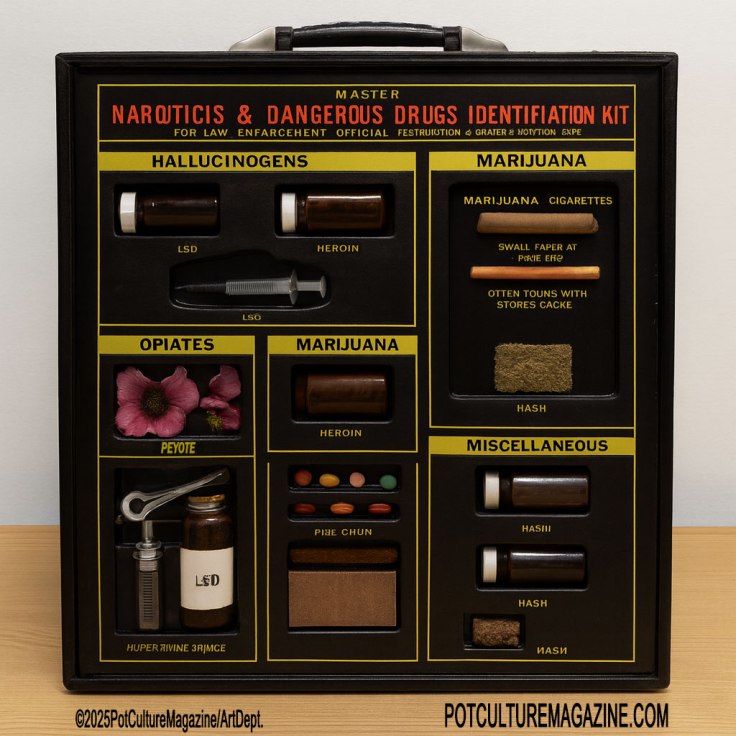
The case opened like something out of an Indiana Jones movie. Think Raiders of the Lost Ark, when the Ark gets opened and everyone stares in awe, right before all hell breaks loose. Now, swap the gold for ziplocks and vials. Inside that hard plastic mold was a visual parade of every forbidden substance the eighties could imagine: cocaine, heroin, weed (looked like backyard clippings), LSD, mushrooms, pills with government names, even acid tabs laminated like they came from a menu. A full-spectrum buffet of doom and damnation.
And here’s the wild part. He told us it was all real. Not props. Not replicas. Real narcotics, sealed under a clear plastic cover so no one could reach in and grab a sample. The whole thing looked like something you’d see in a DEA bust photo. It felt dangerous because it was dangerous. I remember staring at that cocaine, thinking, so that’s what the real stuff looks like. I had watched enough Miami Vice to know the vibe, but this was the first time the fantasy turned tactile.
I’m surprised the briefcase didn’t say Property of Keith Richards.
You could almost hear the drug angels sing. A couple of kids gasped. Most of us leaned forward like we were at a museum exhibit. He told us it was all dangerous, deadly, off-limits. But showing it to us, letting us see the colors and textures up close, only made it more fascinating. This was not a deterrent. This was advertising.
Then came the sermon.
advertisement
F O R T H E C U L T U R E B Y T H E C U L T U R E
CANNABIS LIES Vol. 5: The Gateway Lie
For decades, politicians have claimed marijuana is a gateway to heroin and harder drugs. Federal youth surveys, NSDUH data, and NIDA’s own language tell a different story. Cannabis use is widespread, hard drug use remains rare, and most users do not progress. The data dismantles one of prohibition’s most durable fear narratives.

The Study That Pretends Cannabis Does Nothing
A new cannabis study claims marijuana does nothing for anxiety, depression, or PTSD. The reality is far more complicated. Decades of federal restrictions, limited research access, and synthetic substitutes have shaped the science. This breakdown exposes how incomplete data and selective interpretation continue to drive misleading headlines about cannabis and mental health.
advertisement
One hit and your brain would melt. You would grow paranoid, lose your teeth, get pregnant, get arrested, and jump off a building. Maybe not in that order. You would stop caring about your grades, your family, and your future. You might become a dropout, a prostitute, or a corpse. He piled it on so thick you could spread it with a spatula. It was health class by way of an exorcism. And none of us were buying it.
After thirty minutes of doom, he took our questions. Not about the science, not about the history, just “can we see the briefcase again?” I am almost certain I held it, grinned like an idiot, and did a mock getaway toward the door while the class laughed. Officer DARE laughed too. I think he liked the show.
Shit. I should have known then this would be my life.
Because here we are, almost four decades later, and I run a cannabis magazine. That speaks from the other side of the lie. And every time I see Officer DARE on Facebook now, posting barbecue photos and grandpa jokes, I wonder what he thinks about it all. Does he remember opening that case for a room full of skeptical kids? Does he believe it worked?
Because it didn’t.
DARE was a failure. Multiple studies, including the U.S. Surgeon General and the Department of Education, found it had no measurable impact on reducing youth drug use. It did not reduce drug use. It did not stop crime. What it did was lay the groundwork for the idea that health and obedience were the same thing. That being a good citizen meant being a quiet one. That anything illegal was dangerous, and anything dangerous was evil.
That is the lie they taught us, and they used our teachers, our cops, our parents, and our Saturday morning cartoons to sell it.
It was never about health. It was always about control.
You can still see the fingerprints of that system in the way legalization is unfolding now. Random drug tests that catch THC weeks after the fact. Police are still using odor as probable cause. Cannabis users are treated as impaired, irresponsible, unworthy, even when their use is legal. Meanwhile, synthetic weed gets sold in gas stations, and the same companies that fought against legalization are cashing out on it. You can buy Delta-8 off a rotating rack next to the windshield wiper fluid, but growing your own in half the country is still a criminal act.
The rhetoric has changed. The control hasn’t.
They gave us health-based propaganda in the eighties, and now they hand us safety-based surveillance in the 2020s. But it is the same instinct. Regulate. Contain. Monetize. Punish. What started as DARE evolved into compliance apps, checkpoints, zoning boards, and corporate gatekeeping. They will let you have weed, sure, but only if you get it from the right store, in the right way, at the right time, and never talk back about it.
Every inch of “freedom” they give us is measured in paperwork.
So when I think back to that classroom and Officer DARE’s golden briefcase of forbidden knowledge, I do not feel angry. I feel informed. That was my first real taste of American drug policy. A smiling cop. A scary suitcase. A sermon dressed up as science. And underneath it all, the subtle pressure to stop asking questions and just say yes, to authority, to policy, to punishment disguised as protection.
But some of us never stopped asking. Some of us never bought in. Some of us saw through the glow.
And some of us built magazines.
This account is based on the author’s memory of events that occurred in 1986.
©2025 Pot Culture Magazine. All rights reserved. This content is the exclusive property of Pot Culture Magazine and may not be reproduced, distributed, or transmitted in any form or by any means without prior written permission from the publisher, except for brief quotations in critical reviews.
F O R T H E C U L T U R E B Y T H E C U L T U R E
Florida Blocked the 2026 Weed Vote
Florida’s ballot system claims to give voters power, yet the 2026 election cycle shows how procedural barriers can quietly shut the door on citizen initiatives. Signature thresholds, geographic distribution rules,…
The Cannabis Lie: Vol. 4 — The Crime Wave Lie
Politicians and pundits warned that legal cannabis would unleash a crime wave. The data tell a different story. From Colorado’s violent crime trends to DOJ time-series research and statewide arrest…
South Africa Legalized Weed, But Not the Market
South Africa recognized private adult cannabis use and home cultivation, but never built a legal domestic market around them. With buying and selling still largely outside the law, the illicit…
Discover more from POT CULTURE MAGAZINE
Subscribe to get the latest posts sent to your email.

Leave a comment