Filed Under: Prohibition in Plain Sight
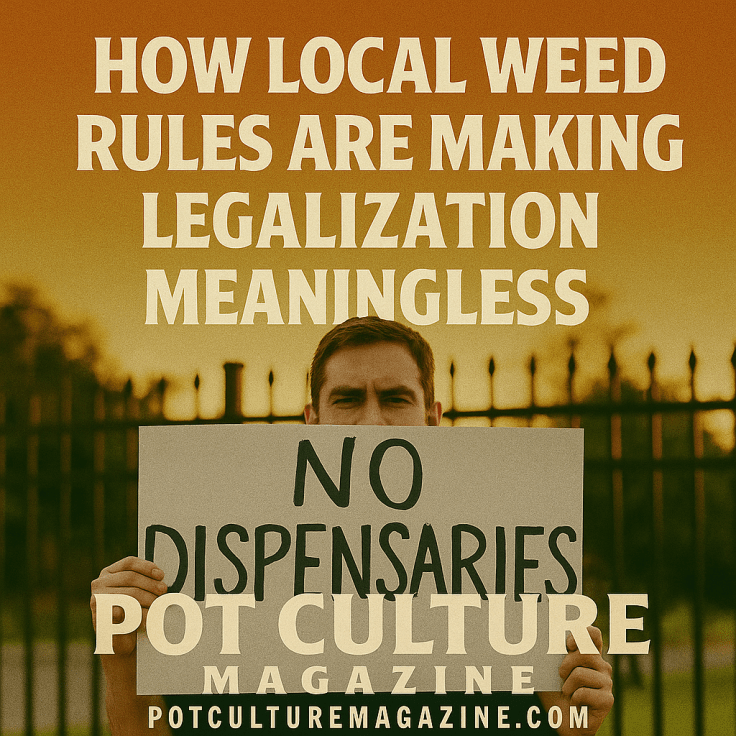
Statewide cannabis legalization is a lie in three acts: first, the vote, then the delay, then the local shutdown. Cities and counties across America’s so-called legal states are quietly gutting access with zoning restrictions, opt-outs, and morality-based codes designed to make cannabis legal in name only. On paper, these states have legalized. On the ground, it is still a war of attrition.
In California, more than half of the state’s municipalities have banned cannabis retail altogether. Entire counties, including Fresno and Kern, remain dispensary deserts, allowing cultivation or manufacturing but prohibiting storefronts. Bakersfield, for instance, enforces a complete retail ban within city limits, while surrounding areas profit from the tax revenue. It is legal to possess, but illegal to buy, unless you are willing to drive two hours or risk delivery in a legal gray zone.
In New York, the situation is even more surreal. Despite full legalization in 2021, more than sixty percent of the state’s towns and villages opted out of allowing dispensaries or lounges. In Suffolk County, over fifty towns said no. Conservative enclaves like Islip and Hempstead have blocked storefronts outright. The result is a black market with better access than the legal one, and an enforcement regime that still finds ways to criminalize sellers outside the state-run system.
Michigan, once a model for recreational rollout, has entered the same trap. Cities like Hudsonville and Livonia enforce zoning laws that keep dispensaries permanently out. In Hudsonville, an ordinance bans cannabis businesses within 1,000 feet of a school, park, church, daycare center, or residential zone. That eliminates the entire city. Livonia banned all recreational businesses through zoning code 11.05.230, which effectively voids state legalization within its borders. You can have your weed. You just cannot buy it here.
These are not temporary restrictions. These are permanent, legal mechanisms designed to undermine the will of voters. They rely on moral language, using words like “nuisance,” “character,” “sensitivity,” or “saturation,” which allow city councils and zoning boards to deny applications without having to say the quiet part out loud.
And they are not without consequences.
In California, a lawsuit filed in early 2024 by the advocacy group Sensible Markets challenged Fresno County’s refusal to issue permits despite meeting state criteria. The suit alleges that local bans violate Prop 64’s original intent and disproportionately harm low-income patients who cannot travel to access a legal supply.
In Michigan, NORML and the Cannabis Caucus of the state Democratic Party filed a complaint in May 2024 against Livonia’s zoning language, citing conflict with the state’s adult-use law and accusing the city of discriminating against both users and licensed businesses.
In New York, the situation is so fragmented that even some medical users have been caught in enforcement crossfire. A 67-year-old patient from Oneida County was issued a citation in January for possession after legally purchasing cannabis in a neighboring jurisdiction. The reason? Local police in his hometown claimed the smell constituted probable cause, even under the state’s updated cannabis laws.
These bans are not passive. They are active, intentional efforts to slow-roll the industry, often under the guise of safety or family values. Local councils hold closed-door meetings. Public hearings happen with no public. Moratoriums are extended year after year. Enforcement discretion becomes a tool of selective punishment.
In places where bans are not outright, the conditions are often unworkable. Licensing caps, location requirements, and inspection fees stack up until only the most connected or well-funded players survive. Legacy applicants are promised a seat at the table, then pushed into bureaucratic purgatory. Social equity becomes a buzzword for campaign donors.
Legalization was supposed to end prohibition. Instead, it gave cities and counties new tools to wage it quietly.
The legal logic is built on home rule, the idea that local governments can regulate land use as they see fit. But when applied to cannabis, that logic enables prohibition through zoning. You cannot outlaw weed outright, but you can zone it into oblivion. You can push dispensaries to the edge of town, next to the landfill, or onto a stretch of highway no one walks. You can delay permits indefinitely, cite odor as a public health concern, or declare dispensaries incompatible with your city’s “vision.”
The result is a map of red tape. Entire swaths of so-called legal states remain dry, not by law, but by ordinance. And for users, that means either traveling across counties to find a licensed shop, relying on delivery services that may or may not be sanctioned, or returning to the black market that legalization was supposed to replace.
The hypocrisy is staggering. States collect tax revenue. Governors campaign on reform. Yet at the city level, paranoia still rules the room. Cannabis is still treated as a threat, a nuisance, a public safety hazard, a moral failing. Advocates spend years building coalitions, passing reforms, and establishing business plans, only to be boxed out by a planning board that equates dispensaries with liquor stores and adult theaters.
It is not enough to legalize. The industry cannot thrive on paper. It needs land, licenses, access, and protection. Voters did not ask for a patchwork. They asked for parity. What they got is a rerun of the same war, this time with permits and parking codes.
Until state governments rein in local overreach, legalization will remain a myth in vast swaths of the country. A legal right that cannot be accessed is no right at all. It is a loophole pretending to be progress.
© 2025 Pot Culture Magazine. All rights reserved. This content is the exclusive property of Pot Culture Magazine and may not be reproduced, distributed, or transmitted in any form or by any means without prior written permission from the publisher, except for brief quotations in critical reviews.
Discover more from POT CULTURE MAGAZINE
Subscribe to get the latest posts sent to your email.

Leave a comment