Filed Under: Identity & Rebellion
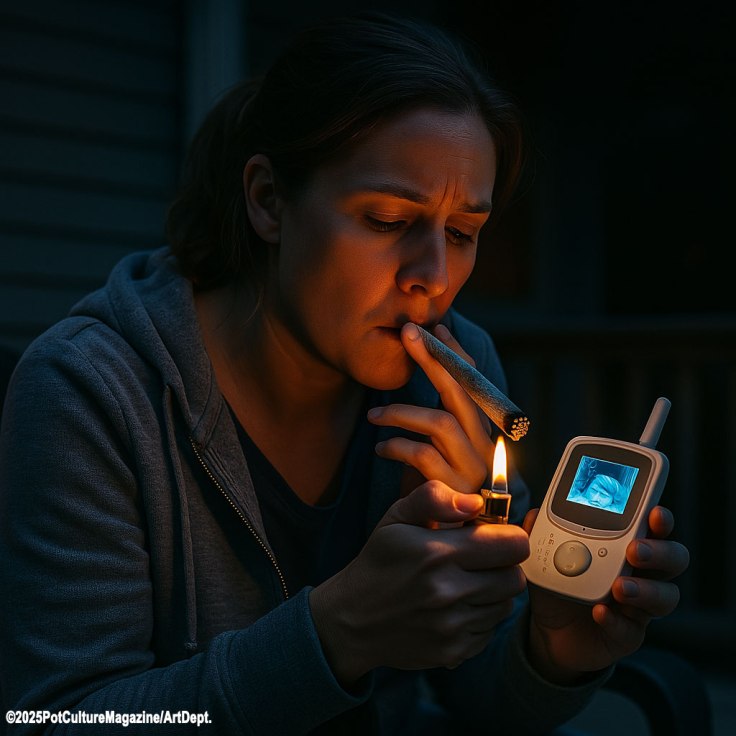
You can slam boxed wine at a backyard birthday party and no one gives a shit. But light up a joint after bedtime—or worse, smell faintly of it at school pickup—and suddenly you’re the drug-dealing parent on the neighborhood watchlist.
That’s not hyperbole. In 2025, with legal weed racking up billions in tax revenue, millions of parents are still acting like their cannabis habits could get them cuffed in the driveway. They hide joints in sock drawers, whisper about low-dose edibles in group chats, and stash vapes in tampon boxes. These are not teenagers. These are homeowners, taxpayers, and PTA volunteers—tiptoeing like they’re fugitives in a culture war that supposedly ended.
For parents, the stigma never left. It just got more polite.
The Double Standard Nobody Wants to Talk About
Let’s be clear: this isn’t just about cannabis. It’s about what society tolerates—and who it tolerates it from.
A mom with a wine tumbler that says “Mommy Juice” is quirky. Relatable. A dad cracking a beer at the Little League BBQ? Classic Americana. But the moment weed enters the frame, the tone shifts. The jokes stop. The judgments start.
Weed parents don’t get sitcoms. They get suspicion. They don’t get cute memes. They get side-eyes at school drop-off and are asked questions about “safety.”
The problem isn’t just public perception. It’s that the systems that shape that perception still treat weed like a red flag—especially if you’re a parent.
Legal? Sure. But Not for You.
Cannabis is legal in more than half the country, but the second you tie that to parenting, the gloves come off.
Child Protective Services has removed kids from households where cannabis was legally used. Judges in custody battles have cited marijuana use—even post-legalization—as evidence of poor judgment. Some states still have drug-free parenting laws on the books that treat cannabis like meth.
And the rules change depending on your zip code and skin color. In white, affluent communities, a vape pen is a punchline. In Black and brown communities, it’s still a potential child welfare case.
We’re not talking about people hotboxing minivans or skipping field trips to get stoned. We’re talking about parents using small, regulated doses of weed to relax the same way others use wine, Ambien, or Xanax. But only one of those options gets you labeled “dangerous.”
Weed as Self-Control, Not Self-Destruction
Here’s the hypocrisy no one wants to own: a nightly glass of wine is called self-care. A microdose of THC is called reckless.
Yet, if you dig into the data, cannabis is safer, less addictive, and has fewer long-term side effects than the prescription meds many parents are prescribed without hesitation.
So why is weed still taboo?
Because it challenges the narrative that parenthood has to be punishing—and that “coping” must come in a bottle made by Big Pharma or Big Booze. Weed didn’t get the PR team. It didn’t get the late-night jokes or the self-deprecating t-shirts. It just got the shame.
The Weed Closet Is Bigger Than You Think
Go to any legal state, and you’ll find hundreds of thousands of parents quietly, carefully consuming cannabis—and lying about it.
Not to their kids, but to their bosses, their doctors, their family members, and especially each other.
They’ll say they “use CBD for sleep” when they mean edibles. They’ll say they “tried it once” when they mean they use it five times a week. Because the risk of being seen as irresponsible still outweighs the relief they get from telling the truth.
That’s not guilt. That’s a culture still stuck in prohibition logic—even when the laws have changed.
So What Does Freedom Look Like?
It looks like honesty. It looks like safety without shame. It looks like parenting without performance.
A parent who uses weed in the same responsible, private way someone else might use melatonin or red wine should not be afraid of losing custody, losing credibility, or losing their community.
That doesn’t mean weed is harmless or that there shouldn’t be boundaries. It means we stop pretending cannabis use is a moral failure while glorifying substances that cause more harm.
It means parents stop being forced into the weed closet while the bar cart gets rolled out at every brunch.
Because if we can’t tell the truth about how we cope, then we’re just raising the next generation to lie about it, too.
© 2025 Pot Culture Magazine. All rights reserved.
This content is the exclusive property of Pot Culture Magazine and may not be reproduced, distributed, or transmitted in any form or by any means without prior written permission from the publisher, except for brief quotations in critical reviews.
Discover more from POT CULTURE MAGAZINE
Subscribe to get the latest posts sent to your email.

Leave a comment