
In a decisive turn of events, the U.S. government has unveiled a trove of documents that sheds light on the much-anticipated reevaluation of marijuana under federal law. For the first time, it’s officially confirmed: health authorities are championing the reclassification of cannabis to Schedule III of the Controlled Substances Act (CSA), recognizing its medical utility and lower abuse potential compared to Schedule I and II substances.
The detailed analysis from the Department of Health and Human Services (HHS), spanning 252 pages, underscores a pivotal acknowledgment: cannabis is medically viable in the United States and poses a lesser abuse risk than previously classified. This groundbreaking recognition follows a comprehensive review that cites the authorization of over 30,000 healthcare professionals to recommend medical marijuana across 43 U.S. jurisdictions, benefiting more than six million registered patients for an array of medical conditions.
HHS’s extensive evaluation, encapsulated in a letter to DEA Administrator Anne Milgram, sheds light on marijuana’s medical applications and its comparative safety. The findings point to a substantial and current body of experience with medical marijuana within regulated programs, overseen by medical authorities, laying the groundwork for a potential shift in federal policy.
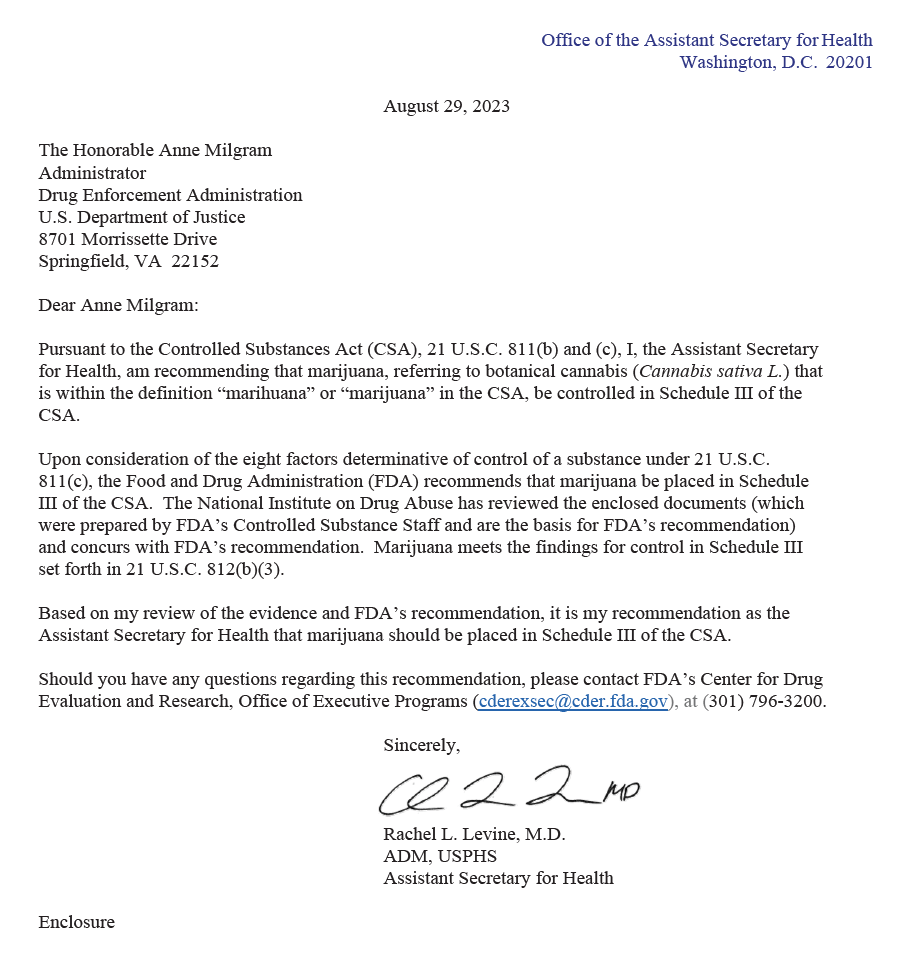
Matt Zorn, an attorney who procured the documents following a Freedom of Information Act (FOIA) request, has made this information public via his On Drugs blog, igniting discussions and speculation on the future of cannabis regulation. The released memo details the government’s eight-factor analysis, emphasizing marijuana’s abuse potential, accepted medical use (CAMU), safety, and risk of physical dependence.
In terms of medical efficacy, HHS acknowledged the widespread legalization of medical marijuana in the U.S. and cited mixed findings of effectiveness across various conditions, with the strongest evidence supporting marijuana’s role in managing pain, specifically neuropathic pain.
Despite a lack of support for certain conditions like epilepsy and anxiety, and the noted
risks in treating PTSD with marijuana, the review recognized credible scientific backing for cannabis’s therapeutic benefits in treating pain, anorexia associated with certain medical conditions, and chemotherapy-induced nausea and vomiting. The analysis didn’t raise any safety concerns that would preclude its medical use for these indications.
The federal health review’s conclusions about the relative safety of cannabis were clear, finding the public health risks to be low, particularly when considering the low occurrence of overdose deaths compared to other substances of abuse. This position is echoed by the National Institute on Drug Abuse (NIDA), which agrees with the agency’s findings.
The news has elicited varied reactions, with key figures like Congressman Earl Blumenauer, founder of the Congressional Cannabis Caucus, welcoming it as a step towards ending cannabis prohibition. The release of these documents brings a new level of transparency to the government’s review process, which has thus far been shrouded in redaction and secrecy.
The potential reclassification of cannabis would not equate to federal legalization, but it would have significant repercussions, such as easing research restrictions and allowing state-licensed cannabis businesses to claim federal tax deductions currently denied under IRS code 280E.
The final decision on rescheduling rests with the DEA, which is currently undertaking its review. The timing of an announcement is uncertain, fueling speculation among cannabis advocates. However, the Congressional Research Service (CRS) has suggested that the DEA is likely to follow HHS’s recommendation based on historical precedent.
The prospect of rescheduling has also prompted calls to action from various stakeholders, including a group of bipartisan lawmakers urging the DEA to act expeditiously and a collective of attorneys general labeling the rescheduling as a “public safety imperative.”
As the cannabis community watches with bated breath, the DEA’s forthcoming decision holds the potential to transform the landscape of cannabis research, medical application, and business operations in the United States. While the path ahead is laden with regulatory complexities, this moment marks a significant stride towards reconciling federal law with the evolving public and scientific perspective on cannabis.
Discover more from POT CULTURE MAGAZINE
Subscribe to get the latest posts sent to your email.

Leave a comment