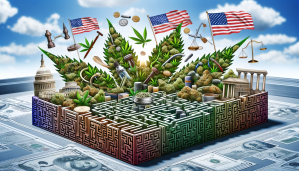
In the ever-shifting terrain of marijuana legislation, President Joe Biden’s recent pardon for certain marijuana-related offenses has spotlighted the intricate web of state and federal laws. While the pardon, an extension of his October 2022 proclamation, now includes offenses like attempted possession and use on federal lands, its impact remains limited, echoing the complexity of America’s legal landscape concerning marijuana.
Biden’s call for governors to mirror his actions at the state level underscores a pressing need for uniformity. His stance, “No one should be in a local jail or state prison solely for marijuana use,” resonates with a growing national sentiment. Yet, the reality is a labyrinth of state-specific regulations, leaving many convictions untouched and creating a national patchwork of laws that often contradict and confuse.
This confusion is rooted in marijuana’s dual identity: an illegal Schedule I drug at the federal level, yet increasingly accepted and legalized at the state level. The DEA’s ongoing consideration to reclassify marijuana only adds to the ambiguity. States now shoulder the responsibility of navigating this legal grey area, resulting in a spectrum of policies from full prohibition to complete legalization.
This fragmentation significantly impacts Americans. NORML’s report of over 350,000 marijuana-related arrests in 2020, despite a decline, highlights the ongoing legal challenges and disparities, particularly affecting communities of color. The Baker Institute’s findings that Black Americans are disproportionately arrested for marijuana possession, despite similar usage rates as white Americans, illustrates a broader issue of inequality in drug law enforcement.
State legislation varies widely. Some, like South Carolina and Idaho, align with federal prohibition, while others embrace medical use, decriminalization, or full recreational legalization. Decriminalization often translates to reduced penalties, such as civil fines, yet stops short of legal acceptance.
In this kaleidoscope of regulations, confusion often reigns. In North Carolina, for instance, the arrest of two individuals for smoking a legal hemp product, THCA, which is indistinguishable from marijuana in odor, underscores the challenges faced by both law enforcement and citizens.
The contrast is stark in states like California and Illinois, considered among the most permissive for marijuana use, where possession for recreational purposes is legal within specified limits. Yet, even in these states, marijuana laws stand in technical opposition to federal law.
As America grapples with these complexities, public opinion increasingly favors legalization. The 2023 polls showing 70% support for legalization reflect a shifting national consciousness. Yet, until a cohesive federal stance emerges, Americans navigate a maze of laws where legality varies not just from state to state but city to city, often leaving citizens and law enforcers in a haze of legal uncertainty.
The patchwork of marijuana legislation in the US remains a complex puzzle, with President Biden’s pardon highlighting the need for more comprehensive reform. As states chart their courses, the call for clarity and uniformity grows louder, echoing the changing attitudes of a nation in flux.
Discover more from POT CULTURE MAGAZINE
Subscribe to get the latest posts sent to your email.

Leave a comment